

ROUZATI RUGS / THE CLOSE LOOK SERIES
Are Uneven Edges Normal
in Handmade Rugs?
Read the outline.
Then look at what holds it together.
SHAPE
02STRUCTURE
03CHANGE
ONE CATALOG RUG / THREE ORIGINAL VIEWS
A closer look starts with more than one photograph.
Kaleidoscopic Kurdish, listed as a 1920s antique kilim soumak rug, 7′9″ × 7′10″ · Rug ID 101051. These views help you ask about the outline, corner and reverse. They do not establish a condition diagnosis or prove how the rug was made.
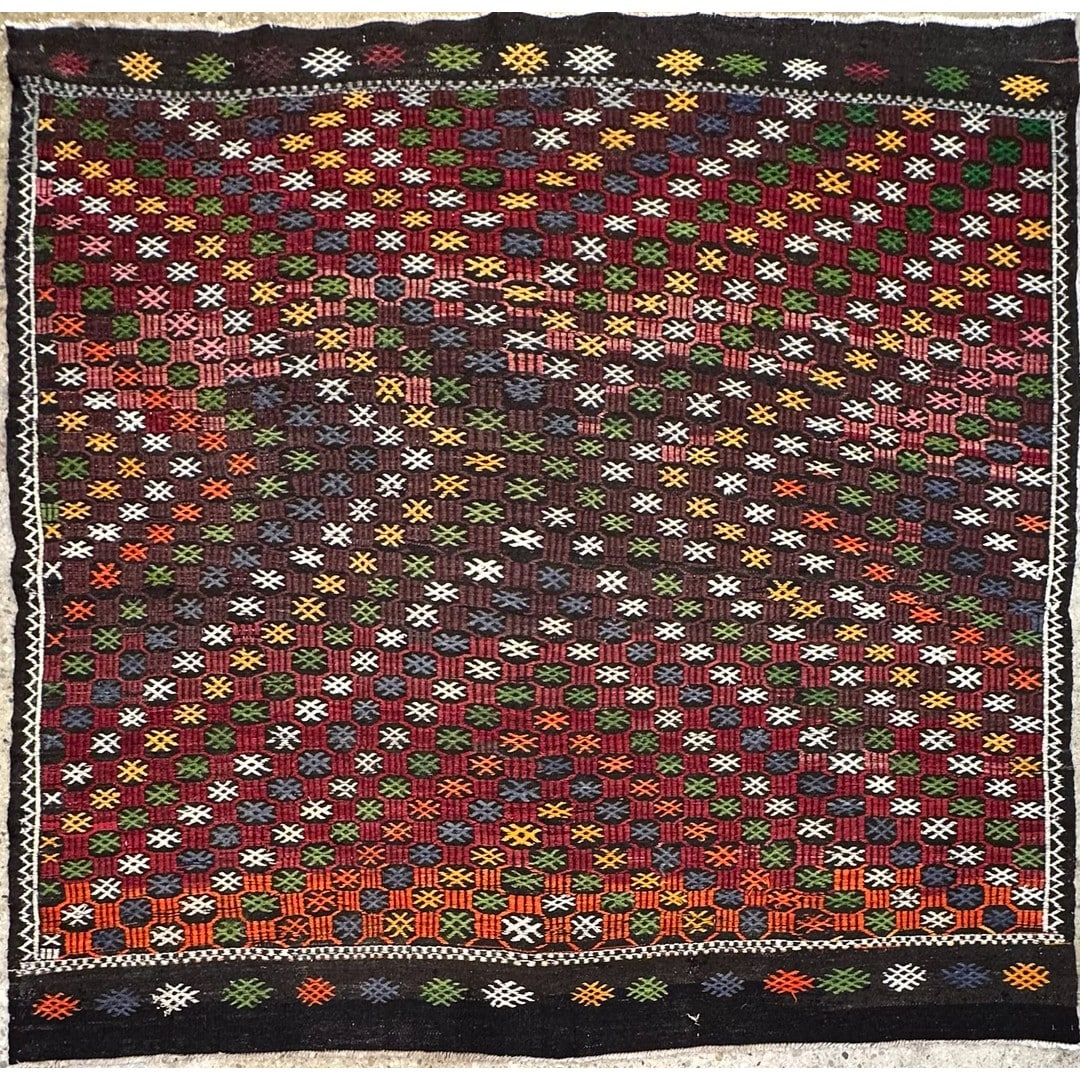
01 / THE OUTLINE
Read the overall shape before concentrating on one short section.
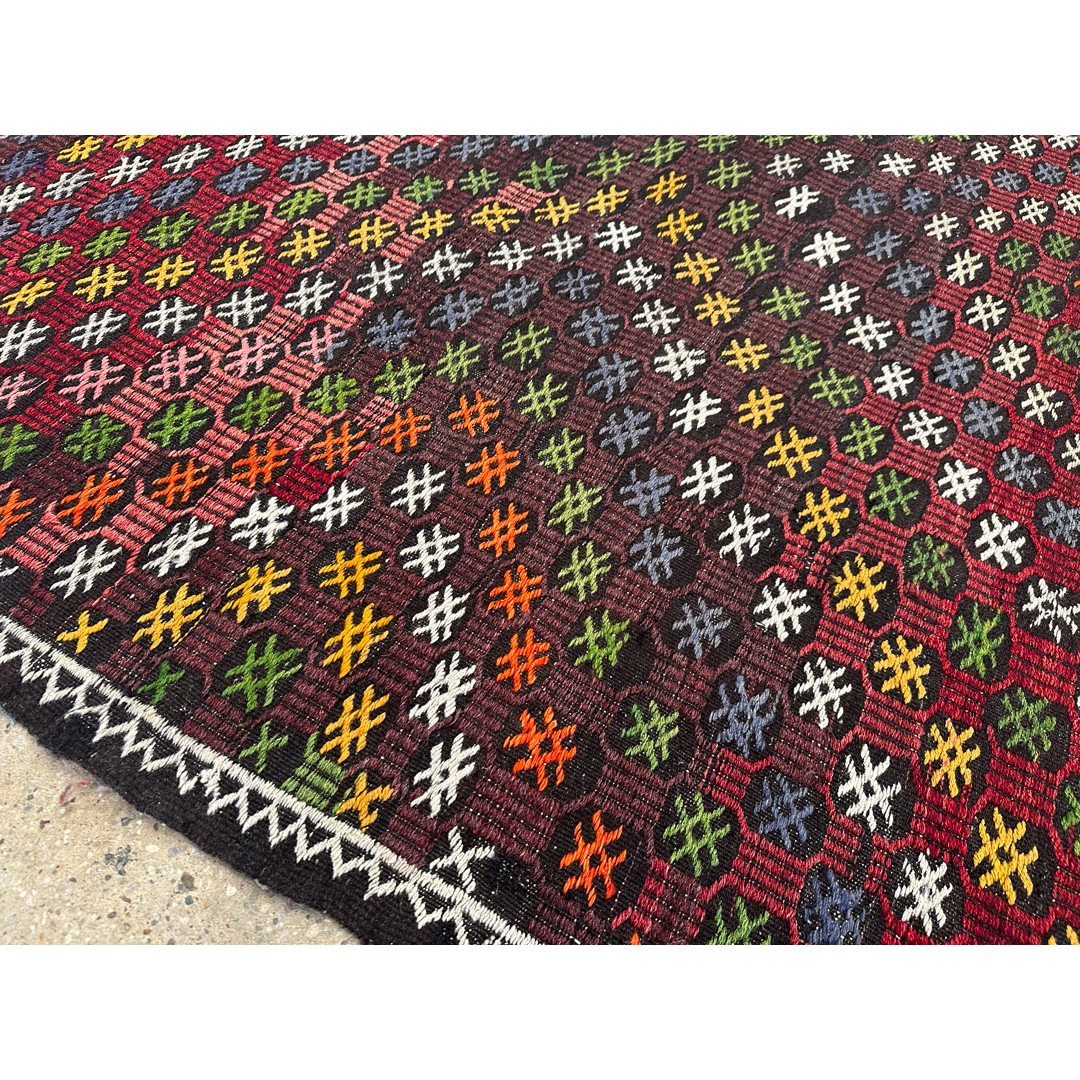
02 / THE EDGE
Ask about the visible side finish and its continuity at the corner.
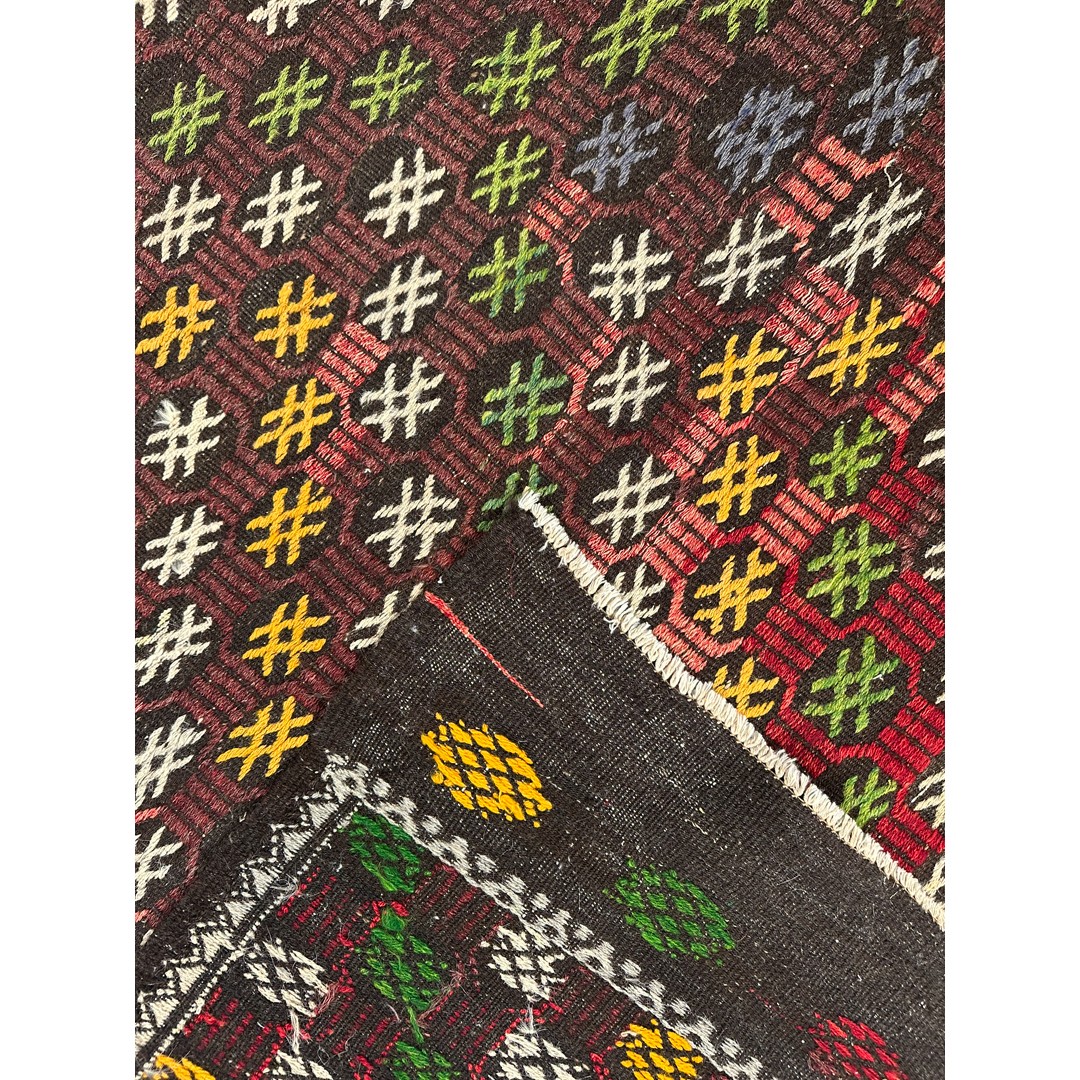
03 / THE REVERSE
Ask how the corner and finish relate to the structure beneath.
THE SHORT ANSWER
A small irregularity can be part of the shape.
A failing edge needs attention.
A slightly irregular outline can occur in a handmade rug without indicating active damage. But “handmade” is not an explanation for every loose edge, missing section or new wave. Compare the shape with the condition of the yarns and finishing, and ask whether anything has changed.
Separate geometry from condition. An edge that is not ruler-straight and an edge that is coming apart are different questions. This guide helps you describe what you see; it does not set a universal tolerance or certify a rug from photographs.
Why might the outline be less than perfectly straight?
A woven rug has lengthwise warp yarns and crosswise weft yarns. The Association of Rug Care Specialists explains that rugs are woven under tension, sometimes uneven tension, and that foundation tensions can change with washing and use. It also discusses irregular foundation yarns and their role in rippling.1
That background gives a reason to ask about the individual weaving rather than expecting every handmade piece to match a perfect rectangle. It does not tell you that a particular curve is original, harmless or acceptable for your intended placement.
Ask the seller or specialist to distinguish an established outline from a later dimensional change. If a precise fit matters, request actual dimensions at more than one point and a clear overall photograph. A size category alone is not enough for a tight space.
Three different questions
- Outline
- Is the rug’s plan shape slightly curved, tapered or asymmetrical?
- Edge finish
- Are the yarns and finishing holding together, or is something opening?
- Flatness
- Is the rug lying on the floor, or does part of it lift, curl or ripple?
These can occur separately or together. A photograph taken at an angle can also exaggerate the apparent shape, so compare views before drawing a conclusion.
What deserves closer inspection?
Look for an opening in the side finish, yarns that appear broken or detached, a gap that is getting larger, or loss near an end. A new change after moving furniture, vacuuming, storage or a moisture event deserves its own history.
Do not pull a thread or tug the fringe to find out whether it is secure. Record the area instead. Icon identifies edges and fringes as particularly vulnerable to wear and recommends professional assessment when wear is present.2
Keep shape and safety separate, too. A lifted section in a walking route needs attention even when its cause is not yet known. See our guide to why rug corners curl for that distinct problem.
COMPARE THE CLUES
What are you actually looking at?
| What you notice | What it may mean | What to do next |
|---|---|---|
| A gentle curve in the outline | An established shape variation may be involved. | Compare an overall view, older photographs and actual measurements. |
| A lifted edge or repeated wave | Flatness or a dimensional change needs discussion. | Note when it appeared and whether cleaning, humidity or storage preceded it. |
| Loose or separating side finish | The edge may need stabilisation or repair. | Stop pulling or aggressive cleaning; request close assessment. |
| Short or uneven-looking fringe | Appearance alone does not identify its construction or condition. | Ask how this end is finished and whether loss or repair is present. |
| Missing yarns, a gap or visible loss | There may be structural deterioration or damage. | Document it and arrange an appropriate inspection. |
| A different outline in two photos | Camera angle or placement may be affecting the view. | Request a straighter overall photograph and repeatable measurements. |
Observation prompts, not diagnostic rules or acceptance limits. A specialist must assess an uncertain edge in context.
Are there standard limits for how uneven is normal?
This guide does not prescribe a percentage, a number of inches or an “allowed” curve for all handmade rugs. A seller’s stated dimensions or manufacturing policy is not a substitute for examining the specific piece, especially an older rug with a history of use.
Describe your own requirement clearly: does the rug need to sit within a narrow recess, line up with a doorway or fit beside cabinetry? Ask whether the actual outline and condition suit that use. Get the relevant dimensions and any condition explanation in writing before buying.
Irregularity by itself also does not prove that a rug is handmade, antique, rare or valuable. Identification and condition assessment require more information than a single edge.
Make a record that someone else can use
- 01
Begin with the whole rug
Photograph the rug resting naturally, with all four sides visible if practical. Avoid a wide-angle setting that stretches the nearest corner.
- 02
Add the detail in context
Take a closer view of the area of concern and a wider view showing where it sits. Use good, even lighting and keep the original files.
- 03
Record repeatable measurements
Measure the body width near each end and at the middle if you can do so without strain. State whether fringe is excluded. Do not stretch the rug to match a number.
- 04
Write down the history
Note when you first saw the change, whether it is progressing and any recent cleaning, moving, storage or moisture event.
- 05
Ask before turning or moving it
For a large, heavy, wet or fragile rug, obtain handling advice before trying to photograph the reverse.
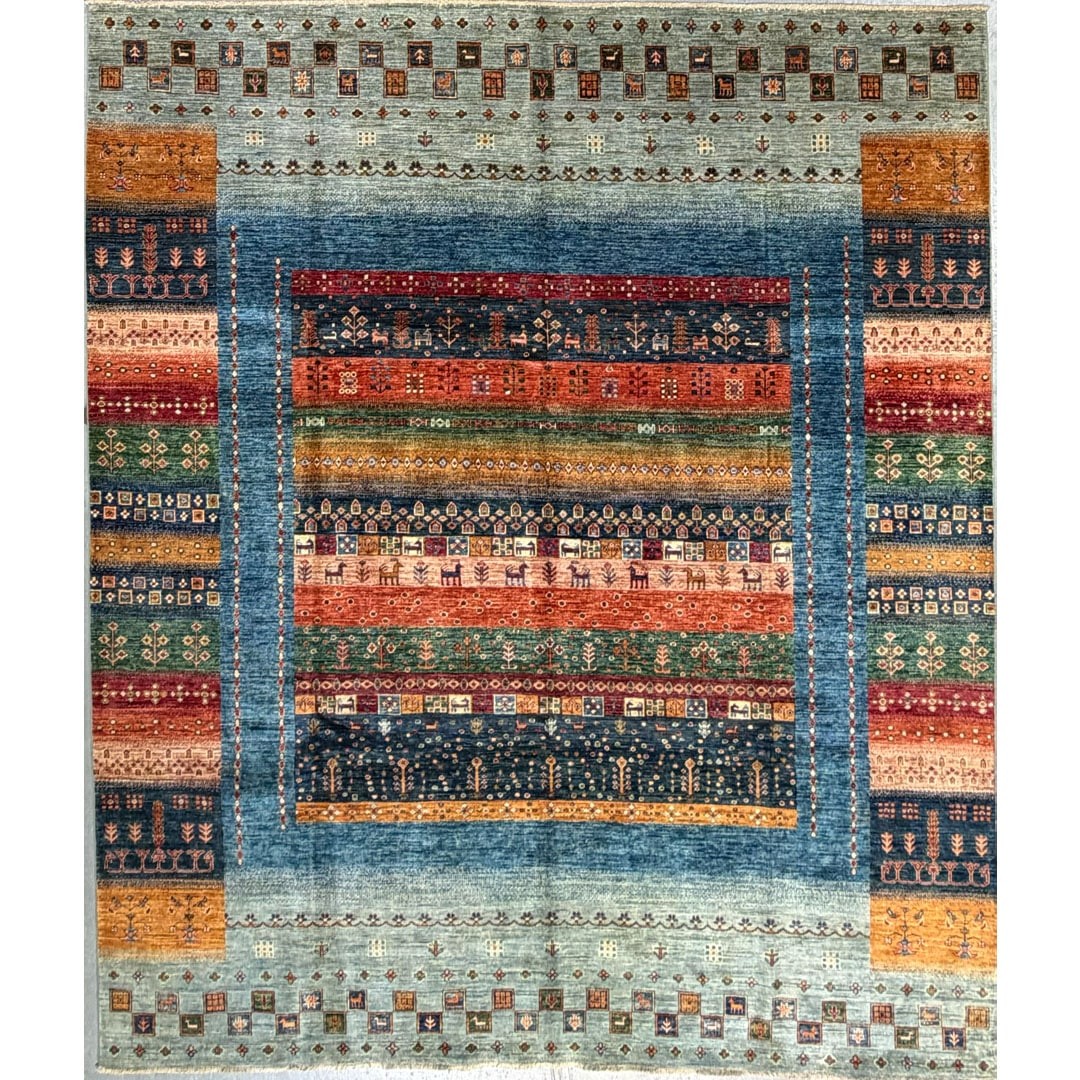
A DIFFERENT RUG / A DIFFERENT RECORD
Vibrant Vista
Listed as an Afghan Lori Baft Gabbeh rug
8′3″ × 9′8″ · Rug ID 109172
Keep questions tied to the exact listing. Do not assume that the edge finish or construction of one rug describes another. This catalog photograph is not a claim that the rug has an edge defect or has passed a condition inspection.
What should you avoid doing to straighten an edge?
Do not cut a side finish, glue loose yarns, pull the rug into a rectangle or wet it to try to change the outline. Avoid using an iron, steam or heavy weights as a general fix for an unidentified edge problem. A condition concern needs an appropriate assessment before a treatment is chosen.
IICRC notes that edge curl or waves can relate to construction and can become apparent after cleaning or high humidity.3 That is useful history to share; it is not a diagnosis of your rug or a guarantee that a home intervention will resolve it.
CCI advises careful handling of textiles and support when moving them. Fragile or deteriorating areas should not be used as handholds.4 Keep traffic away from a vulnerable edge while arranging advice, and follow care instructions suited to the exact piece.
BEFORE YOU BUY / BEFORE YOU REPAIR
Ask about the edge, not just the label.
- Is this the current outline, and are the dimensions of this exact rug confirmed?
- Is there known loss, repair, replacement finishing or a recent change?
- Can I see the concern from above, close up and from the reverse where safe?
- Does the rug lie as intended, and is the area suitable for the traffic in my room?
- What inspection or treatment is proposed, and what result cannot be guaranteed?
Our antique-rug buying checklist explains the wider photo request. For the end finish, see our guide to rug fringe repair.
Questions about handmade rug edges
Is every handmade rug slightly crooked?
No. Handmade rugs vary, and a less-than-perfect outline is not a requirement or an authentication test. Assess the exact rug and its condition.
Is an uneven edge the same as a curled corner?
No. An irregular plan shape concerns the outline. Curling concerns a section lifting away from the floor. They need different observations and may occur together.
Can I tell from a product photograph whether an edge is damaged?
A photograph can help you locate a concern, but angle, light, scale and hidden structure limit what it establishes. Request additional views and a condition explanation.
Should I pull a loose thread to see where it goes?
No. Photograph it without pulling or trimming, and ask for advice. The visible thread may relate to finishing or structure that needs assessment.
Does a rug pad straighten the shape?
Do not expect a pad to change a rug’s woven outline or repair a failing edge. Ask about appropriate support separately from structural concerns.
Can an edge be repaired without changing the rug?
That depends on the rug, the concern and the proposed treatment. Ask what material would be retained, replaced or altered before agreeing to work.
Continue the close look
Compare woven colour variation, learn about pile direction and colour, or check rug thickness and door clearance when placement is the concern. To keep fibre questions separate from outline, use our rug materials guide.
Sources & photograph notes
- Association of Rug Care Specialists: Rug Shrinking & Ripples (2022; PDF hosted by Utah Rug Washing)
- Icon, Institute of Conservation: Carpets and Rugs
- IICRC: Consumer Floor and Furnishings Care Information — Edge Curl and Waves
- Canadian Conservation Institute: Basic Care – Textiles
Reviewed October 30, 2026. All four images are original Rouzati catalog photographs: three views of rug 101051 and one view of rug 109172. The closer photographs show actual edges and corners; they are not annotated diagnoses, repair demonstrations or before-and-after evidence. Product descriptions are attributed to the catalog. No percentage tolerance, independent construction identification or condition certification is supplied.