

THE RUG JOURNAL / A BUYER’S FIELD GUIDE
Buying an antique
rug online?
Start with better photographs.
Then ask better questions.
A practical guide to condition, repairs, measurements and seller policies before you choose a one-of-a-kind rug.
What should you request before buying an antique rug online?
Request clear photographs of the entire front and back, the pile, all edges and ends, and any repaired or worn areas. Ask for exact dimensions, a written condition description and the seller’s current delivery and return terms. Keep those records with the product listing and rug ID.
Buying antique rugs online starts with a visual attraction, but a room photograph cannot answer every practical question. Use photographs to decide what to ask next, rather than treating them as proof of age or condition. If the rug is a substantial purchase for you, consider an independent in-person condition assessment before committing.
SAVE THIS SHORTLIST
Photographs + written condition + exact size + current purchase terms.
If one of these is missing, ask for it before paying.
Which photographs should the seller send?
Ask for images of the exact rug you would receive, identified by its stock number. A useful photo set separates overall appearance from small details. The checklist below is a practical request list; it does not mean every rug needs a particular repair or has a particular defect.
| Photo to request | Ask the seller for | Why it helps |
|---|---|---|
| Full front | A straight, complete view with all borders and ends visible. | Compare shape, pattern, overall wear and the area actually included in the listing. |
| Full reverse | A complete back view and a sharp closer view of the weave. | Ask about backing, patches or structural work that an overall front view may not explain. |
| Pile and surface | Close-ups of the field and any visibly low areas, plus an angled view. | Separate a decorative impression from the surface detail you need to discuss. |
| Edges and ends | Both long edges, both ends, fringe and all four corners. | Check what is included in the description of the rug’s finishing and condition. |
| Repairs and marks | Overview and close-up of each disclosed repair, stain or affected area. | Locate the area, understand its scale and ask what treatment has been done. |
| Color comparison | The same rug under even, indirect daylight, viewed from both ends. | Compare color and sheen without confusing different lighting or viewpoints. |
On a phone, each row becomes a labeled card. The images you request should show the actual item, rather than only a similar rug or a room rendering.
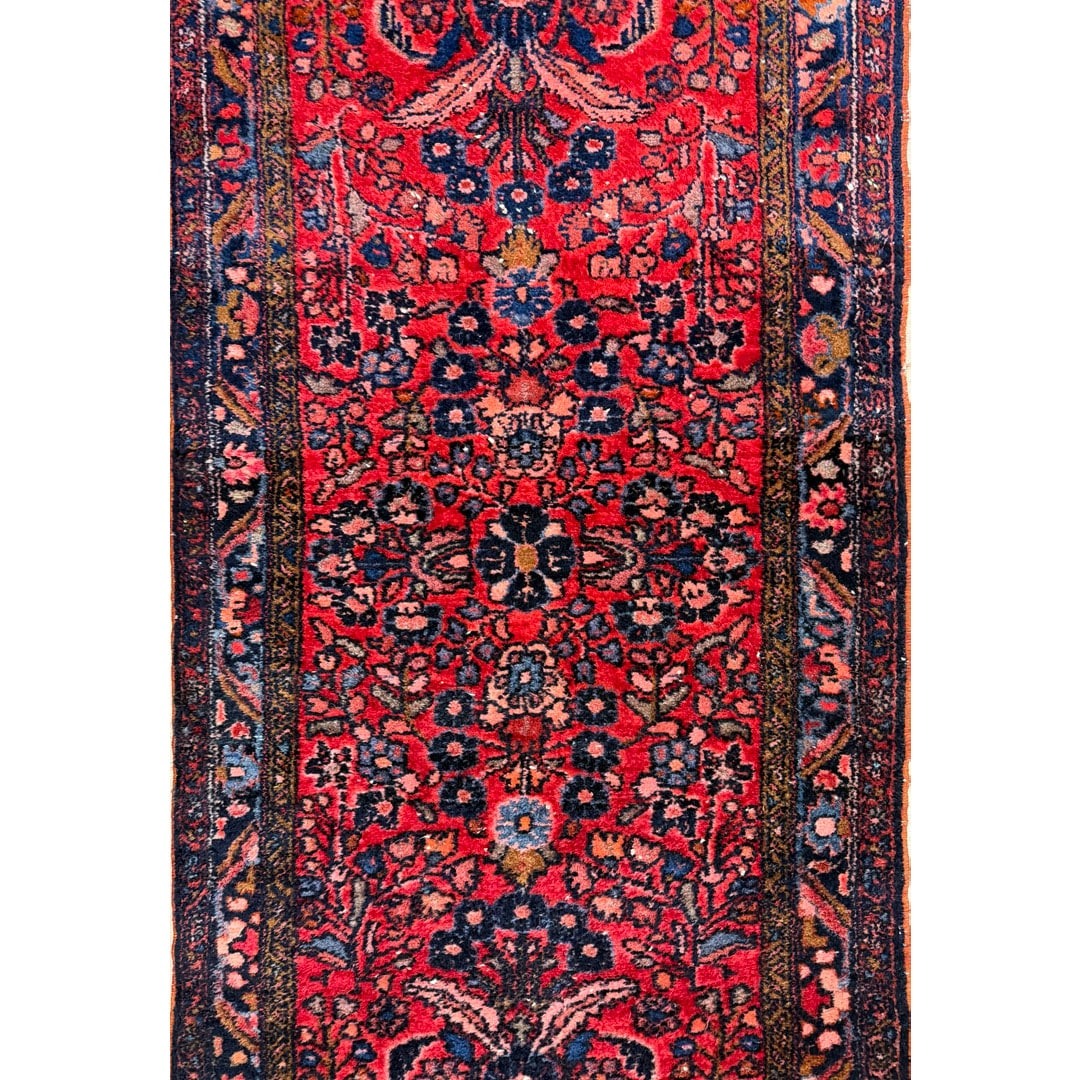
01 / The complete rug
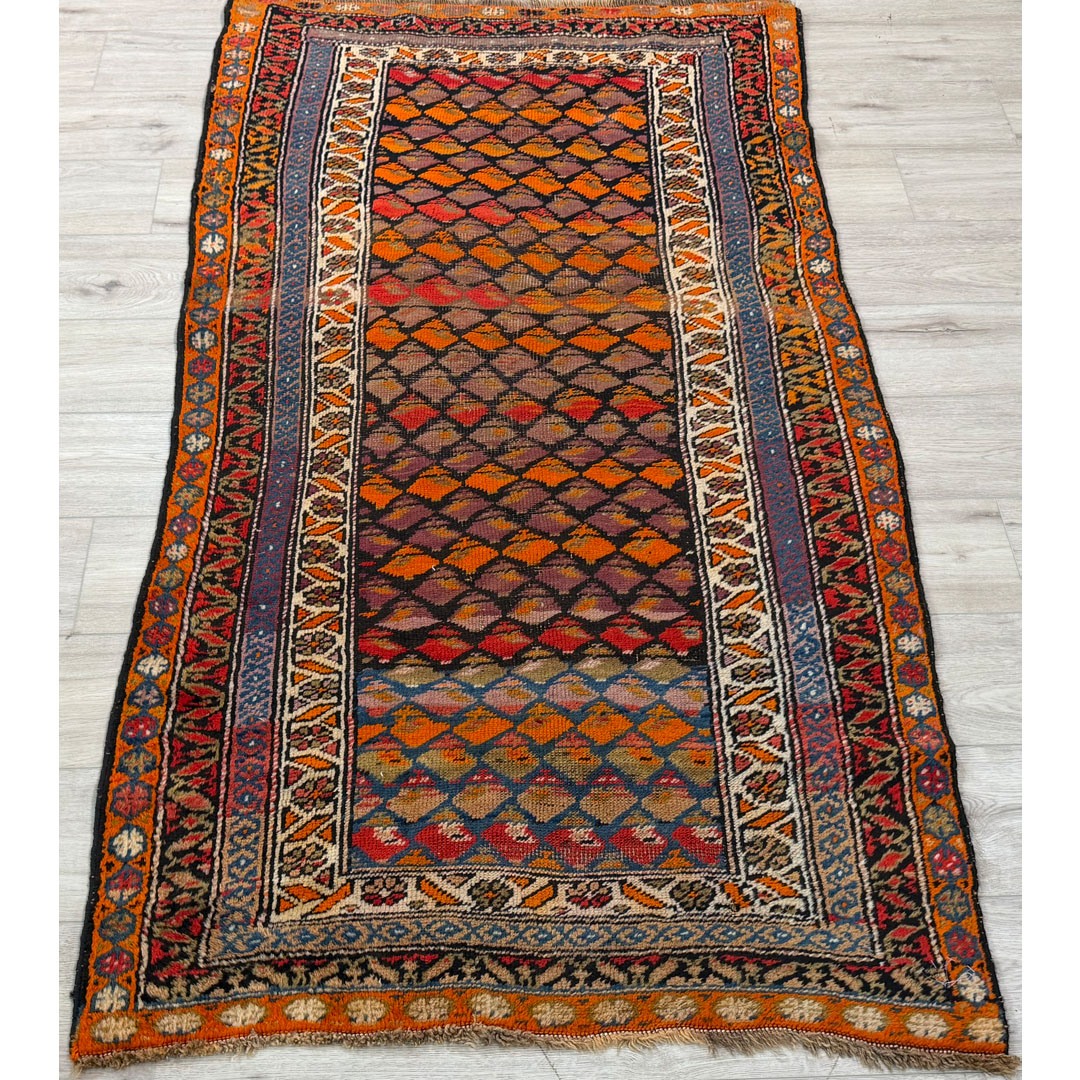
Start with the full design and the outlines of the piece.
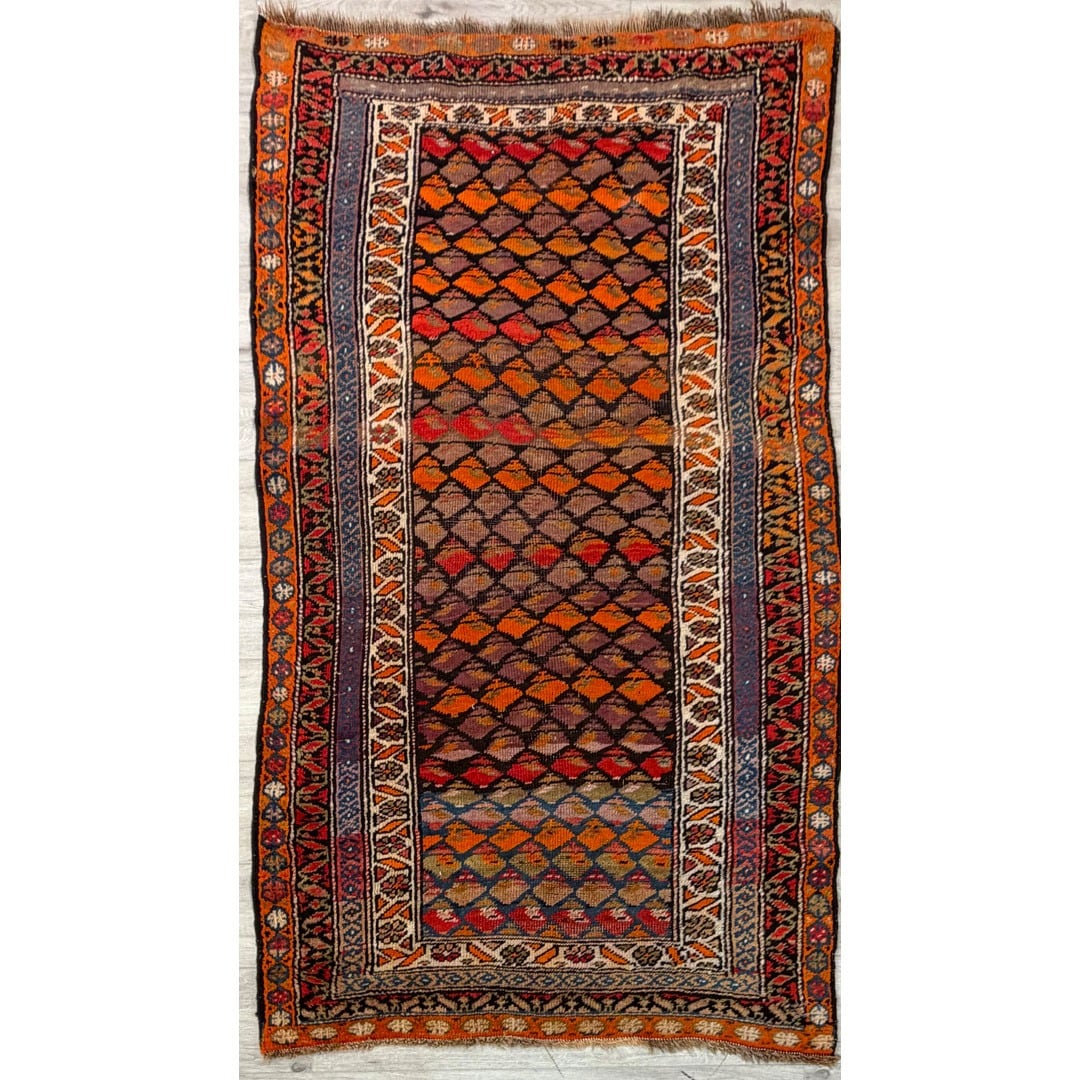
02 / An angled view
A second view adds context for surface texture and light.
03 / A turned-back corner
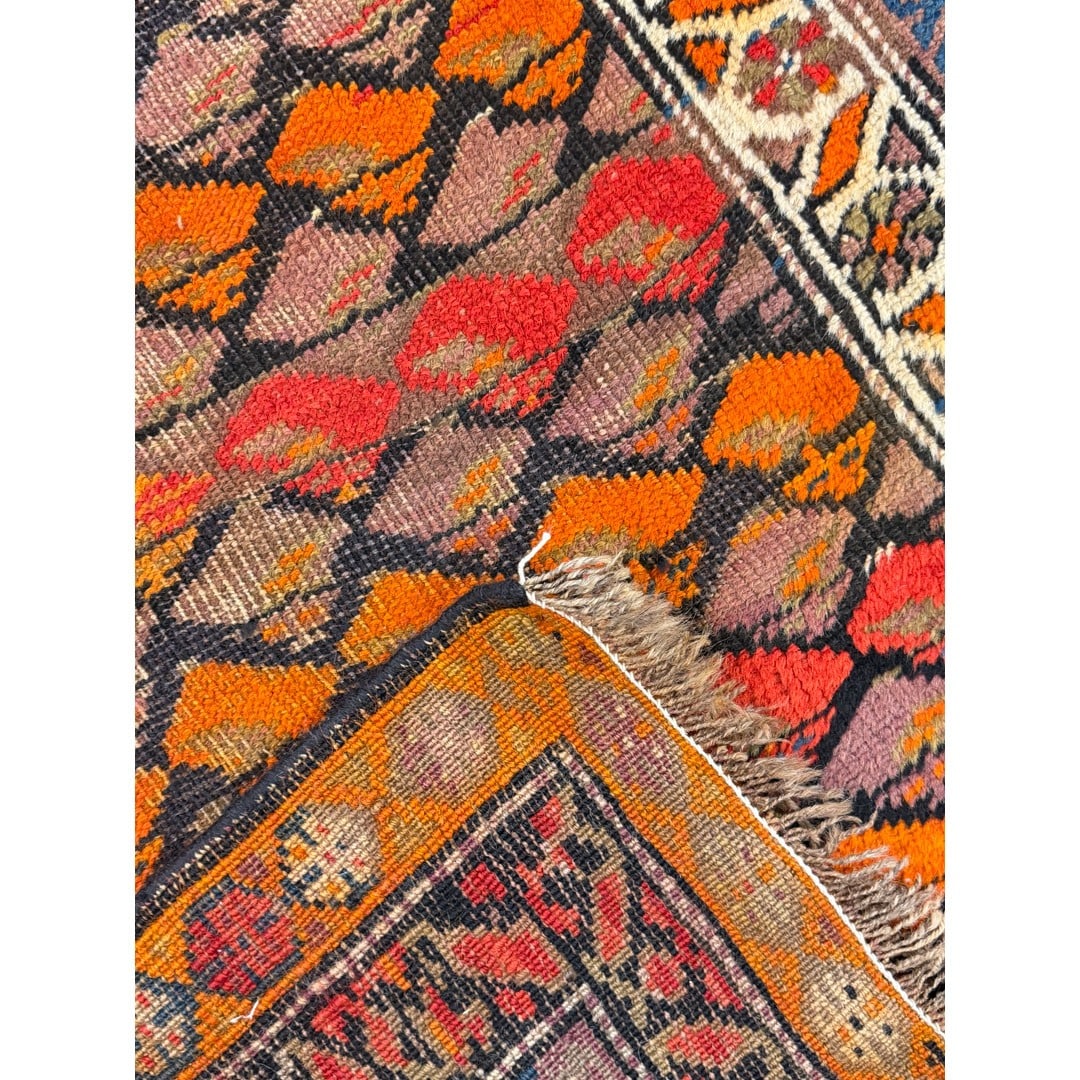
This catalog image shows part of the reverse. Request a complete back photograph too.
How do you read a condition description?
Read for specific locations and explanations. “Good for its age” gives you little to compare; “lower pile in the central field, with an area shown in photo four” gives you a question you can follow up. Ask the seller to distinguish observations from estimates and to identify anything that may affect your intended use.
For a rug that will sit beside a bed, you may accept a different condition from one intended for a busy hallway. Tell the seller where the piece will go, whether furniture will rest on it and how much daily traffic you expect. Condition should be discussed in relation to the individual rug, not assumed from the word “antique.”
ASK ABOUT THE WORK YOU CANNOT SEE AT A GLANCE
Repairs deserve a clear description.
A disclosed repair is something to understand, not an automatic reason to reject a rug. Ask where it is, how extensive it is and whether it concerns the pile, foundation, edges or ends. Request photographs of the same area from both sides.
If the listing mentions restoration, ask what was done and what remains uncertain. Do not translate “restored” into “as new,” or a small photograph into a guarantee of strength. An appropriate specialist can help assess a delicate or structurally uncertain piece.
Which condition questions are worth asking?
Use the seller’s photographs as references when you ask. “Can you explain the area near the lower left border in image three?” is easier to answer than “Is everything fine?” A written reply tied to the images is useful to retain with your purchase record.
- Are there worn or missing areas, tears, patches or other known structural issues?
- Have the ends or side edges been repaired, rebuilt or reduced?
- Are there known stains, odors, insect damage or signs of past moisture exposure?
- Has the rug been recolored, painted, distressed or otherwise treated to alter its appearance?
- What cleaning or restoration history is known, and what history is unavailable?
These are questions to ask, not defects diagnosed from the example products. For a fragile textile, the Institute of Conservation recommends assessment according to its individual condition and materials.1
How can you compare color online?
Request an evenly lit overall photograph and close-ups taken in the same lighting. Ask the seller to avoid strong filters. Compare views from opposite ends, because the direction of the pile can change the way a rug reflects light. Screens and camera processing can also make the same rug appear warmer, cooler, lighter or darker.
Do not decide that a pale band proves age, or that a difference between two photographs proves fading. Ask whether the variation is in the yarn, the finish, the lighting or the condition. The Association of Rug Care Specialists explains the optical effect of pile direction. For related care context, read our guide to silk rugs and sunlight.2
What dimensions should you confirm?
Ask for the rug’s actual width and length and confirm whether the stated length includes the fringe. Request measurements at more than one point if the shape appears uneven. Rounded size categories are useful for browsing; they are not a substitute for the dimensions of the individual piece.
Mark the intended footprint on your floor before ordering. Check doors, furniture legs and circulation space. For a runner, measure the narrowest usable width and check door clearance with the intended pad. For room placement ideas, see our living room rug guide and bedroom rug collection.
WRITE DOWN THE MEASUREMENT
Width × length, with the fringe convention stated.
Keep the measured size next to the stock number so you compare the same piece across photographs and messages.
What should “antique” mean in the listing?
Ask the seller for an estimated date or date range and the reasoning behind it. Ask which parts of the description are documented and which are an attribution or estimate. A design name, a hand-knotted construction or a worn appearance does not, by itself, give you a verified date.
If the origin or age is central to your decision, request the description in writing and ask whether an independent specialist can examine the rug. For more background on the identification questions, see our antique Persian rug identification guide. This buying checklist helps you gather information; it does not authenticate a rug or assign a value.
Which purchase terms should you read before checkout?
Read the current terms for the particular item and delivery destination. Ask when any return window starts, how to request authorization and who pays return packing and shipping. Check for stated exclusions, restocking charges or special conditions instead of assuming that a general banner applies to every purchase.
Confirm the total price shown at checkout, delivery arrangements and what to do if the package arrives damaged. If the item is described as final sale or sold as-is, ask for clarification of what that means in the seller’s own written terms before ordering. Save the listing and the replies you relied on.
This guide does not promise a specific return period, free shipping or a trial for any featured rug. Confirm the seller’s current terms directly.
COPY THIS REQUEST AND ADD THE RUG ID
A message you can send before buying.
Hello, I’m considering rug [stock number / product link] for [room and intended use]. Could you send a full front and back view, close-ups of the pile, both edges and ends, all corners, and any repaired or worn areas?
Please also confirm the measured width and length, whether fringe is included, the estimated age and basis for it, and any known restoration, recoloring, staining or structural concerns.
Could you share the current delivery and return terms for my location, including any costs or exclusions? Thank you.
FROM THE ROUZATI CATALOG
Compare the details, not just the room.
The examples below link to the exact products pictured. Ages, descriptions and sizes are catalog statements, not an independent appraisal. Ask for a current condition description and availability before purchasing.
Kurdish Kaleidoscope
Catalog: rare antique Persian · 3′4″ × 6′
Compare the complete geometric layout with the angled view and the turned-back corner.
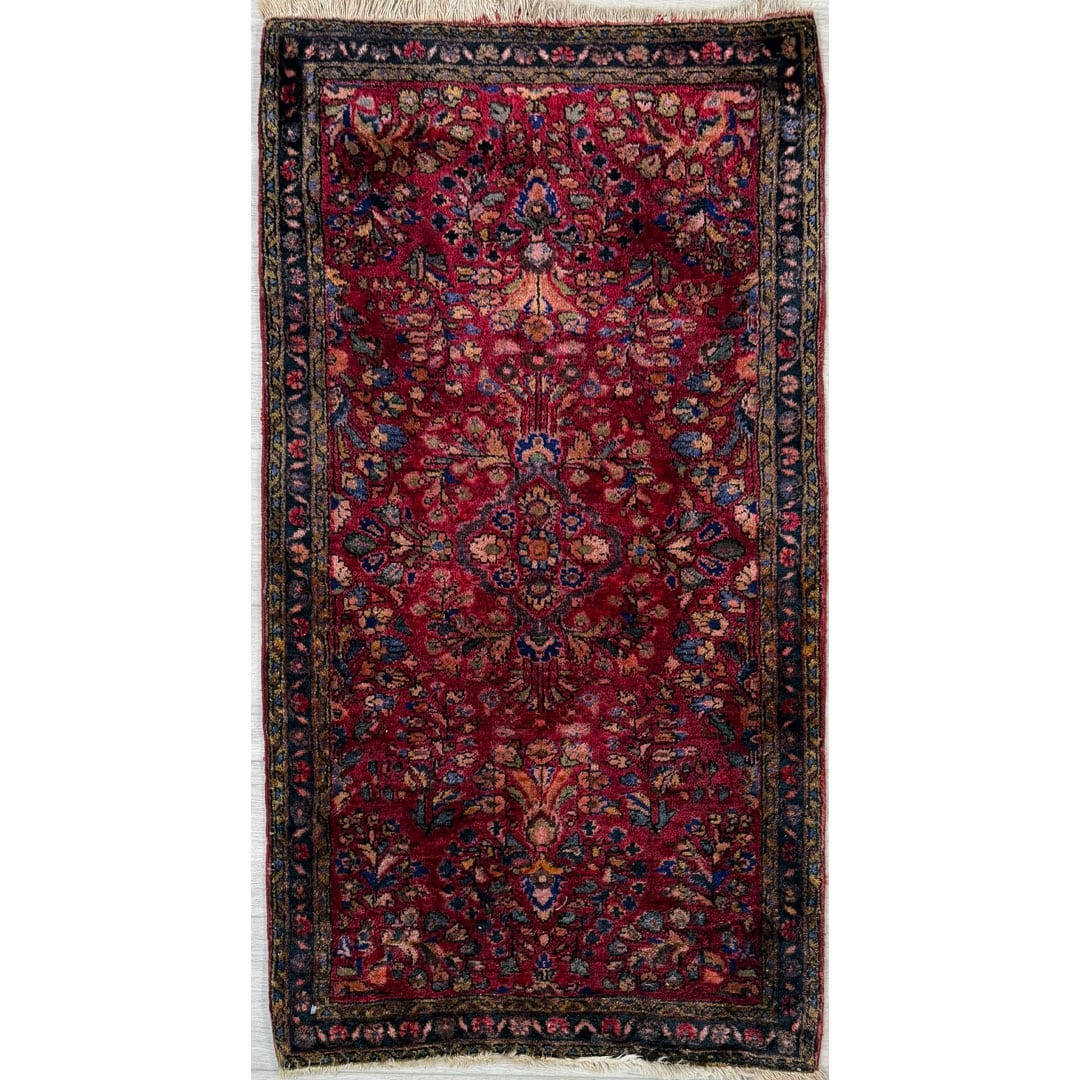
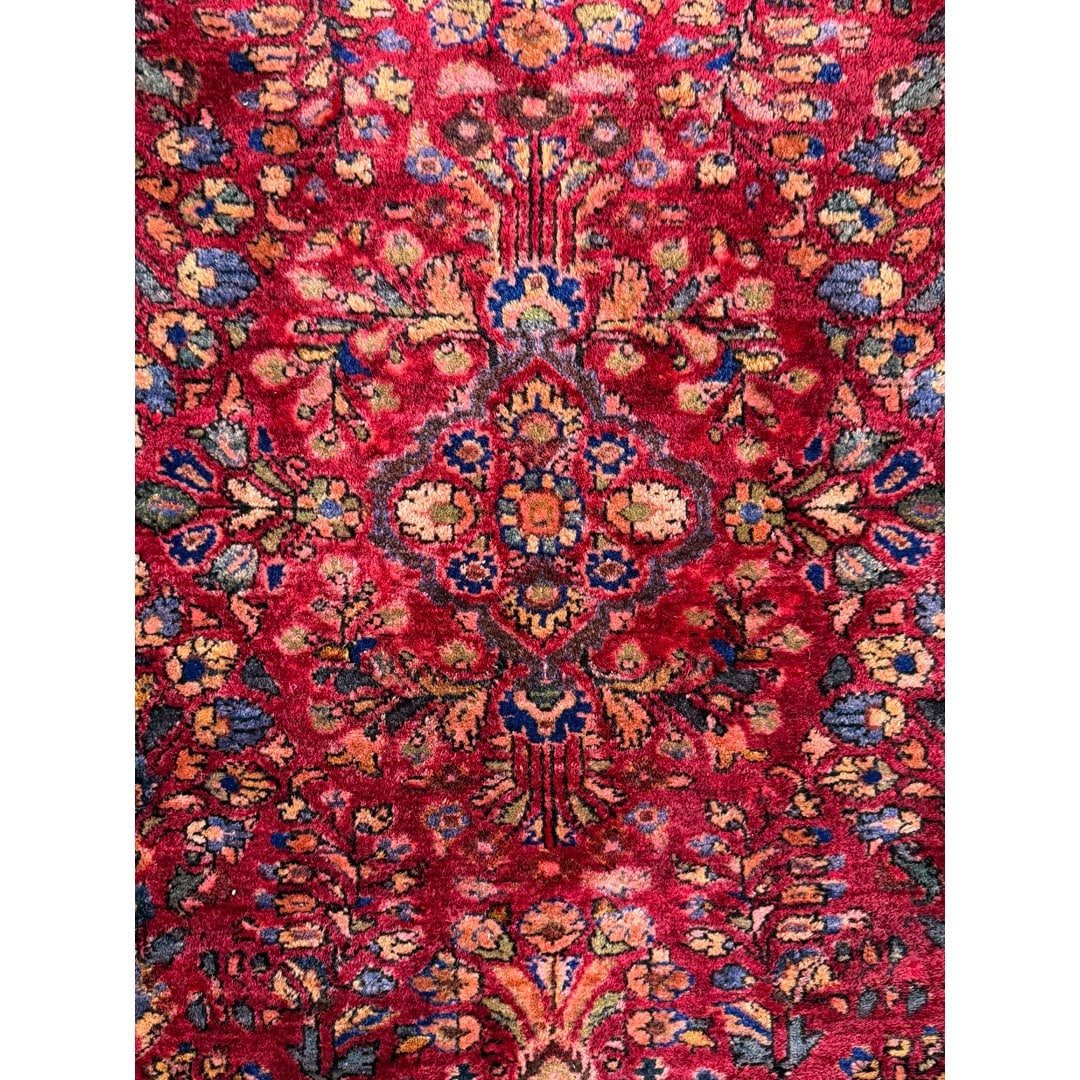
Splendid Sarouk
Catalog: 1920s Persian · 2′1″ × 4′
Use the close view to examine the floral design; request additional edge photographs for a condition decision.
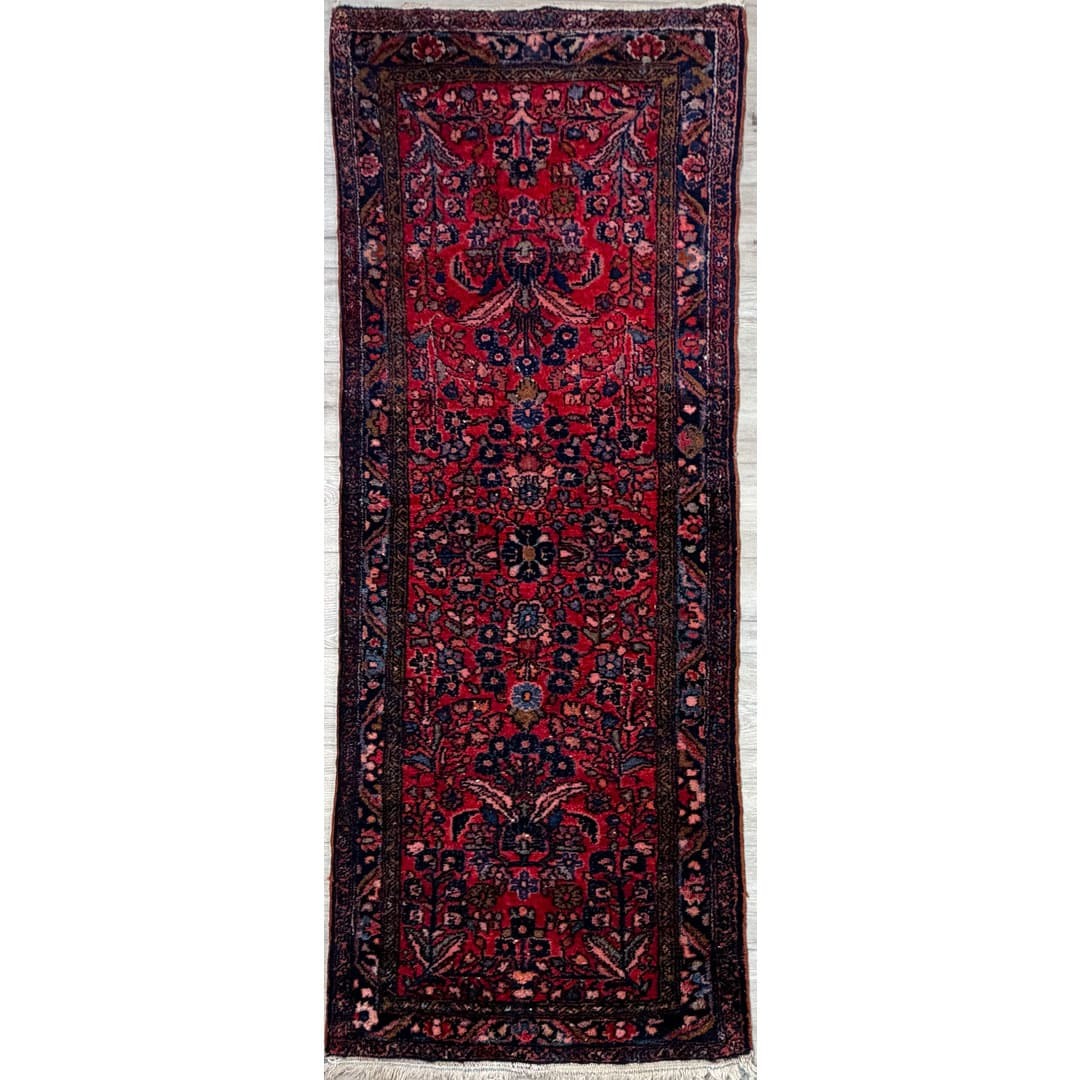
Luminous Lilihan
Catalog: 1920s Persian Sarouk · 2′6″ × 6′7″
A runner needs more than a length check: confirm its width, door clearance and suitability for the intended location.
What should you do when the rug arrives?
Keep the packaging until you have checked the item and read the seller’s return instructions. Compare the rug ID, measurements and condition with the listing and saved messages. Photograph the packaging and any unexpected area while it is still easy to document. Contact the seller promptly if something does not match.
Avoid cleaning, cutting, dyeing or attempting a repair while you are deciding whether to keep the rug. If an older rug looks fragile or has an unexplained problem, seek appropriate advice before using it. The Institute of Conservation notes that cleaning suitability depends on the individual rug’s materials and condition.1 Do not assume that a cleaning method suitable for a modern carpet is suitable for an antique textile.
Before you click “buy.”
Have the photographs. Understand the condition. Check the size. Read the terms. Then choose the rug whose appearance and practical requirements fit your home.
BUYING ANTIQUE RUGS ONLINE
Questions before checkout
Can I judge an antique rug’s condition from photographs alone?
Photographs can show useful detail, but they cannot establish every structural or material issue. Ask for a written description and consider an independent in-person assessment if condition is uncertain.
Should I reject an antique rug because it has repairs?
Ask what was repaired, where and how extensively, and whether the work affects the intended use. A disclosed repair needs an explanation rather than an automatic yes-or-no judgment.
Which photograph is most often missing?
Check for a complete reverse view, all edges and ends, and close-ups of disclosed repairs. A turned-back corner gives only a partial view of the reverse.
Does a product’s age label prove its date?
No. Ask for an estimated range, the basis for the estimate and any supporting records. Keep attributions and documented facts distinct.
Does the listed size include fringe?
Do not assume it does. Ask the seller to state the measured width and length and whether fringe is included before checking the fit.
Are returns available for every antique rug?
Terms can differ by seller, item and destination. Read the current policy and request clarification of any final-sale language, costs or exclusions before ordering.
Sources & image notes
- Icon, the Institute of Conservation: Carpets and Rugs (individual condition and care).
- Association of Rug Care Specialists: Nap Reversal (pile direction and light reflection).
All product images are original Rouzati catalog images. No wear, repairs or damage have been digitally added. Captions describe photographic views, not a professional condition finding. Product availability and purchase terms can change.