

ROUZATI JOURNAL / CARE NOTES 03
When colours
cross the line.
Color Bleeding in Oriental Rugs:
Warning Signs and What to Do
See the warning signs. Keep a clear record.
Know when to pause.
BEFORE YOU DO ANYTHING ELSE
If the rug is wet or colour is moving
- 01 / Stop the treatment
Stop adding water or cleaner. Avoid rubbing and repeated wet tests.
- 02 / Absorb free liquid gently
If there is a fresh surface spill, use a clean, dry white cloth to blot lightly. Do not scrub or drag it across colours.
- 03 / Contact a rug-care professional
Describe the moisture, colour change and any products already used. Ask for handling and drying instructions for this exact rug.
WoolSafe advises blotting rather than rubbing and cautions against general household cleaners. Suspected dye movement calls for product-specific advice, not a stain-removal experiment.3
01 / UNDERSTAND
What is rug colour bleeding?
Rug colour bleeding is the migration of dye away from its intended area. It may show up as an unexpected tint in neighbouring yarns or as colour transfer during wet treatment. IICRC identifies excess moisture, urine contamination, high-pH conditions and aggressive cleaning agents among the factors that can contribute.1
A colour change is a reason to investigate—not proof of the cause. A pink patch might involve transferred dye, a coloured spill or another condition. Describe what changed and when, rather than deciding on a chemical treatment from the colour alone.
02 / OBSERVE
Which warning signs deserve attention?
Look for a change that is new or spreading: a pale area becoming tinted beside a stronger colour, a previously defined motif looking blurred after wetting, or unexpected colour on a cloth already used to absorb a spill. Stop treatment if you see these clues.
Record whether the change followed cleaning, a spill, a leak or another moisture event. Compare with older photographs if you have them. A recollection that the rug “always looked a little pink” is useful history, but an earlier clear image is easier to discuss.
IICRC notes that signs of earlier dye movement may be visible on the reverse. Ask for an inspection; do not turn a large, wet or fragile rug just to look for evidence.1
AN EXPLANATORY SKETCH
Notice the change across a boundary.
Colour stays within the intended areas.
A new tint appears beyond a boundary.
Schematic illustration only. This is not a photograph of a damaged rug, a diagnostic test or a depiction of either catalog product below.
03 / COMPARE
Could it be something other than bleeding?
Several conditions can make a rug look uneven. Use the comparison below to ask better questions, while leaving an uncertain wet area untreated. More than one condition may be present in the same rug.
| Possibility | A clue to discuss | A useful next step |
|---|---|---|
| Possible dye migration | A new tint crossing into another colour, especially after a moisture event. | Stop wet treatment; record the event and request an assessment. |
| Abrash | Variation within the yarn colour, sometimes visible as bands in the weaving. | Compare older photos and read our abrash guide; do not assume every tonal band is damage. |
| Pile shading | A lighter or darker impression that changes with viewing direction. | Compare visually from opposite ends, without rubbing or wetting the surface. |
| Light-related fading | Loss or change of colour associated with exposure over time. | Review placement and older records; a cleaning product cannot simply replace lost colour. |
| Browning or wicking | A yellow-brown appearance or a mark becoming visible during drying. | Ask a specialist to distinguish it from transferred dye, soil or a spill. |
| Colour from an outside spill | A coloured liquid or other material deposited on the rug. | Tell the specialist exactly what was spilled; do not assume the rug’s own dye moved. |
Observation guide, not a diagnosis. For background, see sources 1, 4 and 5 and our abrash guide.
04 / PAUSE
What should you avoid while waiting for advice?
Do not try to rinse colour out, scrub a boundary, steam the area or apply a homemade “fixing” mixture. Avoid cycling through cleaners because the first one did not work. An uncertain dye problem is not a good place to test vinegar, salt, baking soda, bleach or a general stain remover.
Do not create another wet patch to compare with the first one. Keep foot traffic and pets away from the area, and keep the record of anything already applied. If the rug remains wet, seek prompt guidance about controlled drying and protecting the floor beneath it; do not roll or pack it away damp.
For a large leak or saturation, explain that immediately when calling a suitable restoration or rug-care professional. The immediate task is to limit further damage, not to force a colour correction at home.
WHY A HOME TEST IS NOT A GREEN LIGHT
A clear cloth
does not certify
the whole rug.
CCI explains that colourfastness testing is not foolproof and that testing itself may affect the test area. A single successful spot does not establish that every colour, repair thread or proposed cleaning condition is safe.2
05 / ASSESS
What happens during a professional assessment?
Begin with the history and the rug’s identification. Explain the last known normal appearance, when the change was noticed and whether the rug is still damp. Share original photographs, prior cleaning records and any written material information.
Ask the professional to explain the proposed inspection and treatment plan for your particular piece. Relevant questions include which materials are present, whether earlier repairs or treatments complicate the work, and how drying and further colour movement will be managed. Ask what can reasonably be attempted and what cannot be promised.
No photograph or general article can guarantee that transferred dye will be fully removed. Request a clear explanation of risks, expected limitations and the estimate before agreeing to treatment. For a fragile or historically important textile, seek advice from a qualified textile conservator as appropriate.
A short record to send with your enquiry
- The rug
- Name, rug ID, dimensions, material information and any earlier condition report.
- The event
- What happened, when it happened and how long moisture may have been present.
- What changed
- Where the new tint appeared, whether it spread and whether the rug is still wet.
- What was used
- Cleaner names, dilution if known, amount applied and any heat or equipment used.
- The photographs
- One overall view and clear detail views taken without filters or recolouring.
- The next question
- How should I handle and dry this exact rug until you can assess it?
CATALOG REFERENCE / TWO DIFFERENT RUGS
Save the exact product record.
These original Rouzati photographs illustrate why a specific rug ID and listing matter. They are not examples of colour bleeding, and no colourfastness result or condition diagnosis is claimed for either piece.
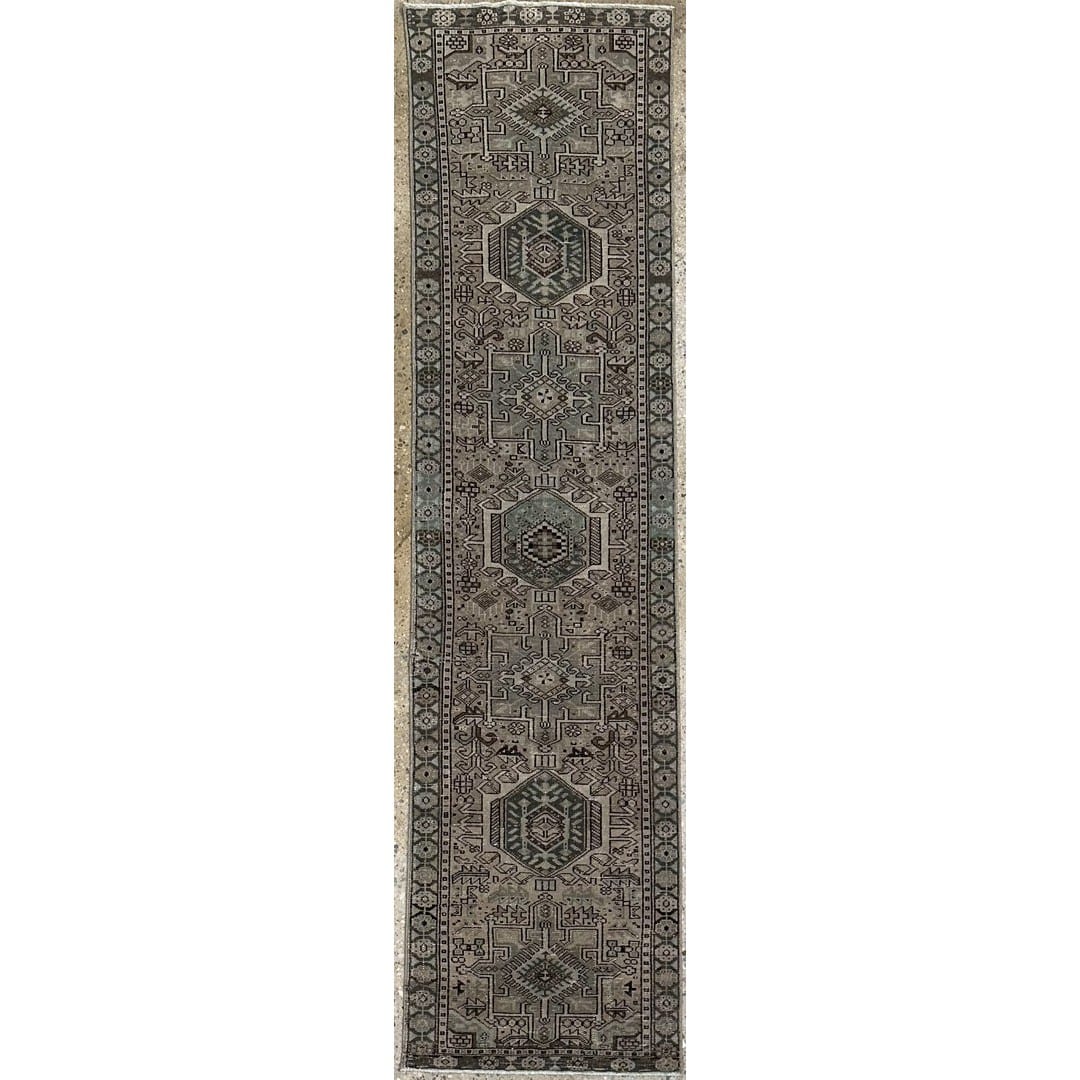
Honest Heriz
Listed as an antique Persian Heriz Karaje runner
2′7″ × 10′5″ · Rug ID 107146
Keep the exact listing with any care instructions and inspection notes.
108396RADIANT RUBY
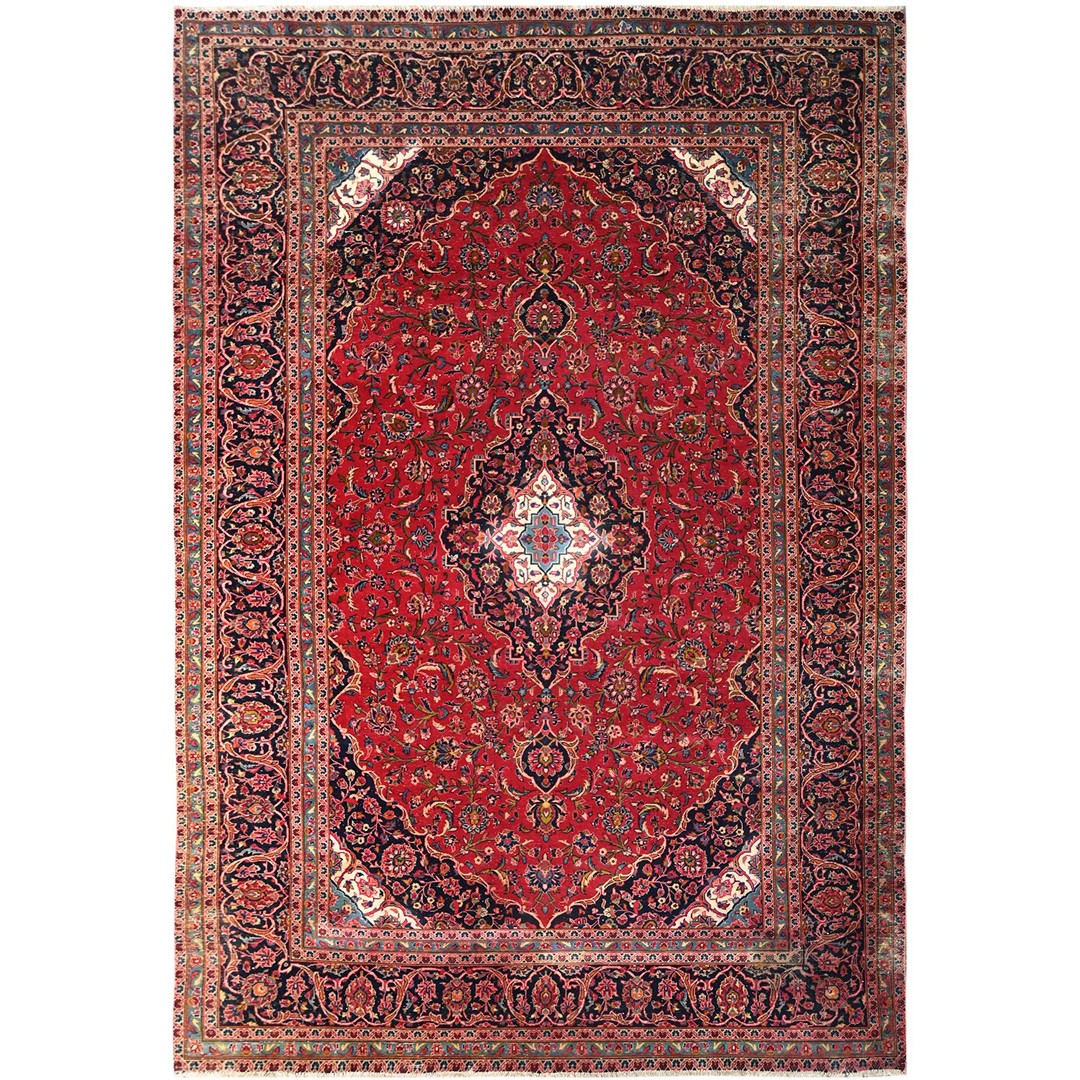
The rug pictured at the beginning of this article. Catalog reference only; no bleeding condition is claimed.
Radiant Ruby
Listed as a distressed vintage Kashan rug
7′10″ × 11′5″ · Rug ID 108396
A product’s colour or distressed appearance alone does not establish dye stability.
QUICK ANSWERS
Questions about colour movement
Does a pink area always mean red dye has bled?
No. A colour alone cannot establish the source. A new tint after moisture deserves assessment, but a coloured spill or another condition can look similar.
Should I add water to check whether the colour runs?
No. If you already suspect movement, stop adding liquid. Ask a suitable professional how to assess the rug without creating another affected area.
Can vinegar or salt set the dye again?
Do not use a home fixing recipe on an unknown dye system. It is not a reliable treatment plan for an individual rug and may complicate the problem.
My rug was cleaned before without bleeding. Is it safe now?
Past cleaning history is useful, but does not prove that every later treatment or condition will be safe. Tell the specialist what was previously done.
Is colour transfer on a cloth proof of bleeding?
It is a reason to stop and investigate, especially after wetting. The colour may involve dye, an outside spill or other material, so preserve the history rather than continuing to rub.
Can all colour bleeding be reversed?
No complete correction is promised. The materials, dye movement, condition and treatment history need to be assessed before anyone can explain realistic options.
Keep reading, without guessing at a treatment.
Compare woven variation in our abrash guide, review silk rugs and sunlight, or use the antique-rug photo and question checklist before buying. For the broader fibre picture, see our rug materials guide.
Sources & illustration notes
- IICRC: Consumer Floor and Furnishings Care Information — Browning and Color Bleeding
- Canadian Conservation Institute: Testing for Colourfastness, Notes 13/14
- WoolSafe: The Safe Way to Care for Your Wool Carpets and Rugs
- Association of Rug Care Specialists: Nap Reversal
- Canadian Conservation Institute: Textiles and the Environment, Notes 13/1
Reviewed October 28, 2026. Conservation guidance concerns the assessment and preservation of textiles; it is not a universal cleaning method for household rugs. The boundary illustration is explicitly schematic. Both product photographs are original catalog views, with no simulated damage or colour changes added. Neither featured product is claimed to have bleeding or to have passed a colourfastness test.