
ROUZATI JOURNAL / THE CLOSE READING
Persian Rug
Signatures
What to ask before you buy
A woven name is a starting point for questions. Read the text, trace the attribution and look at the whole rug.
The original catalog detail shown here belongs to Special Shabestari, rug ID 108590. Tap the photograph to open its product page.
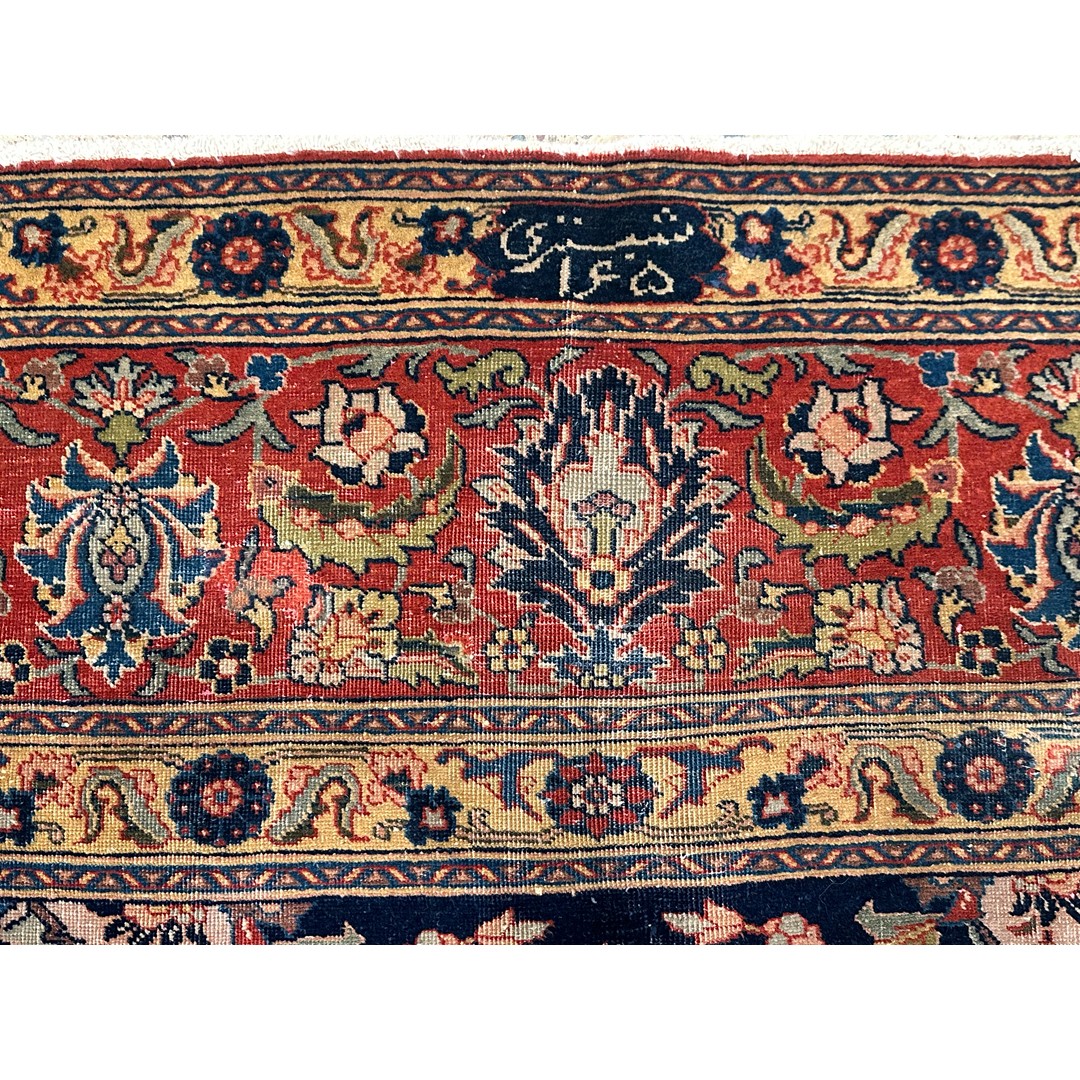
The buying answer: Persian rug signatures can provide useful evidence, but a name alone does not establish the maker, date, authenticity or monetary value. Ask for a readable image, a documented reading and the basis for the seller’s attribution.
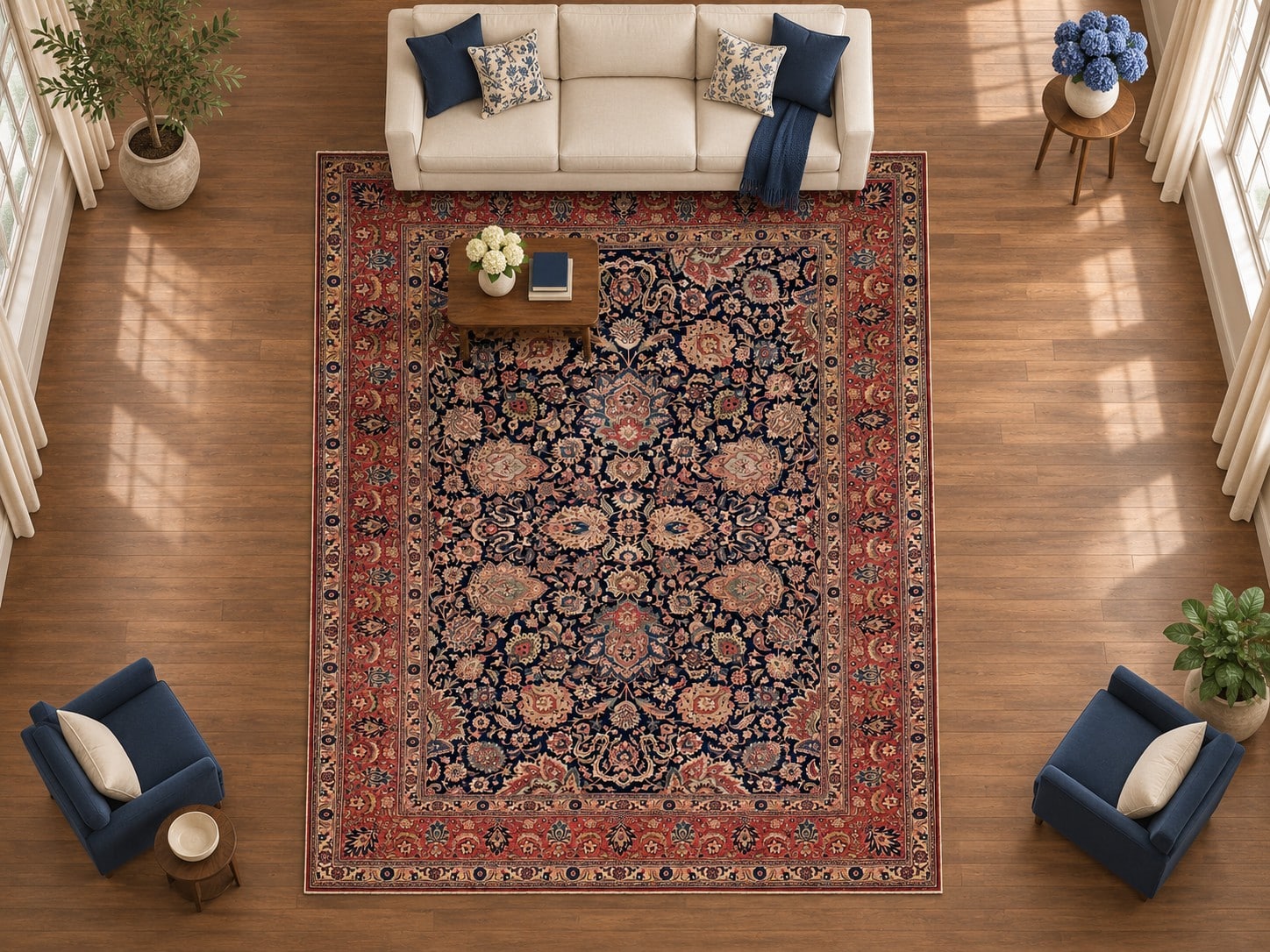
AI ROOM-STYLING CONCEPT · Based on the original catalog reference and title-stated proportions. Approximate visualization, not a real installation, exact reproduction, inscription evidence or measured fit. The schematic gives the stated proportions separately.
CATALOG STUDY / 108590
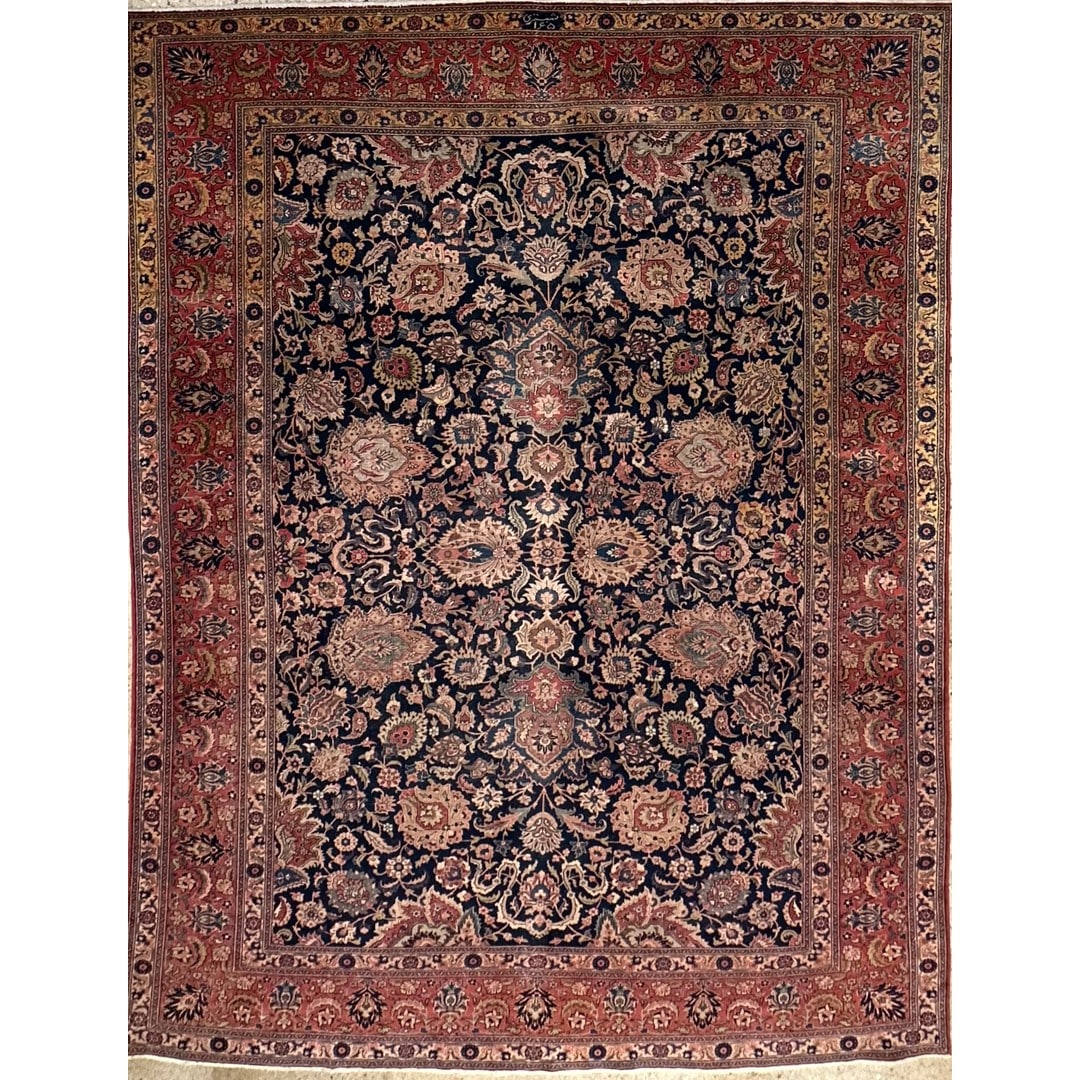
Special Shabestari - Antique Tabriz Signed Persian Rug - Circa 1910s - 9'3" x 12'3" ft.
Rouzati’s listing describes an Antique Tabriz Signed Persian Rug, circa 1910s, measuring 9′3″ × 12′3″. The seller identifies the woven name as Shabestari. Those are the listing’s attributions, not a new independent determination made in this guide.
The close-up at the top of this article and the overall view here are two original catalog photographs of the same product. They connect the inscription area with the complete rug. This article does not offer a fresh translation, identify the individual weavers or authenticate the inscription.
Use the exact product ID when requesting a high-resolution reverse view and the basis for the recorded name and date.
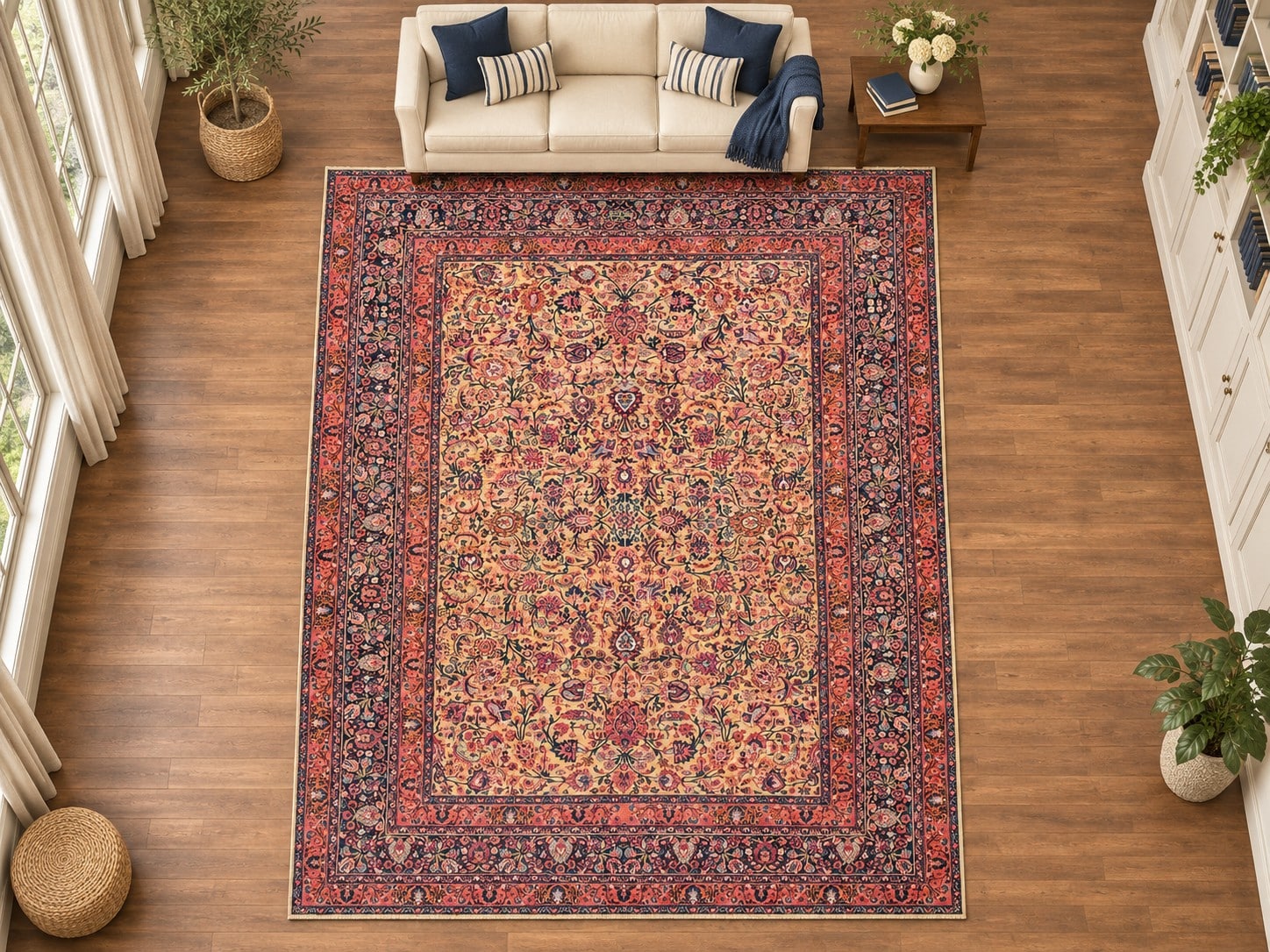
AI ROOM-STYLING CONCEPT · Based on the original catalog reference and title-stated proportions. Approximate visualization, not a real installation, exact reproduction, inscription evidence or measured fit. The schematic gives the stated proportions separately.
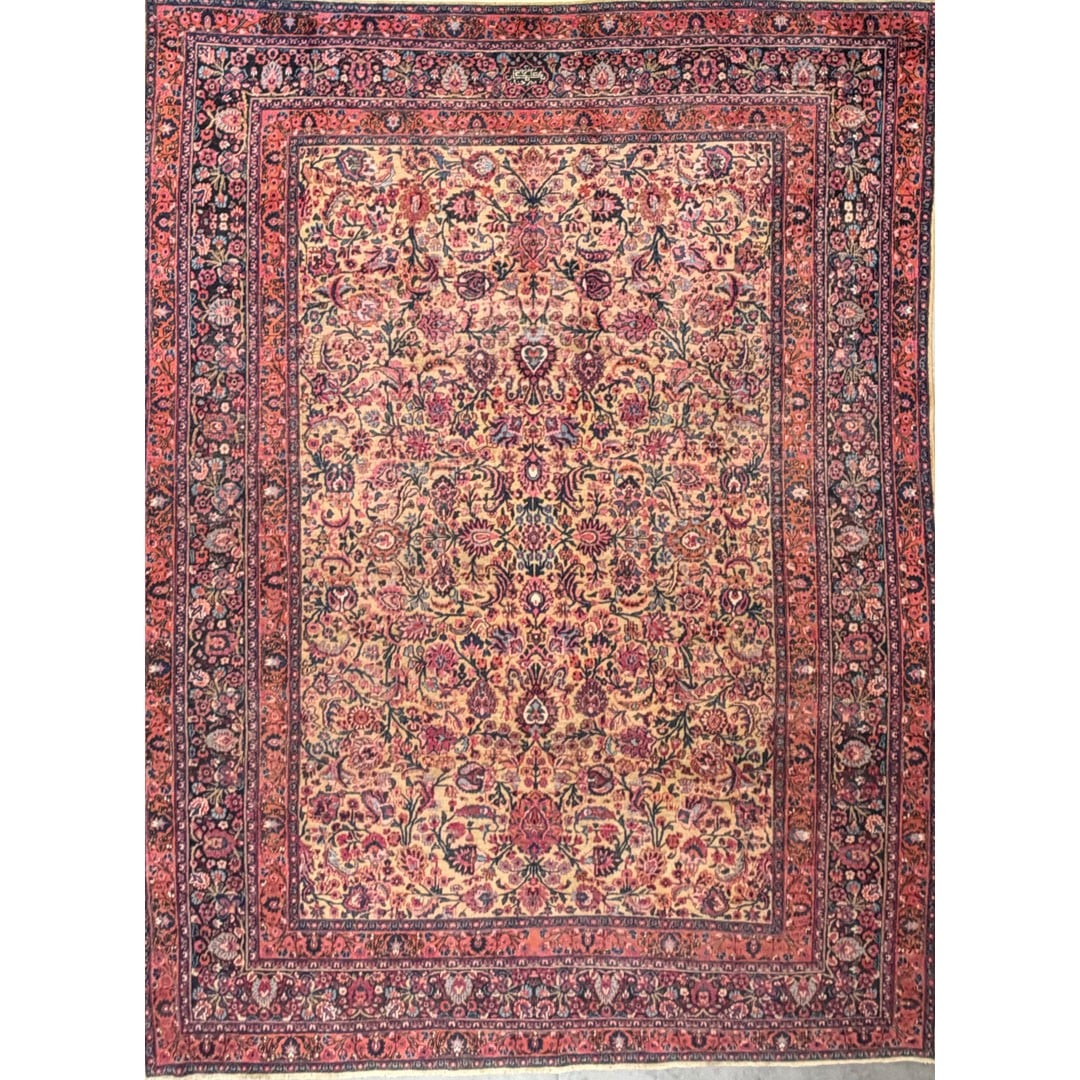
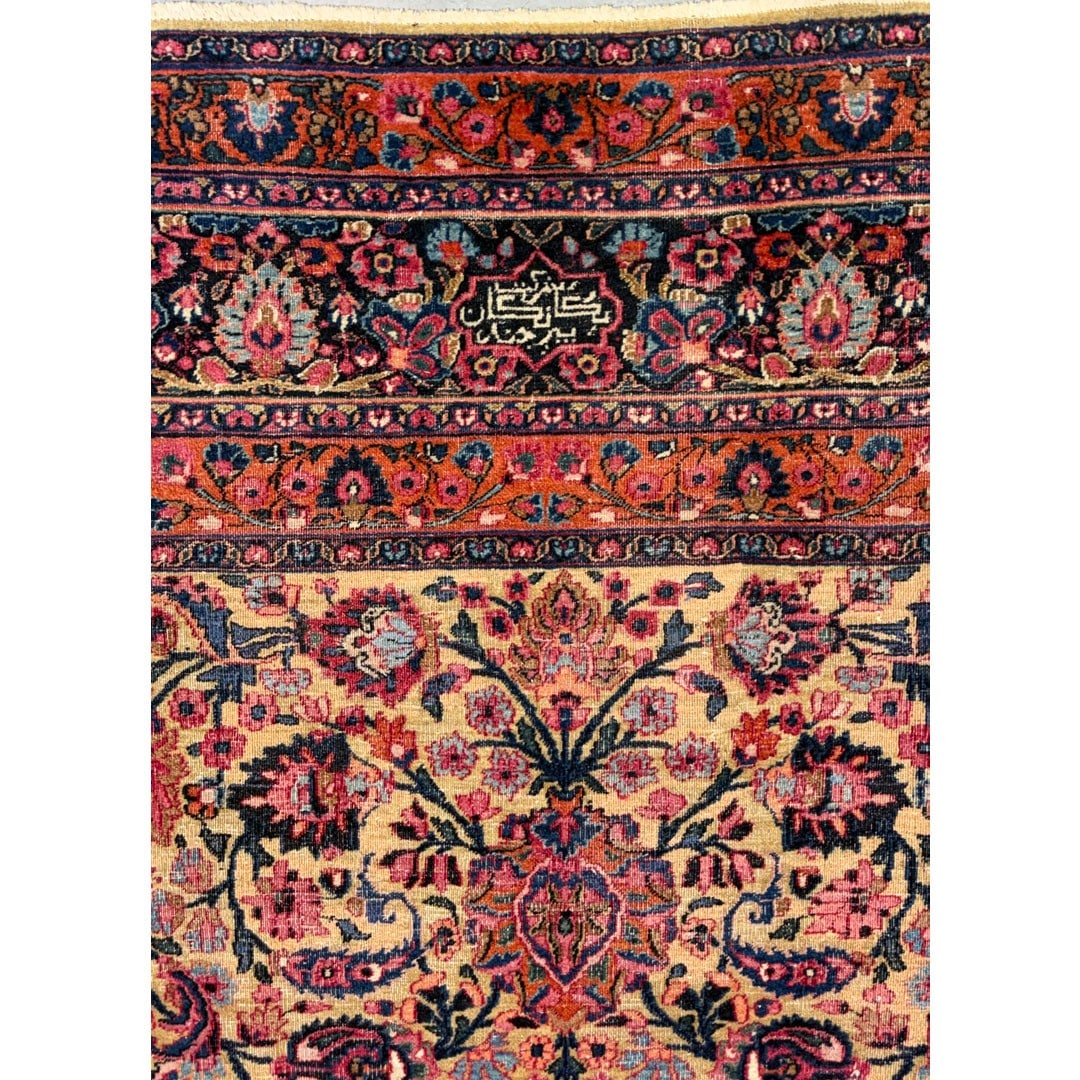
Original catalog photograph. The presence of a woven panel is not, by itself, proof of a particular maker or date.
SECOND CATALOG EXAMPLE / 109164
Boisterous Birjand – 1920s Antique Persian Mashhad Rug with Signature – 9'8" x 12'8" ft.
This listing describes a 1920s Antique Persian Mashhad Rug with Signature, measuring 9′8″ × 12′8″. It is a second example of the word “signature” in a product description.
The catalog detail shows the upper border in context. This guide does not assign a reading to that panel. Before buying on the strength of a named attribution, request the seller’s full reading, an appropriate close-up and its supporting explanation.
01
READ THE TEXT
Separate the writing from the conclusion
A small panel of writing may contain a name, a place, a date, a dedication or a longer text. Do not decide which one it is from the mere presence of script. Ask the seller to identify every readable part and distinguish a literal reading from an interpretation.
It helps to keep four entries in your notes: what is visibly woven, how the text is read, what that reading is said to mean, and what independent evidence supports the attribution. If a letter, numeral or word is uncertain, preserve that uncertainty rather than filling it in.
A useful translation should say where the inscription is located, show the original image and identify who read it. Transliteration records how the words are sounded or written in another alphabet; translation explains their meaning. Neither automatically proves who made the object.
02
KEEP THE CONTEXT
A famous inscription still needs interpretation
The V&A’s account of the Ardabil Carpet identifies poetry, a named signature and a date within its inscription. It also explains that Maqsud Kashani was probably an official responsible for production. That is more careful than assuming the named person individually tied every knot.
LACMA, which holds the companion carpet, describes Maqsud as probably the designer who prepared patterns and oversaw the project. The museum relates the inscription to the commission and the object’s wider history.
The Birmingham Museum of Art separately records a Persian inscription on its 1925 Dabir Kashan Rug. A cataloged reading is a useful model for documentation; it is not permission to apply the same name or date to a visually similar rug.
These are museum examples, not the products pictured in this article. Their lesson for a buyer is methodological: a reading should sit within a documented account of a particular object.
Six questions to take to a seller
| Ask this | Request this evidence | Keep this distinction |
|---|---|---|
| What does the complete inscription say? | A clear, correctly oriented photograph and a line-by-line reading. | Readable text versus guessed letters. |
| Who does the name identify? | An explanation of whether it is attributed to a person, workshop, patron or another role. | A named figure versus a verified maker. |
| Is there a date? Which calendar? | A transcription of the numerals and an explained calendar conversion, if justified. | An inscription’s date versus a proven production date. |
| How was this attribution reached? | The seller’s written reasoning and any relevant records or specialist opinion. | Seller attribution versus independent confirmation. |
| Has this area been repaired or altered? | Current face, reverse and surrounding-area views; disclosed treatment history if known. | A photo observation versus an assessment of weaving history. |
| Does the signature change the valuation? | The actual reasoning within an appraisal or other relevant assessment. | A named inscription versus an automatic price premium. |
A responsible answer can include “not yet established.” If the purchase depends on a particular workshop or date, do not let an unresolved attribution quietly become a certainty between a conversation and an invoice.
03
ASK FOR BETTER VIEWS
A useful inscription photo set
Request an overall image first so the inscription’s location is clear. Add a straight-on close-up, a view with the surrounding border visible and a corresponding reverse view where it can be obtained without stressing the rug. A tight crop alone can detach writing from its context.
Keep the unedited originals. If you rotate an image for reading or add a marked copy, retain the original alongside it. Do not use aggressive sharpening, AI reconstruction or generated letters to turn an unclear character into apparent evidence. Ask for a better photograph instead.
Some writing may be obscured by wear, an edge treatment or a repair. A photograph may help you formulate questions, but it is not a reliable basis for diagnosing the history of an inscription area. Ask for disclosed repair information and an appropriate in-person assessment when it matters.
Buy the rug with the evidence you actually have
A signature can be part of your interest in an object, but keep its condition, design, dimensions and suitability in the decision. An unsigned rug should not be dismissed solely because it lacks a name, and a signed rug should not receive an assumed premium solely because it has one.
When browsing persian rugs for sale, save the item ID, the seller’s exact wording and the supporting photographs. A written record is more useful than remembering that a rug was “signed.” For practical photo requests beyond the inscription, see our antique-rug buying checklist.
If you are also comparing turkish rugs for sale, ask the same text-and-evidence questions whenever a listing mentions an inscription. Do not assume that the language, a place name or a design name alone establishes where that particular rug was woven.
For a decision involving value, separate the seller’s asking price from the purpose and findings of an appraisal. Our rug appraisal and purchase-price guide explains that distinction. Once you own the rug, keep the inscription photos with its photo and ownership record.
A SHORT MESSAGE YOU CAN USE
For this rug ID, please send an overall view, a clear inscription close-up and a corresponding reverse view if safely available. What is the complete reading, who made that reading, and what supports the stated maker and date? Please also identify any known work around the panel.
Frequently asked questions
Does every Persian rug have a signature?
Do not use a signature as a required test for Persian origin or quality. Evaluate the rug and the evidence supporting its description; the absence of a visible name is not a conclusion about authenticity.
Does the signature name the person who tied the knots?
Not necessarily. The named person’s role requires interpretation. The Ardabil museum accounts above discuss a production official or designer, which illustrates why a name cannot simply be equated with an individual weaver.
Can I translate a rug signature from one phone photo?
A clear photo can help a qualified reader, but small, worn or stylized characters may remain uncertain. Request better images and preserve ambiguity. Automated translation or reconstructed lettering should not become provenance evidence.
Does an inscribed date establish the rug’s age?
Record the exact numerals and the proposed calendar first. Ask how the date relates to the object and what supports that interpretation. This guide does not date a rug from its inscription alone.
Are signed rugs always worth more?
No automatic premium follows from the presence of writing. A meaningful valuation needs the relevant purpose and evidence, including attribution, condition and the particular object.
What should appear in the purchase record?
Keep the item ID, product page, photographs, seller’s exact description and any written qualifications or supporting report. Preserve attribution wording rather than silently upgrading it to a verified fact.