

ROUZATI JOURNAL / THE RUNNER EDIT
A better way
to compare
two runners.
Width first.
Then the border.
Then the rhythm.
THE
SHORTLIST
FILE
A narrow rug can look generous in a close-up. A large motif can appear delicate when a long runner is squeezed into a thumbnail. Put both candidates through the same three checks before choosing.
How to choose a vintage Turkish runner
Start with the actual measured width and length, then compare the visible border and the size of the repeating motifs. Use the same viewing conditions for both candidates and ask for full-length photographs before treating a detail view as the complete design. Keep the rug’s current condition and the seller’s terms beside your visual notes.
A runner is a long composition, not a square thumbnail. Your shortlist should account for the whole rug, both long borders and the individual motifs you will see nearby.
TWO CATALOG CANDIDATES
Same shopping category.
Different visual jobs.
These are individual catalog examples, not a ranking of Turkish weaving or a promise that either rug suits your passage. Names, vintage descriptions and dimensions below are Rouzati catalog statements; ask for current measurements and condition before ordering. The photographs are original catalog detail views, not dimension-matched full-rug plans.
CANDIDATE A · RUG 106080
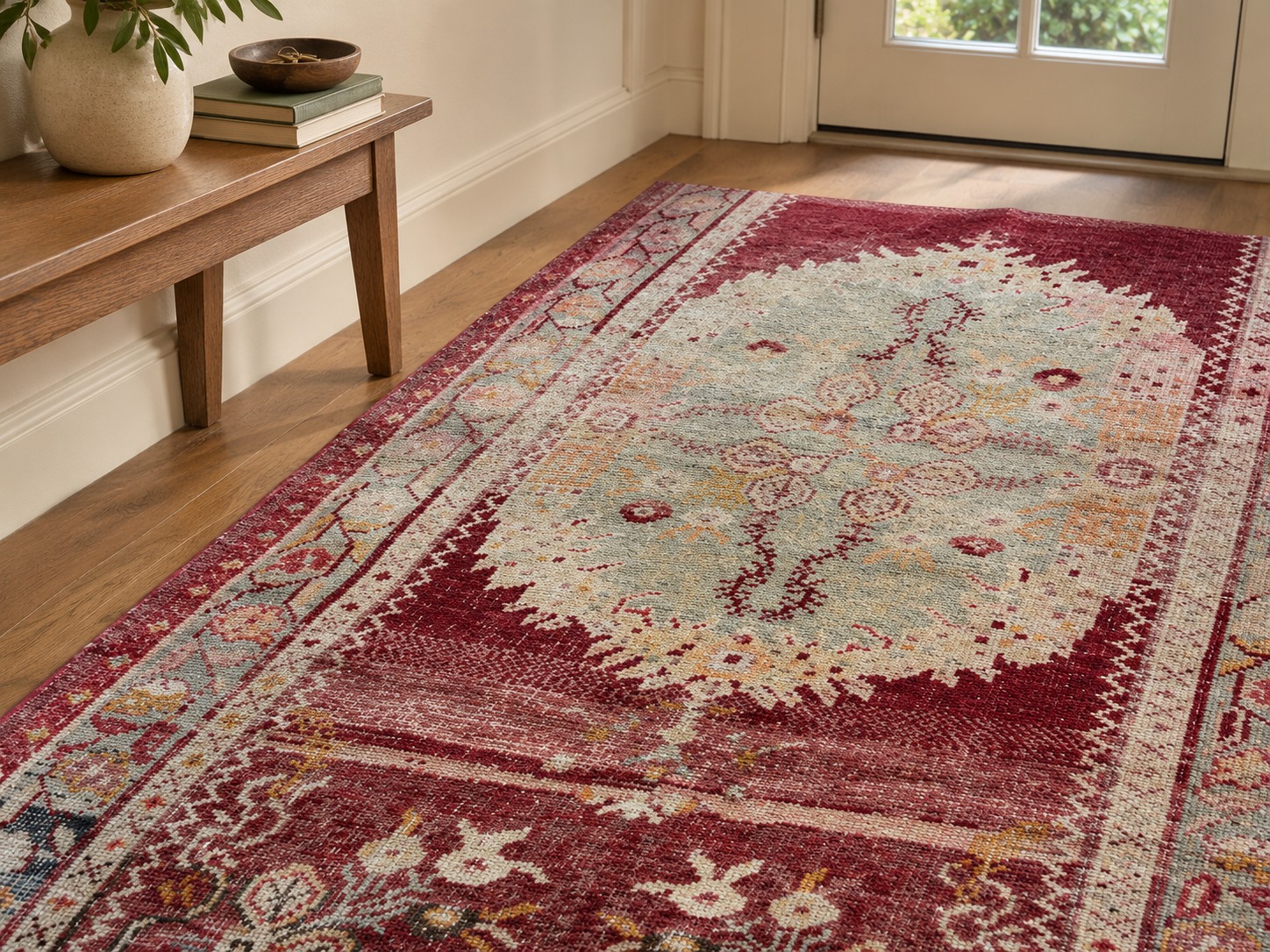
ROOM STYLING CONCEPT
AI-generated from this rug’s catalog reference. Not a real installation, exact reproduction or proof of scale, fit or condition.
ORIGINAL CATALOG REFERENCE · Click either view for this exact product.
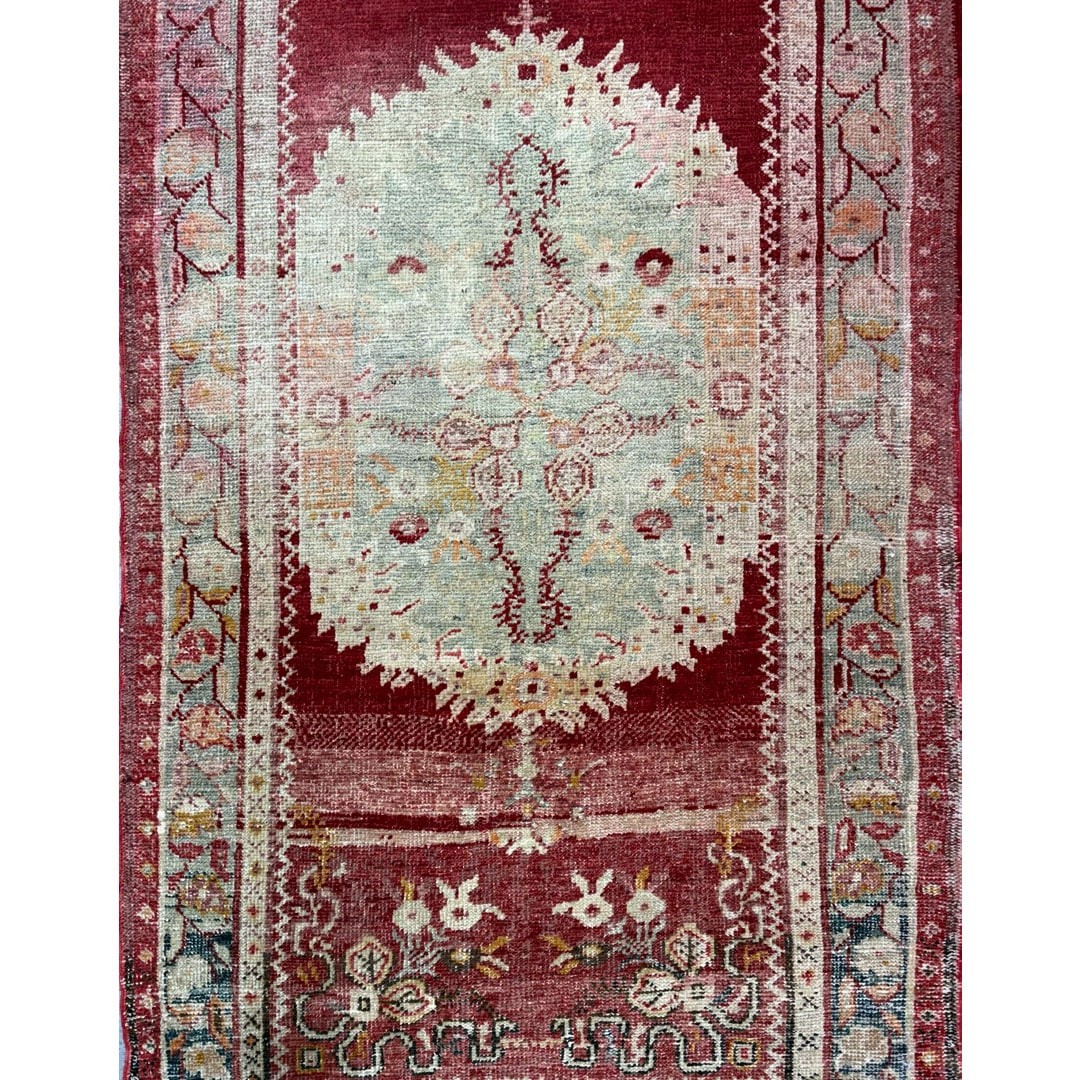
Classic Crimson
CATALOG · 3′3″ × 14′6″
Catalogued as a vintage Turkish Oushak runner. In the available detail, a large pale motif contrasts with the red surrounding field, while the long borders introduce their own repeated ornaments.
The buying question: how does that large light form repeat or change over the entire length? Request an unobstructed full view of both ends before assuming the close-up represents every section.
CANDIDATE B · RUG 109077
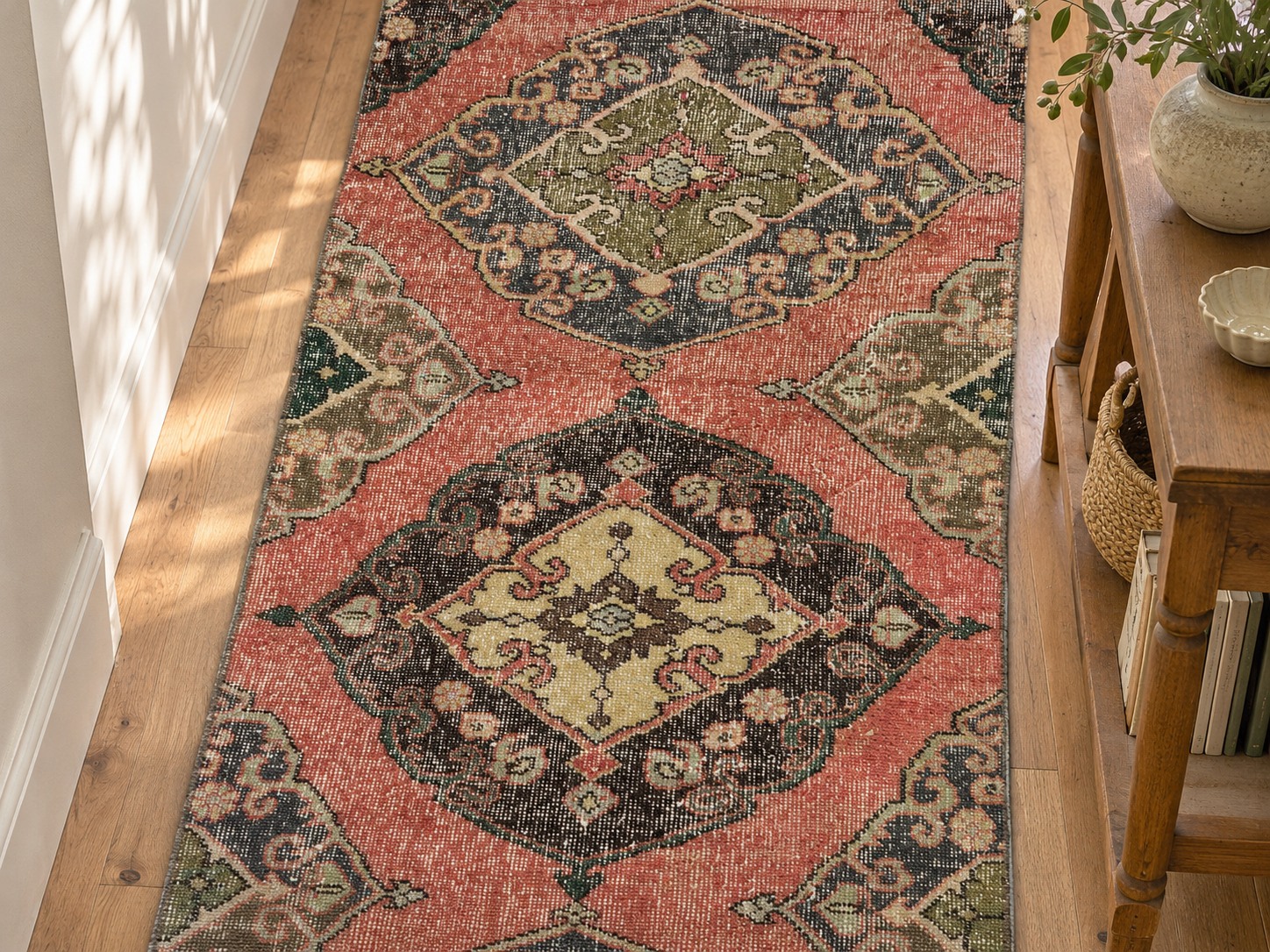
ROOM STYLING CONCEPT
AI-generated from this rug’s catalog reference. Not a real installation, exact reproduction or proof of scale, fit or condition.
ORIGINAL CATALOG REFERENCE · Click either view for this exact product.
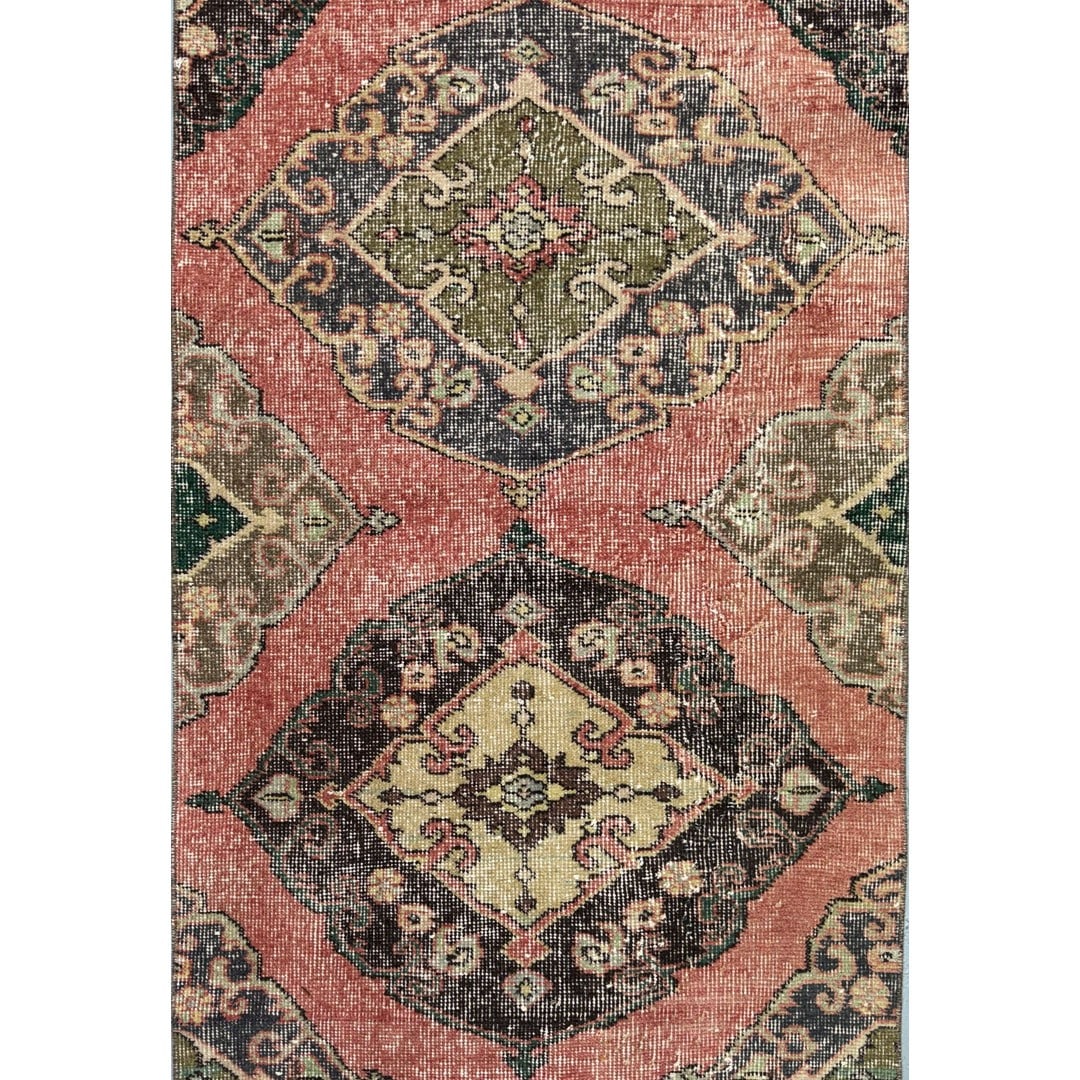
Terrific Turkish
CATALOG · 2′6″ × 11′7″
Catalogued as a vintage Turkish Oushak runner. The detail shows neighboring angular medallions and smaller ornament inside them. Compare the size of a complete motif with the width of the rug rather than judging only the number of visible shapes.
The buying question: do you prefer this repeated geometric rhythm when viewed along the passage, and do the side borders remain distinct beside the surrounding floor?
01 / THE FOOTPRINT
Nine inches
is not a detail.
The catalog widths are 39 inches for Candidate A and 30 inches for Candidate B: a nine-inch difference. Their listed lengths also differ, so these are not interchangeable footprints. Treat the figures as a starting point to confirm with the seller, not measurements taken from the photographs.
A / 39 IN
B / 30 IN
SCHEMATIC · RELATIVE CATALOG WIDTHS ONLYMeasure the space where the rug will lie, including any fixed furniture or changes in the passage width. Mark each proposed rug footprint separately with a removable method suitable for your floor. Decide how much exposed flooring you prefer on each side; there is no single side-gap rule that fits every passage.
Ask whether the quoted dimensions include fringe and whether the body width varies along the piece. A handmade rug need not be a perfect rectangle. Do not silently substitute the nominal size category for the seller’s current measured dimensions.
02 / THE FRAME
Look at the
two long edges.
The border is the patterned frame around the field, often accompanied by narrower guard bands. In a runner, the two long sides can be prominent in the furnished view. Compare their color contrast, the apparent breadth of the frame and the amount of field left between them.
A border that reads strongly in one catalog photograph may blend into a similarly colored floor. A lighter border may separate the rug from a dark floor, but that is a visual possibility to test with your own samples, not a rule about these products. Lay a flooring or paint sample beside the image and compare both candidates under the same lighting.
The Met’s discussion of a historical Lotto carpet treats the border as a meaningful design element in its own right.1 That historical example does not identify the construction, age or condition of a modern shopping candidate. Here, the practical lesson is simply to give the frame its own line in your comparison.
03 / THE RHYTHM
Read the repeat
at two distances.
First look from the entrance to the passage. Notice the larger sequence: medallions, open areas and shifts in color. Then look at the distance from which you will usually see the rug nearby. Small interior motifs may become more noticeable while the big sequence recedes.
The Met’s family guide suggests observing repeated shapes and colors from farther away, then inspecting the smaller details and comparing the border with the center.2 Apply that looking method consistently to both rug photographs. It is an observation exercise, not a formula for which pattern you must buy.
- Identify one complete large motif rather than counting partial shapes at the photo edge.
- Ask for a full-length view to see how the sequence begins and ends.
- Avoid enlarging one candidate much more than the other and calling its pattern bolder.
- Record what you prefer in plain language: more open field, stronger frame, larger motifs or a denser repeat.
Your two-runner comparison sheet
| Check | Candidate A · Classic Crimson | Candidate B · Terrific Turkish | What still needs confirmation |
|---|---|---|---|
| Catalog footprint | 3′3″ × 14′6″; width 39 in. | 2′6″ × 11′7″; width 30 in. | Current measured body dimensions; fringe inclusion; any width variation. |
| Visible design in the detail | Large pale motif, red surrounding field and patterned long borders. | Adjacent angular medallions containing smaller motifs. | Full sequence and both end borders; the detail is not the complete rug. |
| Border decision | Does the contrasting frame remain visible against your floor? | Can you distinguish the frame from the motif-filled field? | Comparable photographs and a floor sample. |
| Pattern-scale decision | Do you like the large light form from the end of the passage? | Do you like the repeated geometry from that same viewpoint? | Consistent viewing size and a full-length photograph. |
| Purchase record | Save rug ID 106080 and the seller’s written replies. | Save rug ID 109077 and the seller’s written replies. | Current condition report, exact materials/construction and current seller terms. |
These are catalog descriptions and visual observations, not independent authentication or measured border widths. Use the blank printable comparison-sheet.html included in the ZIP for your own shortlist.
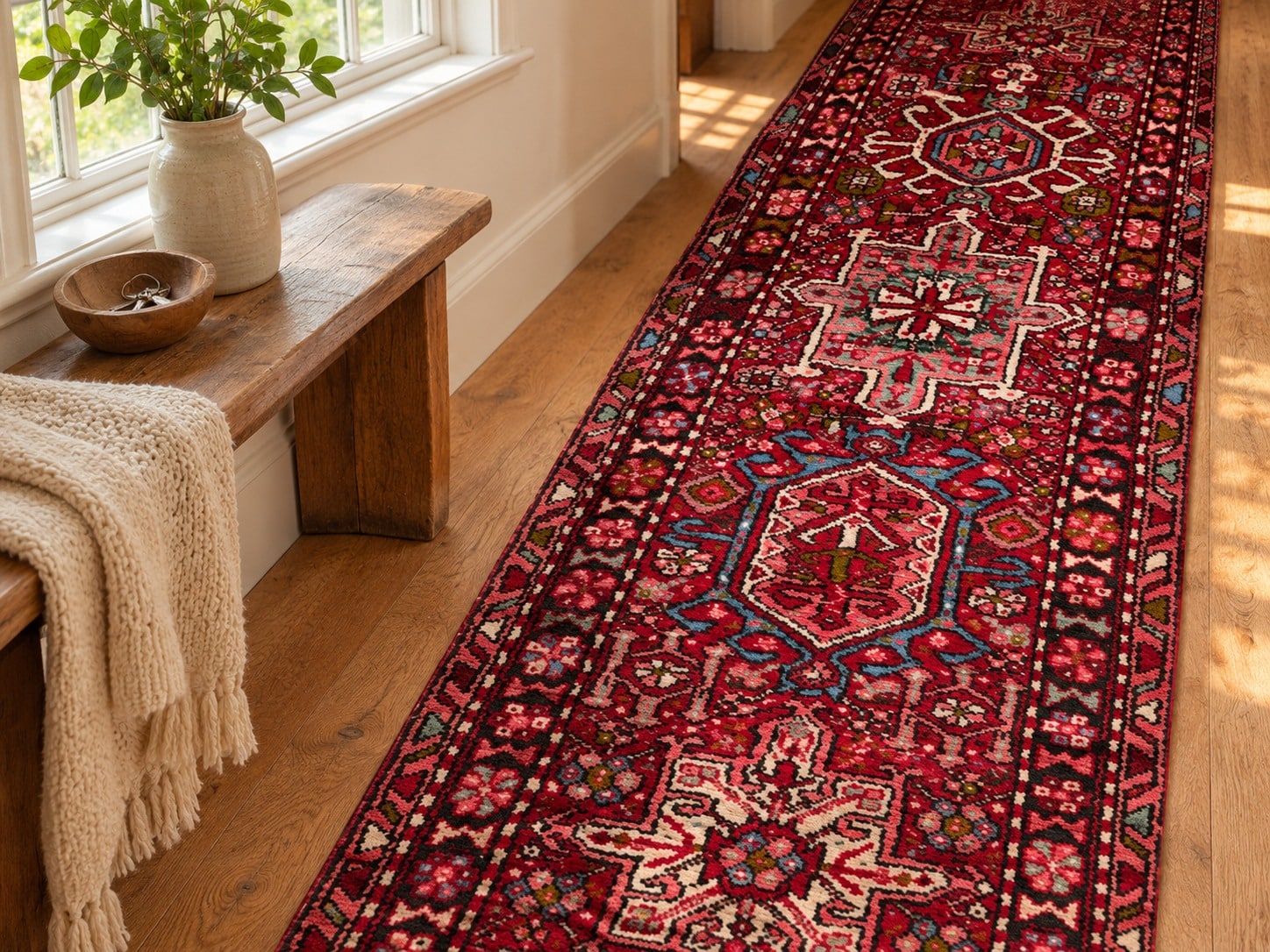
ROOM STYLING CONCEPT
AI-generated from this rug’s catalog reference. Not a real installation, exact reproduction or proof of scale, fit or condition.
ORIGINAL CATALOG REFERENCE · Click either view for this exact product.
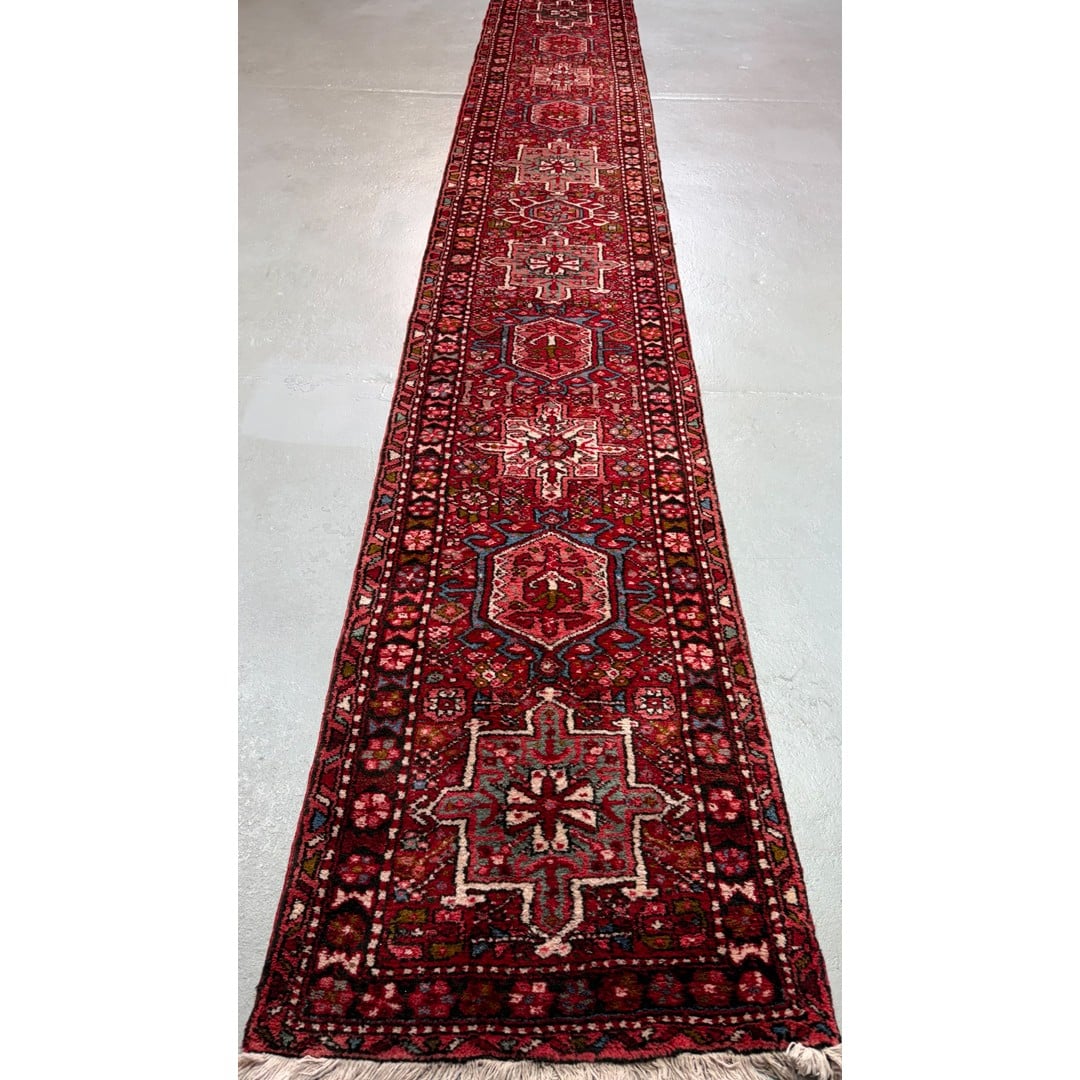
ONE PERSIAN ALTERNATIVE / RUG 109037
Historic Heriz
The current listing identifies an antique Persian Karaje runner measuring 2′4″ × 14′8″. The catalog photographs show a red ground and a succession of contrasting geometric forms within long patterned borders. Use it as another composition to compare, not a like-for-like size substitute.
Its stated width is 28 inches, narrower than either Turkish example above. Check its own footprint, current condition and full set of views before adding it to a shortlist. The smaller original angled catalog photograph illustrates the lengthwise sequence; perspective makes it unsuitable for measuring proportions on screen.
Keep the shortlist specific.
Browse turkish rugs for sale with a written width range and visual priorities beside you. Compare individual listings for origin, design and construction; a category name alone does not establish where or how a rug was made.
If you also want a different composition, explore persian rugs for sale using the same worksheet. Keep each rug’s own measurements beside its photograph rather than assuming all runners occupy the same space.
For a broader photo and condition request, follow our guide to buying an antique rug online. For interpreting a listing’s geographic and design wording, read our guide to Turkish rugs versus Turkish-style labels. This article is about comparing loose-laid runners, so staircase fitting is a separate assessment.
Shortlist rule: first eliminate an unsuitable footprint, then compare the frame and repeat. Keep current condition, construction and seller terms as separate purchase checks.
Before you choose: quick answers
Should two runners be the same length to compare them?
You can compare their visual designs, but not assume the same fit. Draw each confirmed footprint separately and record both length and width.
Is a wider border better for a narrow passage?
There is no universal winner. Compare how much field remains visible and whether the border separates from the surrounding floor in your preferred view.
Can a close-up tell me how the pattern repeats?
Only within the area photographed. Request an unobstructed full-length view and both ends to check the complete sequence.
Are Turkish runners always geometric?
No. Compare the specific piece rather than treating a country or collection name as a complete pattern description. Design style and weaving origin are separate questions.
Do these dimensions guarantee the runners will fit?
No. They are seller/catalog figures, not measurements of your space or a new inspection of the rug. Confirm current rug-body dimensions, fringe inclusion and any width variation.
Which condition questions should I ask about a vintage runner?
Request current photographs of both long edges, both ends, the reverse and any repaired or worn areas. Ask the seller to describe known changes and confirm the materials, construction and purchase terms in writing.