
ROUZATI JOURNAL
BUYING NOTES / 01
≠
DESIGN
Turkish Rugs vs.
Turkish-Style Rugs
A country tells you where a rug was made. A design name tells you what it references. A good listing keeps both visible.
The useful comparison is not which label sounds more prestigious. It is whether the seller has clearly described the specific rug: its weaving location, design, construction, materials and condition.
One listing. Three separate questions.
When comparing Turkish rugs vs Turkish style, start by separating three fields that are often compressed into a product title. “Turkish” can be presented as a geographic description, while “Turkish-style,” “Turkish design” or “Oushak-inspired” may describe a visual tradition used by a weaver elsewhere. The extra words matter.
Origin
Where was this rug woven or manufactured?
Design
Which tradition or pattern does its appearance reference?
Construction
How was this particular rug made?
A shopping category can group rugs by visual style as well as place. Do not use category membership, a product nickname or a collection name as independent evidence of origin. Ask for the seller’s country-of-manufacture statement and keep it beside the item number.
Keep this distinction: “Oushak design” is not the same statement as “woven in Turkey.” Likewise, a Persian design can be woven outside Iran.
Two real listings, read carefully
These Rouzati catalog examples show why origin, pattern and construction deserve their own lines. The descriptions below are attributed to the seller’s current listings, not an independent authentication of either rug. No product’s quality or suitability is established by its name.
EXAMPLE A / TURKISH-DESIGN LANGUAGE
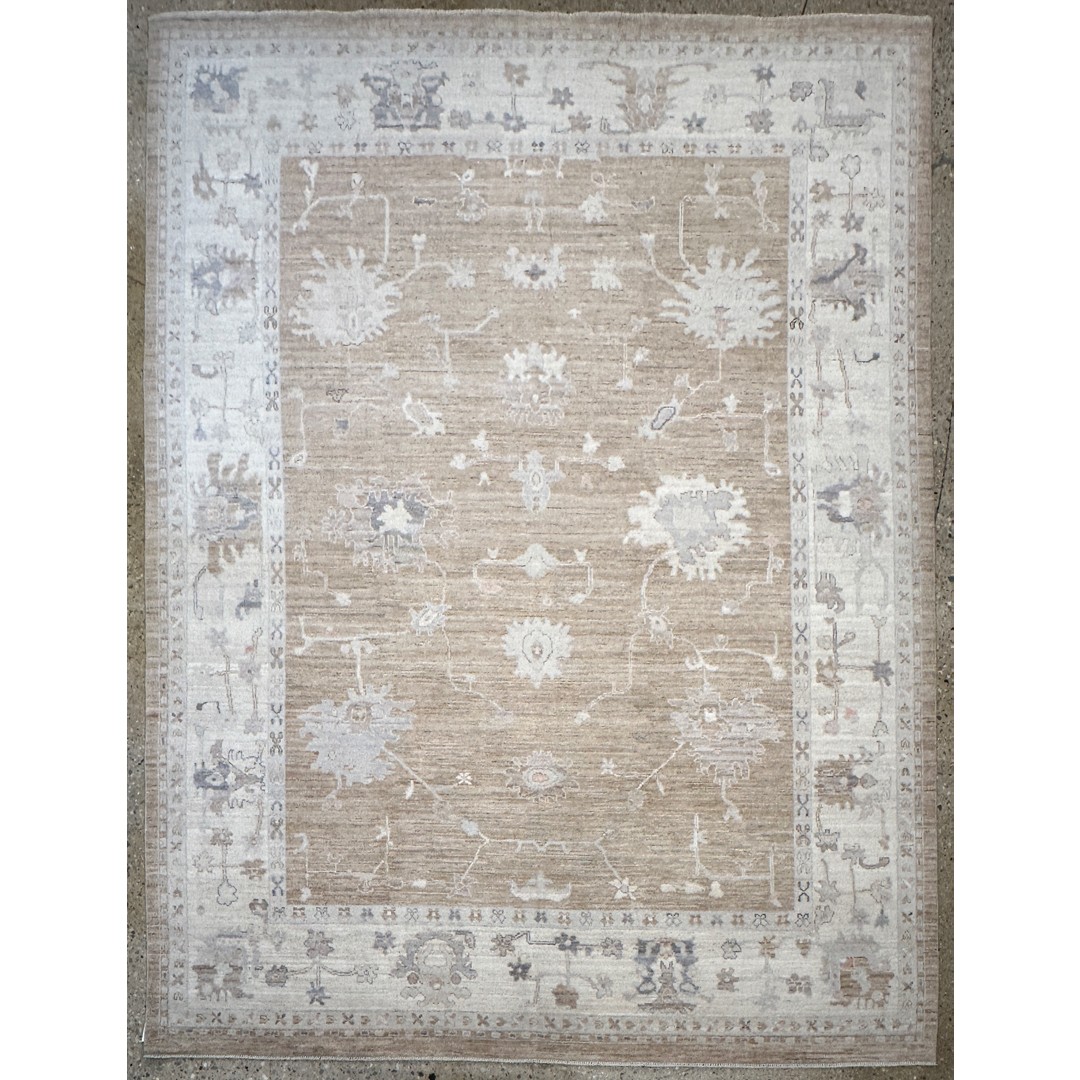
Aesthetic Afghan
The live listing describes a Turkish Oushak design and says the wool rug was hand-knotted by Afghan artisans. Its stated size is 9′ × 11′10″. The design reference and the seller’s Afghan attribution appear together.
Read it as an Oushak-design listing with a separately stated production attribution. If you specifically require a rug woven in Turkey, ask the seller to confirm the actual weaving country rather than treating “Oushak” as that confirmation.
EXAMPLE B / PERSIAN-DESIGN LANGUAGE
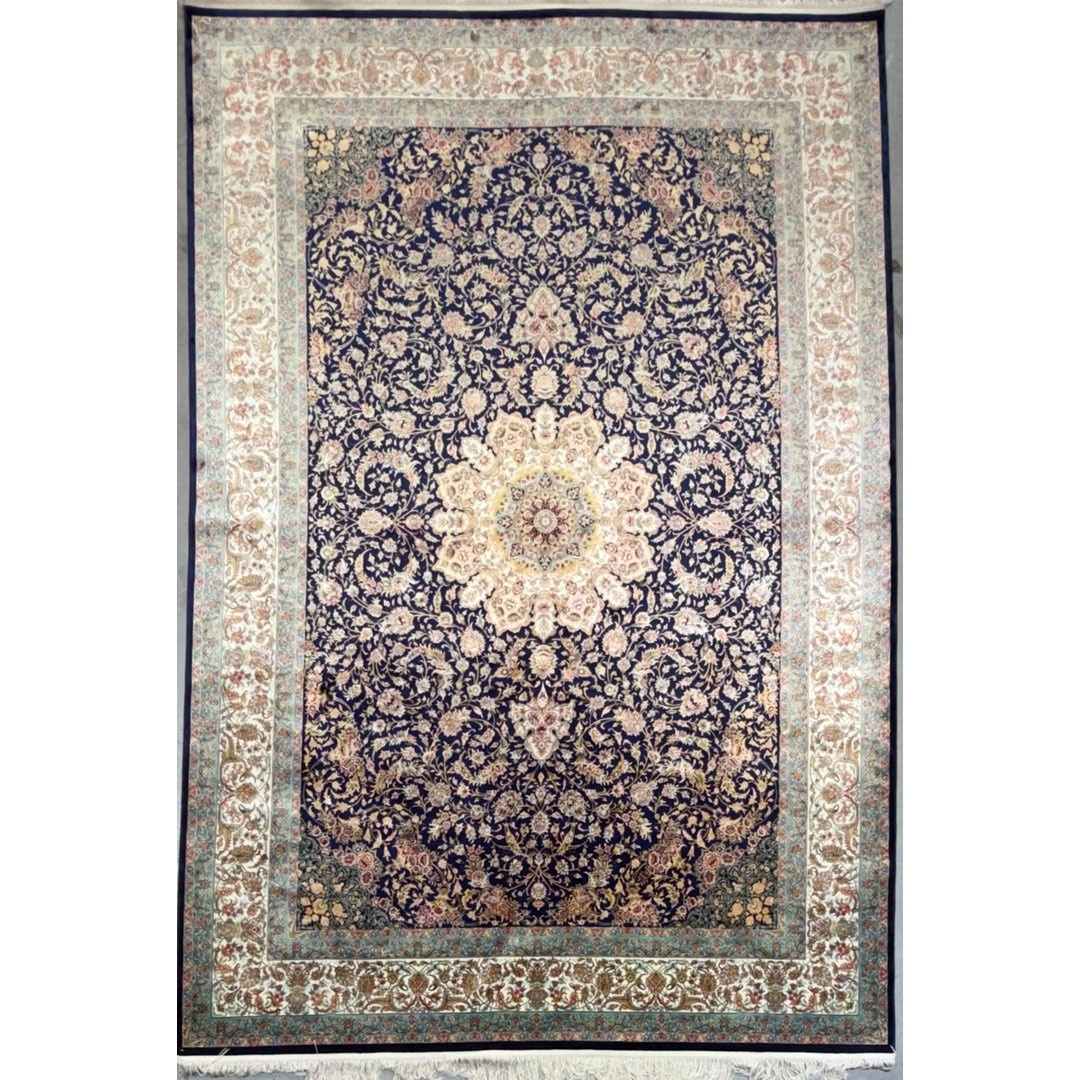
Terrific Turkish
The listing calls this a Turkish power-loomed rug with a Persian Tabriz design, measuring 6′7″ × 9′6″. The word “Persian” describes the pattern here; the listing is not presenting it as a hand-knotted Iranian Tabriz rug.
This is also a reminder that “Turkish” alone does not specify hand-knotted construction. Confirm the manufacture country and exact fiber description separately, especially when a marketing material name appears in a listing.
What a label can—and cannot—tell you
| Listing wording | What it tells you | What to confirm |
|---|---|---|
| Made in Turkey / woven in Turkey | An explicit manufacture or weaving-origin claim. | The claim applies to this rug, with its item number. |
| Turkish-style / Turkish design | A stated design reference. | Actual country of manufacture and construction. |
| Oushak / Uşak | A name with a historic regional connection that is also used in design descriptions. | Whether the seller means historic attribution, manufacture location or an inspired pattern. |
| Persian Tabriz design | A Persian design reference in the example above. | Whether manufacture took place in Iran or elsewhere. |
| Hand-knotted / power-loomed | A construction description. | Materials, condition and suitability for your room. |
| Ships from a U.S. address | A dispatch location. | Weaving origin; the two locations may differ. |
A precise description can contain both a regional design name and a different production location without contradiction. The problem is an unclear or unsupported claim, not the existence of cross-regional design influence.
A MUSEUM CHECK
Patterns travel.
Evidence stays specific.
The Metropolitan Museum of Art’s Carpet with Quatrefoil Design record connects its pattern with the Ushak tradition, while discussing other features that point toward central or eastern Anatolia. It is an example of a museum weighing several characteristics rather than letting the pattern name settle every attribution.1
Knot terminology also needs care. The Met catalogs another carpet as attributed to Iran and describes its pile as symmetrically knotted. A knot commonly called “Turkish” is therefore not, by itself, proof of Turkish manufacture.2
For the wider regional comparison, read our Persian and Turkish rug comparison. This guide focuses on the narrower task of reading a listing accurately.
A useful seller question is specific
The FTC’s textile-labeling guidance treats country of origin, fiber content and the responsible business’s identity as separate information. That is a helpful reading framework; it does not make every old rug label an authentication certificate.3
Before comparing turkish rugs for sale, ask whether each listing uses “Turkish” for the weaving location or for design. Then compare the same fields across your shortlist, rather than comparing a fully documented rug with an ambiguous title.
COPY THIS QUESTION
For rug ID _____, please confirm the country where the rug was woven or manufactured, the construction method, and whether “Oushak” describes its design or its attributed weaving location. What label, record or attribution supports that description?
A clear reply might still contain uncertainty. “Attributed to” is a qualified description, not the same as a documented production record. Ask what the attribution rests on and what remains unknown. Save the response with the product URL; a screenshot of an attractive title is not the same record.
Build a shortlist without turning origin into a quality score
First decide whether geographic origin is essential to your purchase or whether you are primarily looking for a particular design. Both are reasonable preferences. They simply produce different shortlists. A Turkish-style rug made elsewhere may fit the design brief; it does not satisfy a requirement for Turkish manufacture merely because the pattern looks right.
Next compare actual dimensions, fiber information, construction, wear, repairs and the way the pattern will sit beneath furniture. Ask for clear overall, detail and reverse photographs where appropriate. Do not infer a rug’s age, knot density, dye type or expected lifespan from its country name.
Use the same separation when exploring persian rugs for sale: confirm whether “Persian” refers to Iranian origin or a Persian-inspired pattern. A large central medallion is a design feature, not a passport.
If the rug is older or the purchase depends on a regional attribution, our antique-rug online buying checklist helps organize the photographs and seller questions to request. Seek an independent specialist’s opinion when the attribution is central to your decision and the available record does not resolve it.
Frequently asked questions
Does Turkish-style mean made in Turkey?
No. It describes a design association unless the seller separately states a Turkish manufacture or weaving origin. Read the full listing and ask about the exact item.
Can a rug be Turkish and have a Persian design?
Yes. Origin and design are separate descriptions. The Terrific Turkish listing above is described by its seller as Turkish and power-loomed, with a Persian Tabriz design.
Does Oushak always mean the rug was woven in Uşak?
No. The name has a regional history, but modern listings also use Oushak as a design term. Ask which meaning is intended.
Does a Turkish knot prove Turkish origin?
No. A knot name is a construction term, not a complete geographic attribution. The museum example above shows symmetrical knotting on a rug attributed to Iran.
What if a vintage rug has no surviving label?
Ask the seller how its origin was attributed and what evidence is available. A missing label does not settle the question either way; preserve qualified wording and seek further assessment if origin is essential.
Is Turkish-style a lower-quality category?
The phrase alone does not establish quality. Compare the exact rug’s materials, construction, condition and fit with your intended use. Neither a design name nor a country is a substitute for that assessment.