

Rouzati Journal / The Repair File
Buying a Restored Persian Rug: Questions About Patches, Reweaving and Altered Size
Ask where the work was done, what changed, and what the seller can verify.
BUYER FILE / 01
The repair file
Map the work.
Confirm the size.
The quick answer
Ask for the work, not just the label
When buying a restored Persian rug, ask for three things before you decide: a repair map, a written description of the work and current measurements that say whether the fringe is included. A broad label such as “restored” cannot tell you whether the seller means a small area in the pile, a backed patch, an end that was secured, or a change to the overall size.
A repair isn’t automatically a reason to walk away. But a buying decision should rest on the work described for that exact rug, the part of the rug it affects, and what remains uncertain.
If you need the complete list of photographs to request, start with the guide to buying an antique rug online. The steps below go further on one question: what has changed since the rug was made?
01 / Locate the work
Ask for a map before you ask whether a repair is visible
Ask the seller to mark each disclosed repair on one full-front image with the stock number visible or written in the caption. Label the two ends A and B and use the same labels on the reverse, because turning a rug over can reverse left and right in the photo. Give each area its own label, such as R1 or R2. Then ask for a front close-up and a reverse close-up of that same area, plus one wider view that shows where it sits.
Request an approximate footprint for each area and a ruler in the close-up if the seller can include one without disturbing the textile. A small repair close to an end and a long repair crossing the middle can have different implications for where you plan to place the rug. Neither location alone tells you how sound the work is today.
Copy this request: “Could you mark each known repair on a full photo of this exact rug, identify both ends, and send the corresponding front and reverse views? For each area, please say what was done, what the repair covers, and which parts of the history are unknown.”
Schematic only. R1 and R2 are invented labels, not findings about either catalog rug. Have the seller mark the actual piece.
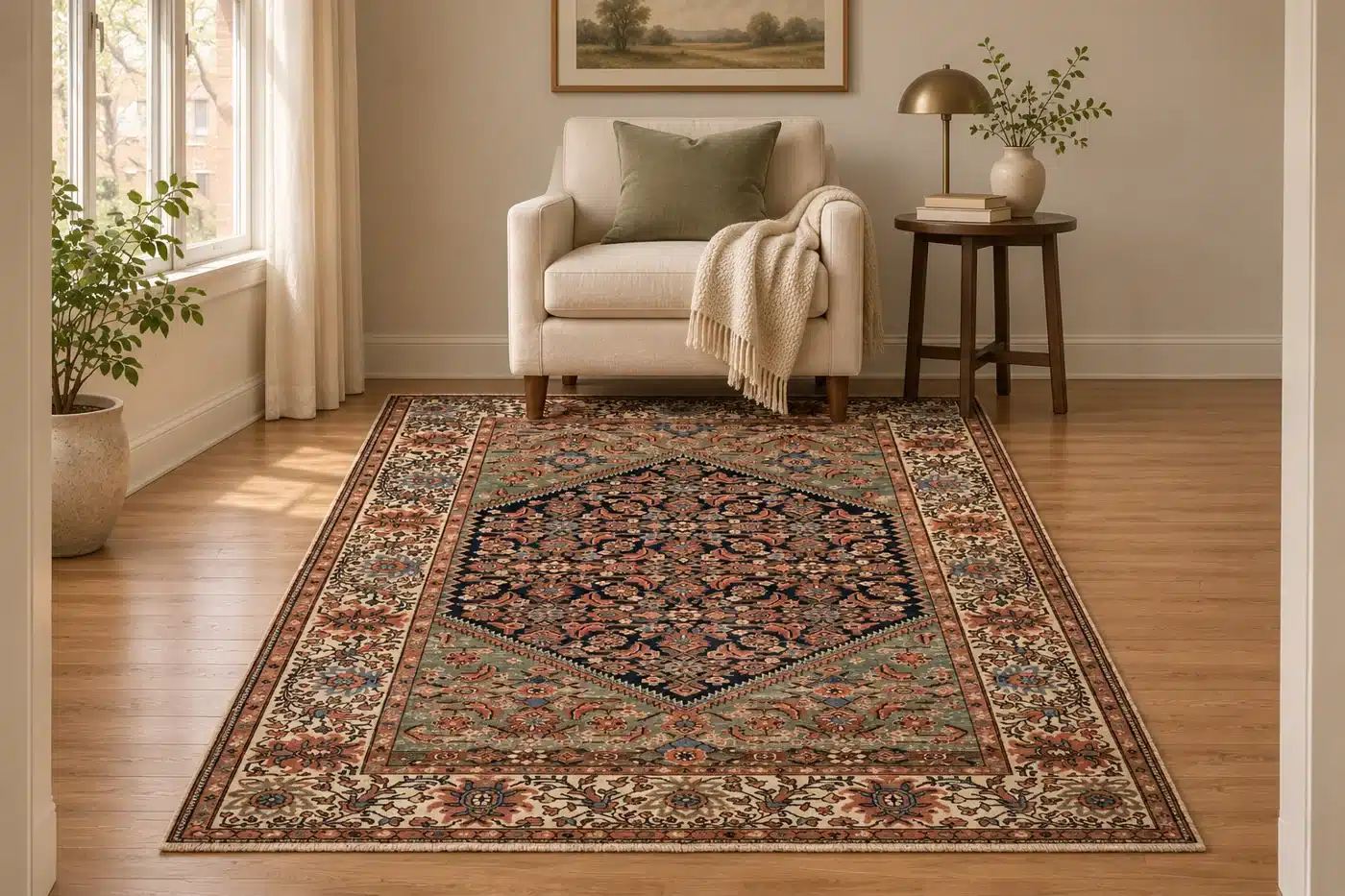
AI ROOM-STYLING CONCEPT · Inspired by this rug’s original catalog photograph; the room is illustrative. Neither image establishes restoration, condition or fit.
File A / Ask for the reverse
Miraculous Malayer - 1930s Antique Persian Rug - Herati Design - 4'9" x 6'11" ft.
CATALOG SKU 104584 · 57 × 83 inches
The catalog lists a Herati design and a size of 4′9″ × 6′11″; confirm whether that measure includes fringe. The fine repeat makes this a useful example of why overall appearance is not a repair report. Ask the seller for a full reverse and matching front-and-back close-ups if any work is disclosed.
Repair status: not established for this example; the images are not condition evidence.
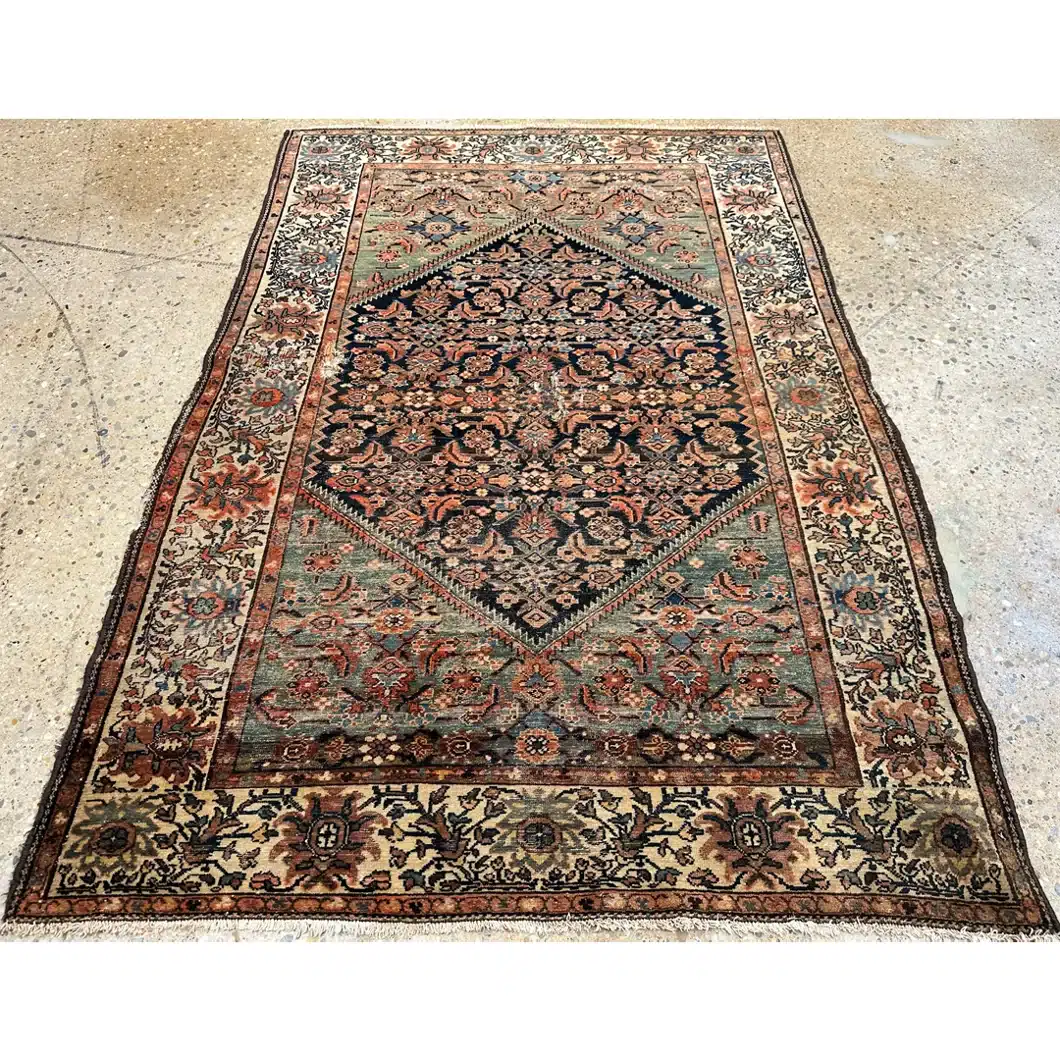
Original angled catalog photograph · Overall design reference only.
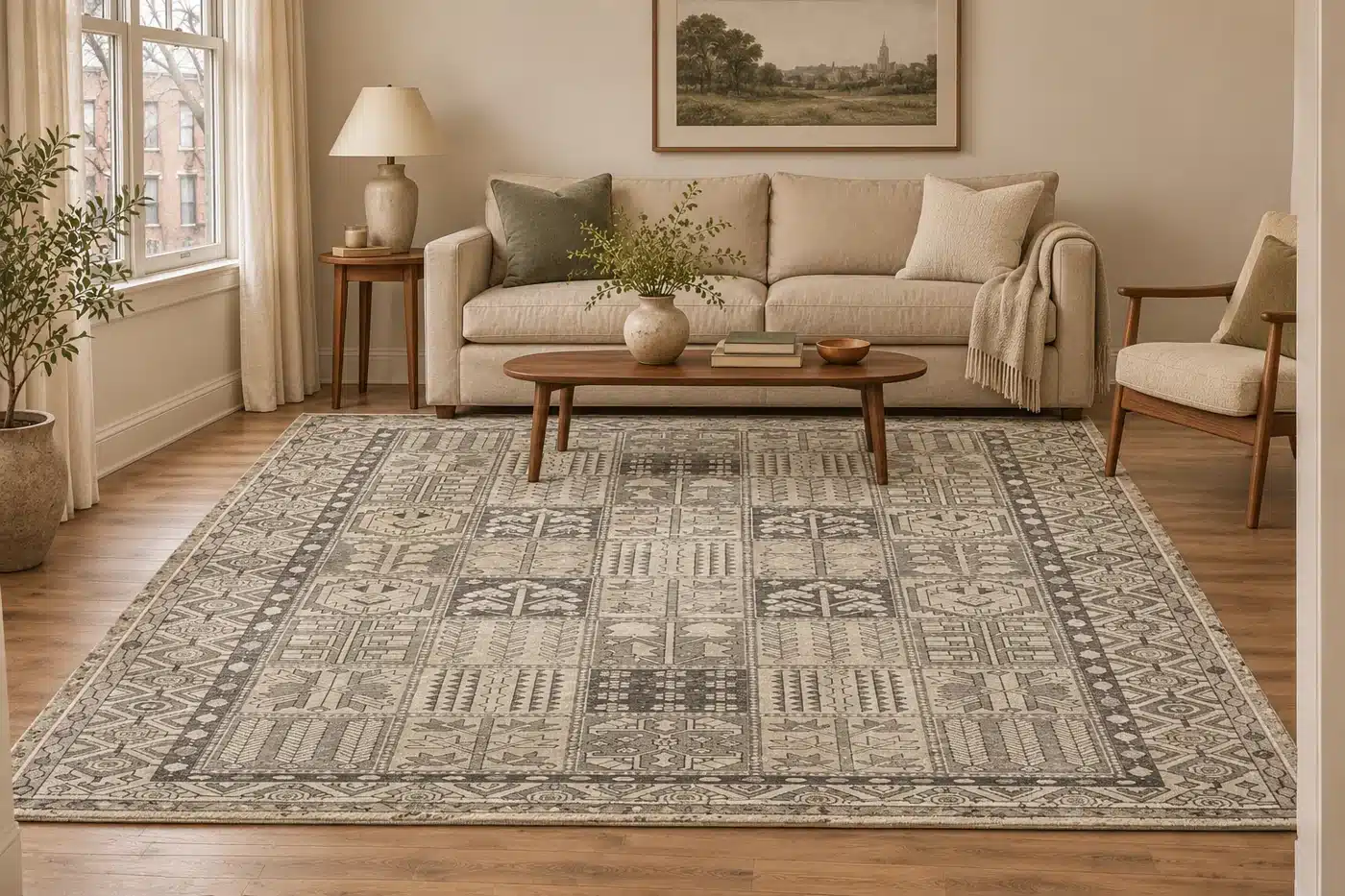
AI ROOM-STYLING CONCEPT · Inspired by this rug’s original catalog photograph; the room is illustrative. Neither image establishes restoration, condition or fit.
File B / Ask about the ends
Dazzling Distressed - Vintage Persian Bakhtiari Rug - 6'8'' x 9'5'' ft.
CATALOG SKU 106997 · 80 × 113 inches
The catalog title uses “distressed.” Ask whether that word describes the finish, wear, a particular treatment, or something else. It does not disclose a patch, reweave or reduction. Confirm the current 6′8″ × 9′5″ listing measurement, whether fringe is included, and what is known about both ends.
Repair status: not established for this example; the images are not condition evidence.
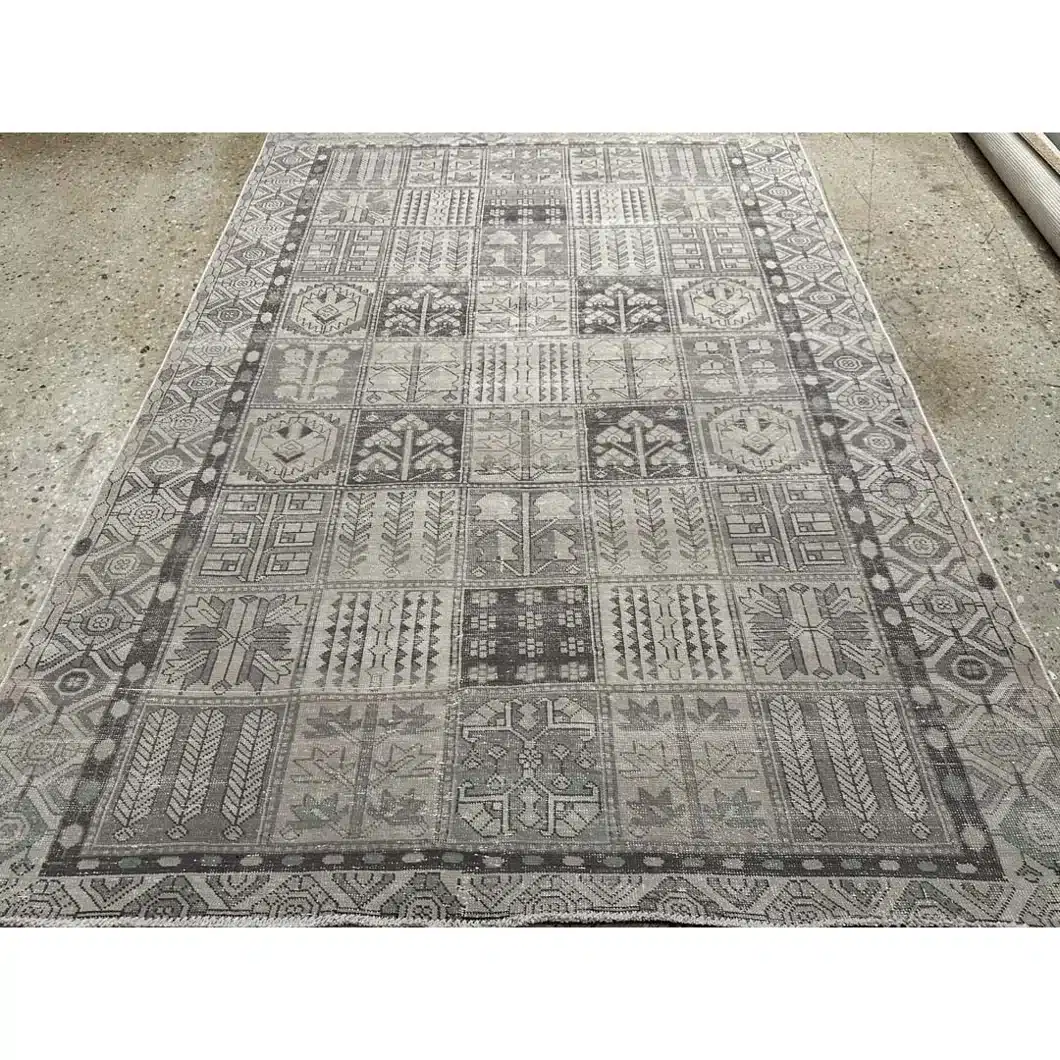
Original angled catalog photograph · Overall design reference only.
Buyer’s evidence checklist
What each repair description should come with
| Seller’s description | Clarify in writing | Ask to see |
|---|---|---|
| Patch or added support | Was material inserted, added behind, or attached another way? Ask what is known about the attachment. | A marked overview and matching photos of both sides; approximate extent. |
| Reweaving | What was rebuilt: foundation, pile or both? Was it one area or more? | A contextual view and close-ups of the same section on front and reverse. |
| Ends or sides secured | Which edge was worked on? Was the existing material secured or was some removed? | Full views of both ends or sides; current body measurements. |
| Shortened or altered size | Which end or side changed? Are earlier dimensions supported by a dated record? | Current width and length, fringe stated separately, plus any older records. |
02 / Name the intervention
Separate a patch, a reweave, and an end finish
Use the seller’s terminology as the beginning of a conversation. A patch can mean an added piece or support at a specific location; ask whether it was inserted, stitched behind the rug or attached another way. For a reweave, ask which parts were rebuilt: the underlying foundation, new pile, or both. A treated side or end may have been secured against further loss without changing the body dimensions. A cut and newly finished end is a different claim. Ask the seller to describe the difference in plain language.
The Metropolitan Museum of Art’s textile conservation team documented past mending, reweaving, and adhesive patches on six Iranian carpets. Those museum examples establish that different interventions can exist on one textile. They do not tell you what was done on a rug for sale, and museum display treatment is not a benchmark for everyday floor use.
If a seller says a repair will be invisible, ask for unretouched close-ups under the same lighting as the surrounding area and a normal-distance view. Even a photographed match does not establish long-term behavior, and an area that appears different is not automatically a repair.
03 / Record what measures today
Ask what is original at each end
Start with the size you can plan around: current body length and width laid flat without stretching. Ask the seller to state the fringe separately and say what was included in the quoted length. If the ends or sides vary, ask for width near both ends and at the middle, and length along each long side. Keep the figures as measurements of different positions rather than averaging away the variation.
Then ask about end A and end B separately. Is the finished edge thought to be original, secured, rebuilt, shortened or unknown? Does the seller have an older measurement, photograph or repair note, and does it use the same definition of length? A difference between an older fringe-inclusive figure and a current body-only figure is not evidence that the rug was cut.
For example, a reported 83-inch body and 2 inches of fringe at each end would total 87 inches along that line. These numbers are hypothetical. They show why the measurement convention matters, not how much any rug in this article has changed. If the original dimensions cannot be documented, record them as unknown. Our guide to uneven edges in handmade rugs explains what to ask when the outline varies.
04 / Decide on evidence
Make a decision about the exact piece and intended use
Put the map, photographs and measurements side by side before making a shortlist. Check that the stock number agrees across all three. Ask whether the report covers all work known to the seller or only the most apparent area, and whether any earlier work is undocumented. Save the response with the listing so you have a record that ties each statement to the correct rug.
Explain where you want to use it. A rug intended for a frequently walked route, under a chair that moves, or as a display piece will raise different questions. Ask a qualified rug specialist or textile conservator for an in-person assessment if the structure or intended use matters and the seller’s report leaves it unclear. A photograph does not establish longevity or the effect of a repair on price.
When browsing persian rugs for sale, compare the quality of the documentation as carefully as the design. If your shortlist also includes turkish rugs for sale, use the same stock-number, repair-map and current-measurement questions. Origin labels are separate from condition and do not answer repair questions.
Questions before purchase
Restored Persian rugs: FAQ
Is a restored Persian rug a bad buy?
Not necessarily. Base the decision on the specific work, the scope of any unknowns, the current dimensions and how you plan to use it. Get an independent assessment if condition is important and the documentation is incomplete.
Can you distinguish a patch from reweaving in a photo?
A useful photo can show where to ask questions. Use the seller’s or specialist’s description of materials and construction to distinguish the interventions. One overall photo cannot establish the method.
Does new fringe prove an end was shortened?
No. Ask what was done to each end and whether the current body is a different length from a documented earlier measurement. Changes to fringe alone are not proof of a reduction.
What if the seller has no repair map?
Request a simple marked full photo with the disclosed areas numbered, then ask for close-ups from both sides. Record missing treatment history as unknown, even if the current description is thorough.
Can I rely on an older listing’s measurements?
Ask for the current body measurements and whether the ends or sides were changed. Keep older figures as historical context only when you know how they were measured and that they belong to the same rug.
Keep the repair file with the listing
Keep the report, marked photographs and current measurements together before you decide. Leave any undocumented details listed as unknown.