
ROUZATI JOURNAL / THE CHAIR CHECK
The rug.
The chair.
The movement.
Turkish kilim vs. knotted-pile rugs:
what to check before the chair moves.
START HERE
Construction is
the first question.
For a Turkish kilim vs pile rug decision under movable chairs, compare the actual surface, the edges the chair crosses and the complete rug–pad–floor setup. A kilim is a flatwoven textile rather than a knotted-pile carpet, but that distinction alone does not tell you whether your chair will move smoothly or the rug will remain in position.
Do not buy by “thin” or “thick” alone. Ask what the rug is, where each chair foot travels, and what happens at the perimeter. Neither construction is a universal recommendation for every dining chair.
This guide concerns chairs moved by hand during ordinary seating. Rolling office chairs, stair fitting and door clearance call for separate assessments. The featured products are examples for questions, not tested installations or endorsements for a particular chair.
CATALOG SHORTLIST / NOT A PERFORMANCE TEST
Three rugs. Three sets of questions.
The names and dimensions below are seller catalog statements. The examples have different footprints and are not substitutes at the same size. Origin is not inferred from collection membership. Room views are explicitly labelled styling concepts; the original catalog reference remains available beside each product.
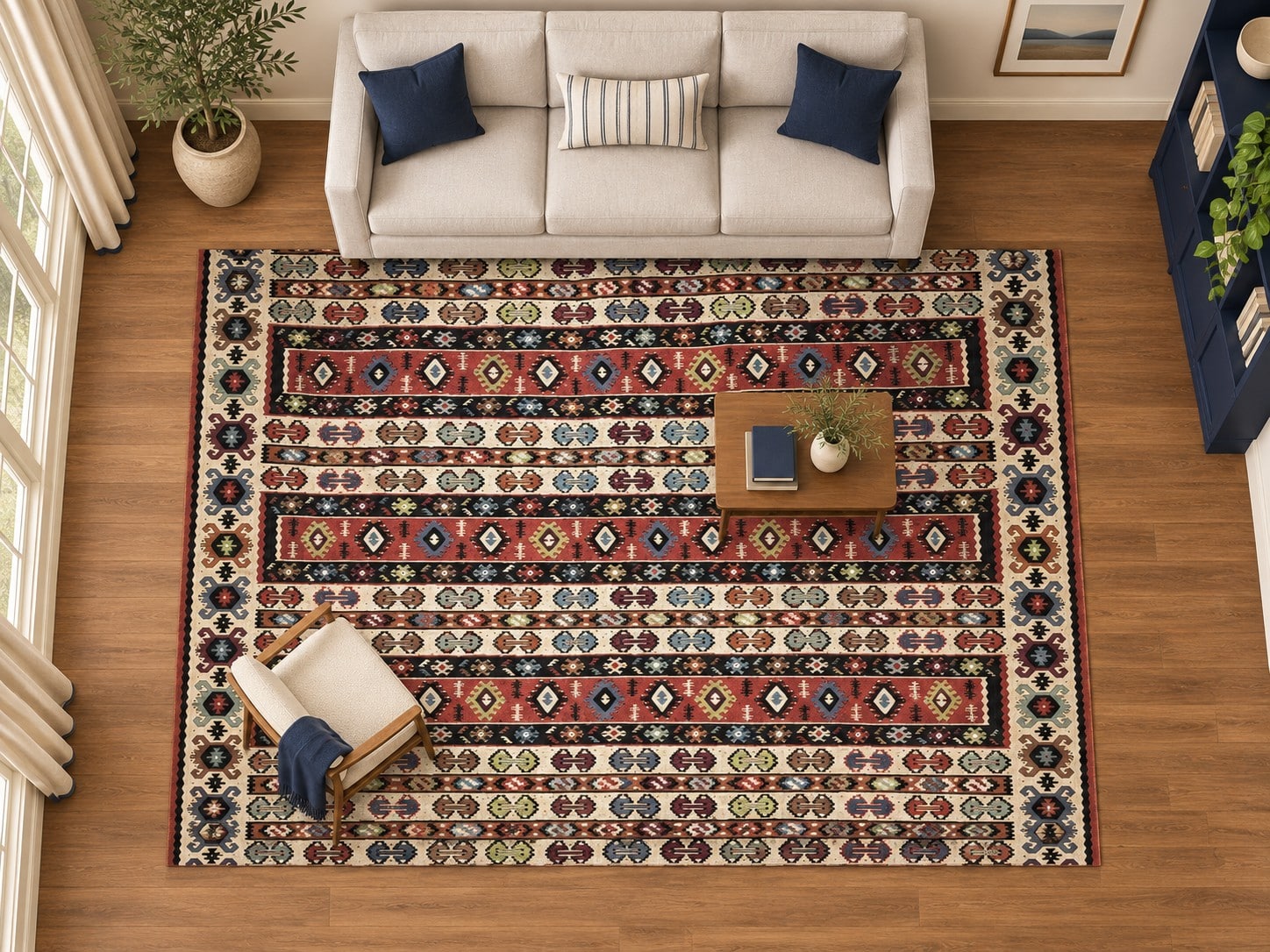
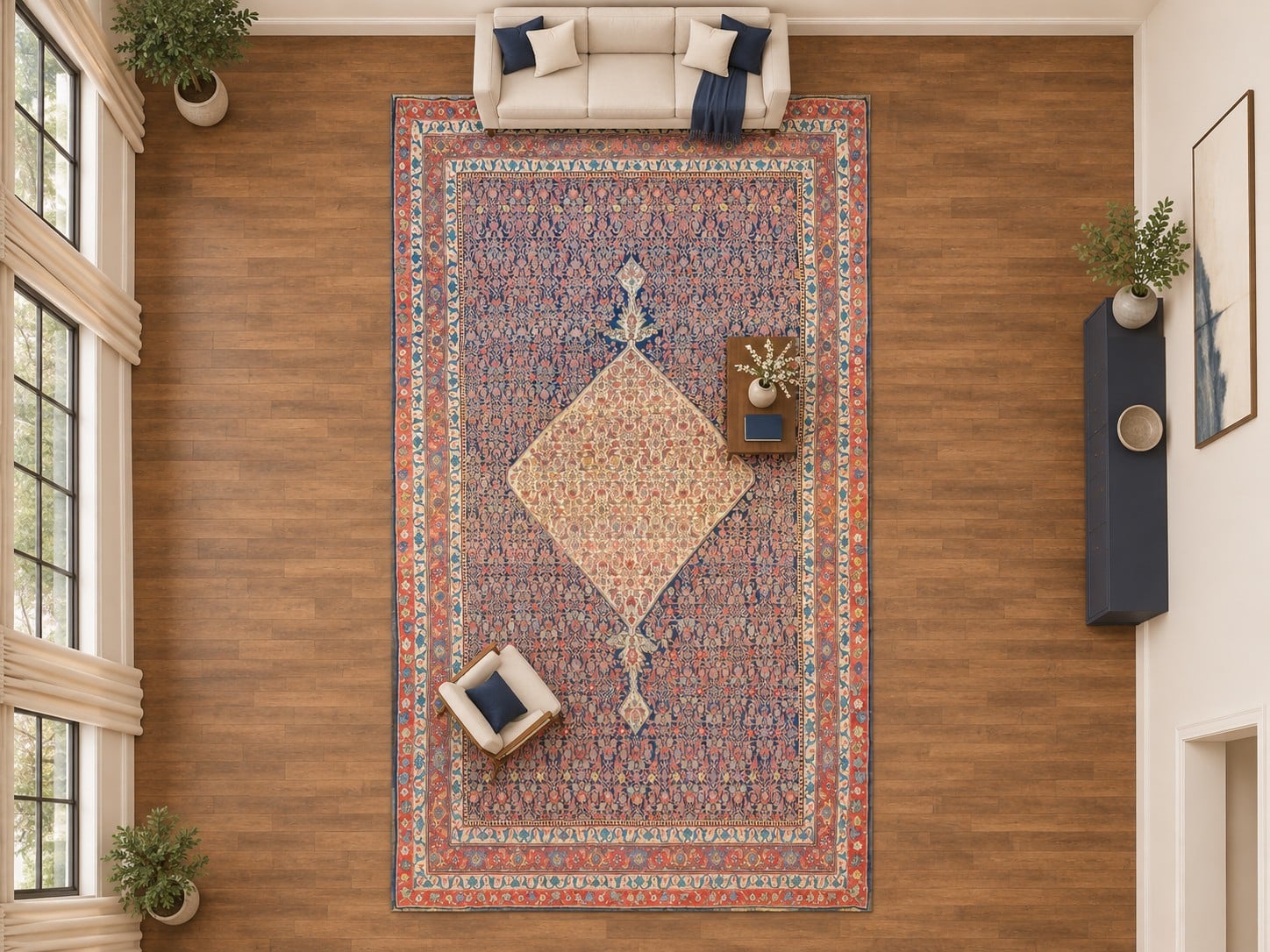
AI ROOM-STYLING CONCEPT · Based on the original catalog reference and title-stated proportions. Approximate visualization, not a real installation, exact reproduction, inscription evidence or measured fit. The schematic gives the stated proportions separately.
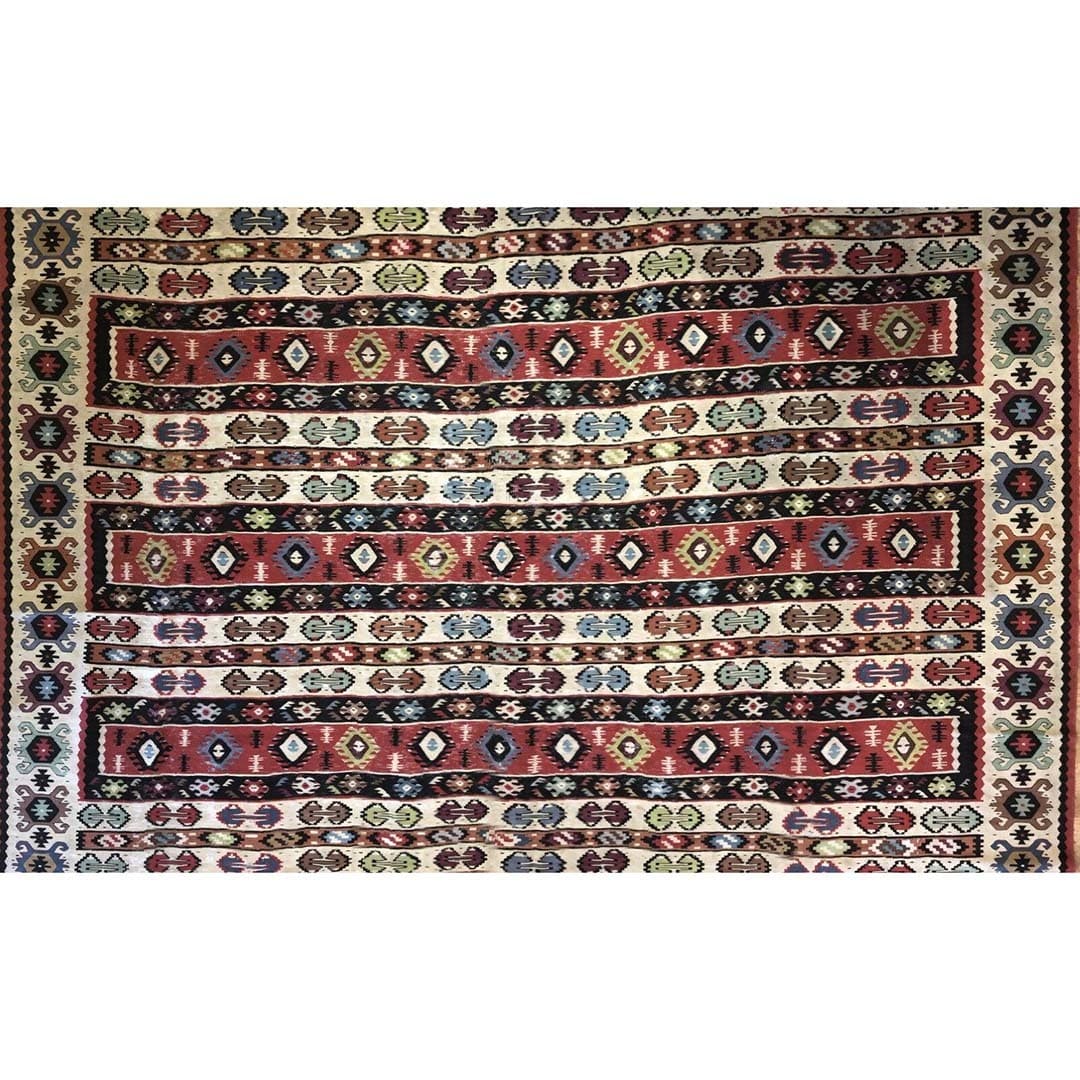
Smaller view: original catalog photograph. Both images link to the exact product.
Seller-labelled Turkish kilim / flatweave
Beautiful Bessarabian - 1910s Antique Turkish Kilim - Flatweave Rug - 8' x 11' ft
The catalog names a 1910s antique Turkish kilim flatweave at 8′ × 11′. The reference photograph shows horizontal patterned bands and a framing border. The title is the seller’s attribution, not independent verification of age or weaving country.
The chair question
Ask for close views of the actual weave, all edges and any joins or repairs. Explain the chair path and request an assessment of whether this particular antique textile should receive that use.
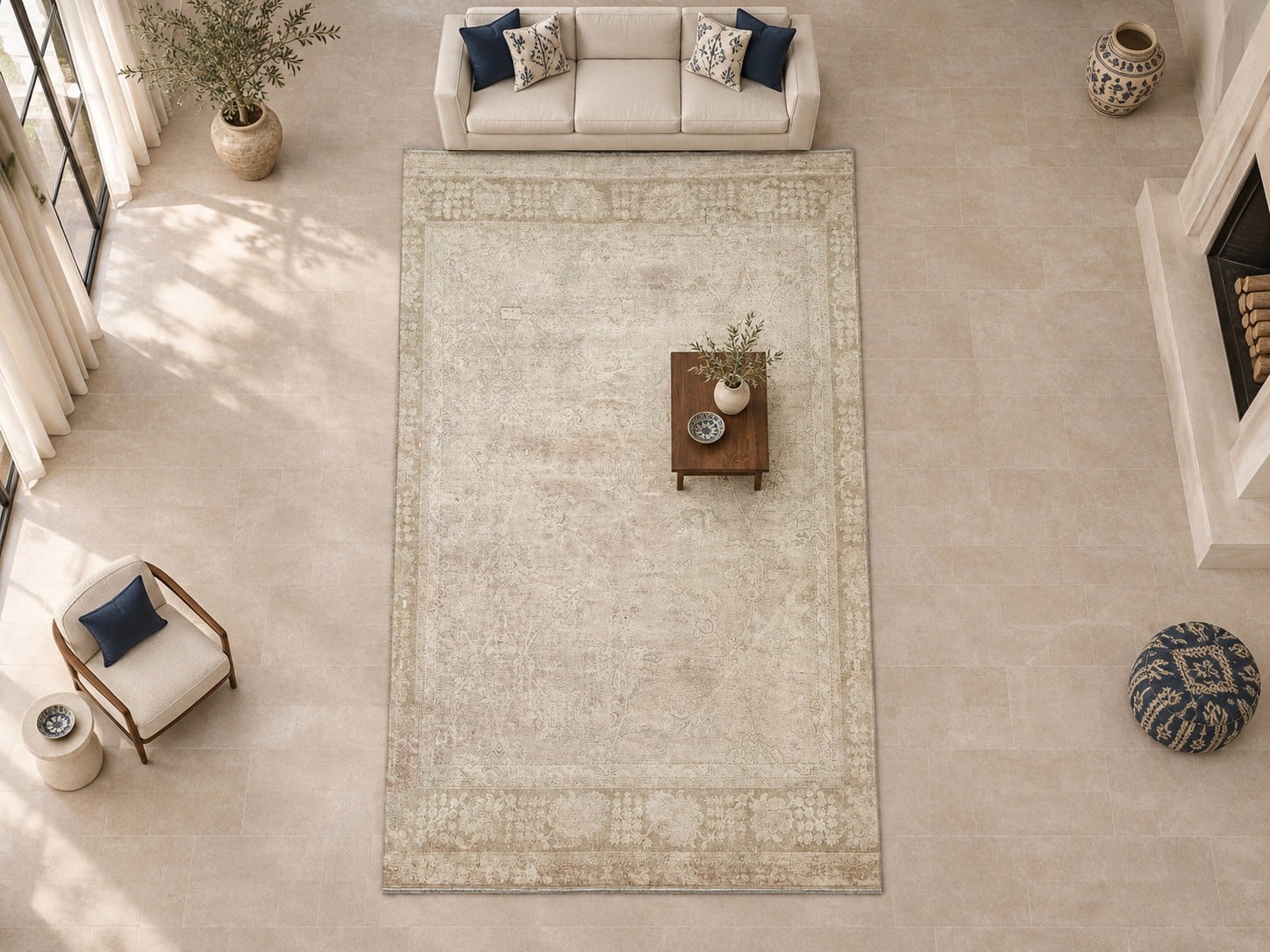
AI ROOM-STYLING CONCEPT · Based on the original catalog reference and title-stated proportions. Approximate visualization, not a real installation, exact reproduction, inscription evidence or measured fit. The schematic gives the stated proportions separately.
Smaller view: original catalog photograph. Both images link to the exact product.
Seller-labelled Turkish hand-knotted Oushak
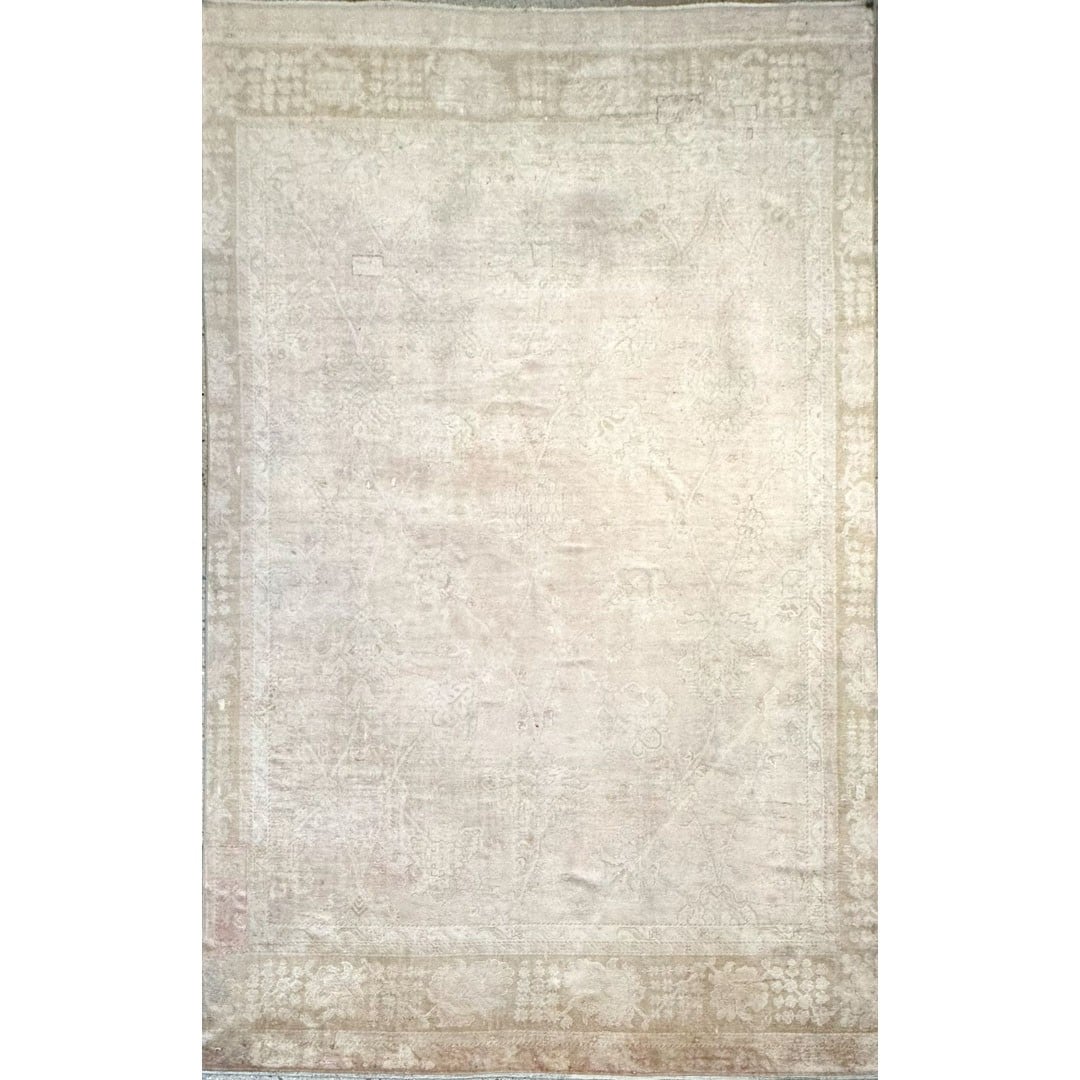
Authentic Anatolian – Antique Hand-Knotted Turkish Oushak Rug – 10’ x 16’4″ ft.
The catalog explicitly names an antique hand-knotted Turkish Oushak at 10′ × 16′4″. The original view has a pale field and subtle border. That quiet appearance does not reveal pile height, foundation stability or resistance to chair movement.
The chair question
Request the actual surface profile, reverse and edge condition. Confirm the measured footprint separately and ask about the proposed pad and chair feet rather than treating “hand-knotted” as a performance rating.
AI ROOM-STYLING CONCEPT · Based on the original catalog reference and title-stated proportions. Approximate visualization, not a real installation, exact reproduction, inscription evidence or measured fit. The schematic gives the stated proportions separately.
Smaller view: original catalog photograph. Both images link to the exact product.
A Persian alternative to assess separately
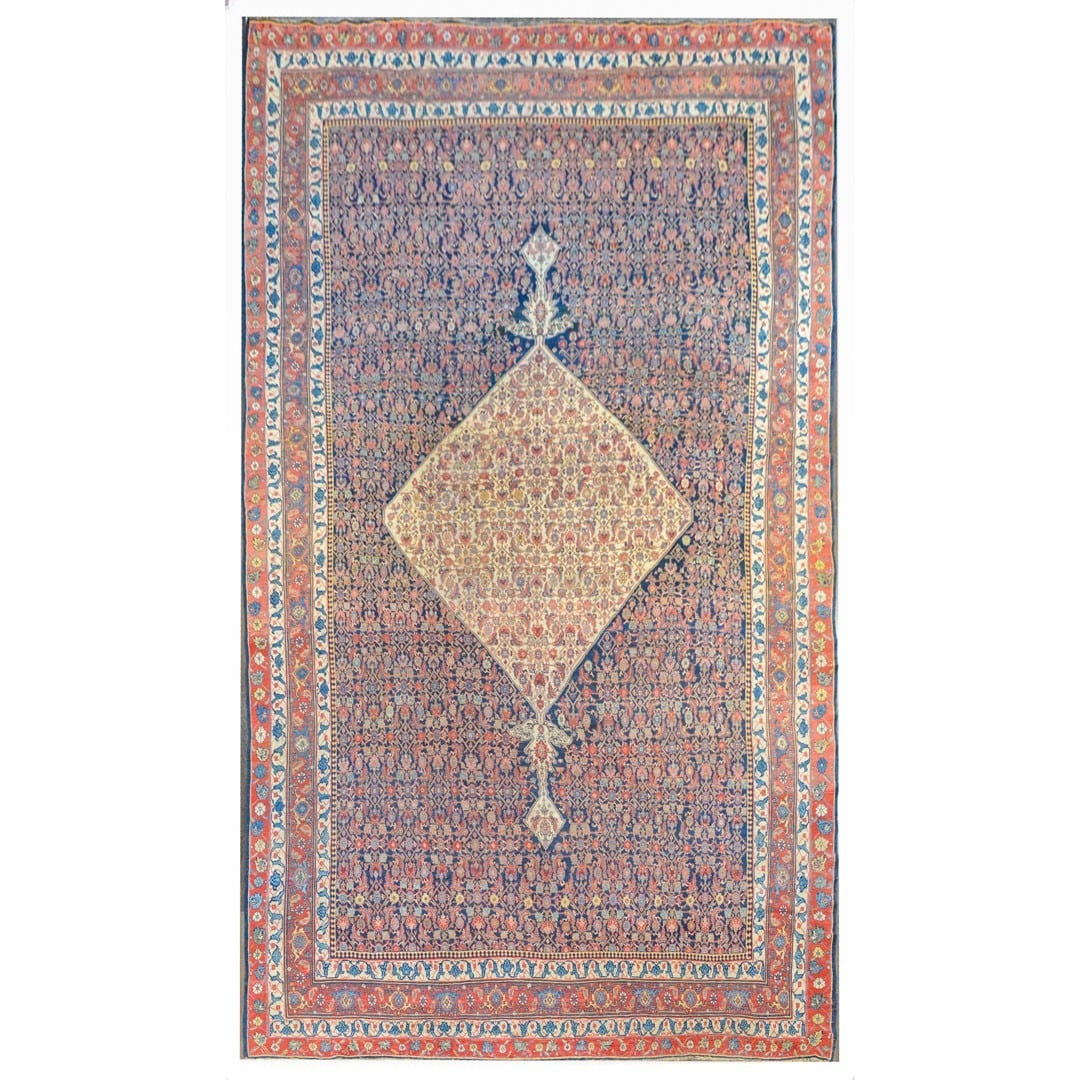
Lovely Large – 1880s Antique Persian Garous Bijar Rug – 12’6″ x 21’6″ ft.
The catalog identifies an 1880s antique Persian Garous Bijar at 12′6″ × 21′6″. The photograph shows a large central diamond surrounded by a dense patterned field. Its much larger stated footprint needs its own room plan.
The chair question
Ask the seller to confirm construction and current condition, then discuss whether repeated chair movement is appropriate at all. “Bijar” or “Persian” is not used here as a promise of exceptional strength or suitability.
01 / WOVEN SURFACE
Kilim: read the weave.
In a flatweave, the woven structure forms the surface rather than a separate layer of knotted pile. “Kilim” does not establish one fiber, thickness or finishing method. The Metropolitan Museum of Art records a kilim with slit-tapestry weaving and brocaded details; its description notes that the added work creates differences in relief.
That museum object is attributed to Syria, not Turkey. It illustrates why a construction term and a geographic attribution must remain separate. For the exact Turkish example you are considering, request clear surface, reverse and edge photographs and a written construction description.
02 / KNOTTED SURFACE
Pile: read the profile.
A knotted-pile carpet has pile formed by knotted yarns on its woven foundation. The Met identifies its historical Medallion Ushak carpet as wool warp, weft and pile with symmetrically knotted pile. The museum classification explains the structure; it does not authenticate a retail rug.
“Hand-knotted” still does not supply a measured pile height, backing stiffness or chair-glide result. Ask for the actual profile and present condition of the piece. A worn section, repaired area or different edge finish deserves its own photograph instead of being inferred from the front view.
THE DECISION GRID
Compare what the chair meets.
| Check | Kilim / flatweave question | Knotted-pile question | Confirm for either |
|---|---|---|---|
| Surface | Are there raised woven details, open joins or loose yarns along the chair path? | What is the actual pile profile, and are there worn or repaired areas in that path? | Current close-ups and the seller’s description; a label is not a test. |
| Perimeter crossing | Does a chair foot meet a flexible edge, fold or fringe? | Does the foot encounter a change in level at the bound edge or fringe? | Where every foot is when seated and when the chair is pulled out. |
| Movement | Does the specific piece shift or gather with the intended pad? | Does the specific piece shift, gather or resist the chair’s movement? | The actual rug, compatible pad, floor and chair together. |
| Chair feet | Could a rough foot or unsuitable glide catch exposed yarn? | Could a rough foot or unsuitable glide catch or rub the pile? | Foot shape, finish and any protective fitting approved for the chair and floor. |
| Condition | Are joins, ends and edges secure enough for the proposed use? | Are pile, foundation, ends and repairs appropriate for the proposed use? | Qualified assessment for fragile, valuable or uncertain textiles. |
These are inspection questions, not measured performance results. The two constructions are not ranked for durability, safety or ease of movement.
A
Map the
chair path.
Measure the area occupied by the table and chairs in the positions you actually use. Record the seated position, the pulled-out position needed to stand, and any route a chair takes away from the table. Mark the rug boundary on your own floor plan. A photograph of an attractive dining room cannot establish those clearances.
Check all four feet throughout that movement. A rear foot can cross an edge while the front feet remain on the textile. If the setup changes level during the movement, pause and reconsider the footprint or placement with the seller rather than assuming the chair will clear it. There is no single extra-inch rule in this article.
Keep the fringe outside the proposed movement path where practical. Do not trim it, glue an edge down or alter an antique textile to make a layout work. A different rug or a different placement may be the more suitable choice.
B
Check the
whole setup.
Write down the chair type, floor finish and intended pad before requesting advice. Ask the pad supplier and flooring manufacturer about compatibility, and ask the rug seller about the textile. A pad description on its own is not proof that the finished arrangement will stay stable or allow easy chair movement.
The Canadian Conservation Institute identifies repeated chair movement as a source of rug wear, advises lifting furniture when repositioning it, and describes underlay as protection against uneven floors and furniture loading. These are conservation principles, not a guarantee that any particular retail pad or antique rug is suitable under a dining chair.
For a robust piece whose seller has agreed that a practical check is appropriate, observe ordinary chair movement in the intended setup without forcing or repeatedly dragging a snagging foot. Stop if the textile catches, shifts, folds or develops a raised edge. A fragile or valuable antique should be assessed before any such use check. Do not turn a concern into a repeated stress test.
Shop the question, not the label.
When browsing turkish rugs for sale, save the exact stock number and ask separately about origin, construction and the proposed use. A Turkish-style design, a Turkish weaving attribution and a knotted structure answer different questions.
You can include persian rugs for sale in the same shortlist, using the same chair-path and condition checklist. Do not relax those checks because a regional name sounds reassuring. For the broader photo request, use our guide to buying an antique rug online; for room planning, see the dining-room rug collection and planning page.
A useful seller message: “I am considering this exact rug under chairs moved daily. Please confirm construction, measured dimensions, present edge and repair condition, and whether you recommend that use with my chair, pad and floor setup.”
Questions before the chair moves
Is a kilim always easier to use under dining chairs?
No. Flatwoven construction alone does not establish how the particular rug, edge, pad, chair feet and floor interact. Ask about the exact piece and layout.
Does knotted pile mean a thick rug?
No measured thickness follows from the label alone. Request the actual pile and overall profile of the rug under consideration.
Can I judge chair glide from a room photograph?
No. A room view can suggest styling, but it cannot demonstrate stability, chair-foot movement, scale or clearance. The generated concepts here are explicitly not tests.
Should I repeatedly pull a chair over a catching edge to flatten it?
No. Stop when catching or bunching appears. Reassess the layout and condition with the seller or a qualified textile specialist rather than forcing the movement.
Is an antique rug automatically unsuitable under chairs?
Age alone is not the complete assessment, but condition and conservation priorities matter. Some pieces may deserve a less demanding placement. Seek advice for the actual textile before use.
Will any non-slip pad solve the problem?
No universal claim is made. Confirm compatibility with the rug and floor, and assess the complete arrangement. A pad cannot establish that a fragile edge is suitable for repeated chair movement.