

Rouzati Journal / The Pattern Studio
Pairing Small Persian Rugs With Retro Tiles
Let the tile show. Give the rug a clear place to land.
The design brief
Start with the floor.
Let one pattern lead.
The quick answer
Give one surface the lead
Start by deciding which pattern should catch your eye first. If the floor is a bold checkerboard or a dense floral repeat, try a small Persian rug with a quieter field or one broad motif. If the tile has a softer, more even rhythm, a stronger rug border or a crisp medallion can provide the focal point.
Leave enough tile exposed to read the pattern from the doorway, and borrow a single color from the floor: the cream in the squares, the blue in a small flower, or the brown in a border. In a compact space, one connection often does more than an exact color match.
01 / READ THE FLOOR
Find the repeat before you choose the rug
Stand just outside the room and notice what reads first: a graphic grid, a repeated flower, the fine texture of a mosaic, or a border around the edges. Take a photo from that spot. The pattern you see from there matters more for the pairing than the detail you notice while holding a sample in your hand.
Measure one complete repeat, rather than assuming one tile is one motif. A star can span four tiles; the repeat in a checkerboard includes both colors. Mark the repeat in your photo and look for existing tile borders, a change in grout direction, or a centered floor panel. Those details can organize where a rug belongs.
The National Park Service’s brief on historic ceramic tile floors documents geometric borders, ceramic mosaics and printed or inlaid designs. Here, retro tile describes the look. You can style an original floor or a reproduction by its visible pattern without trying to identify how the tile was made from a photo.
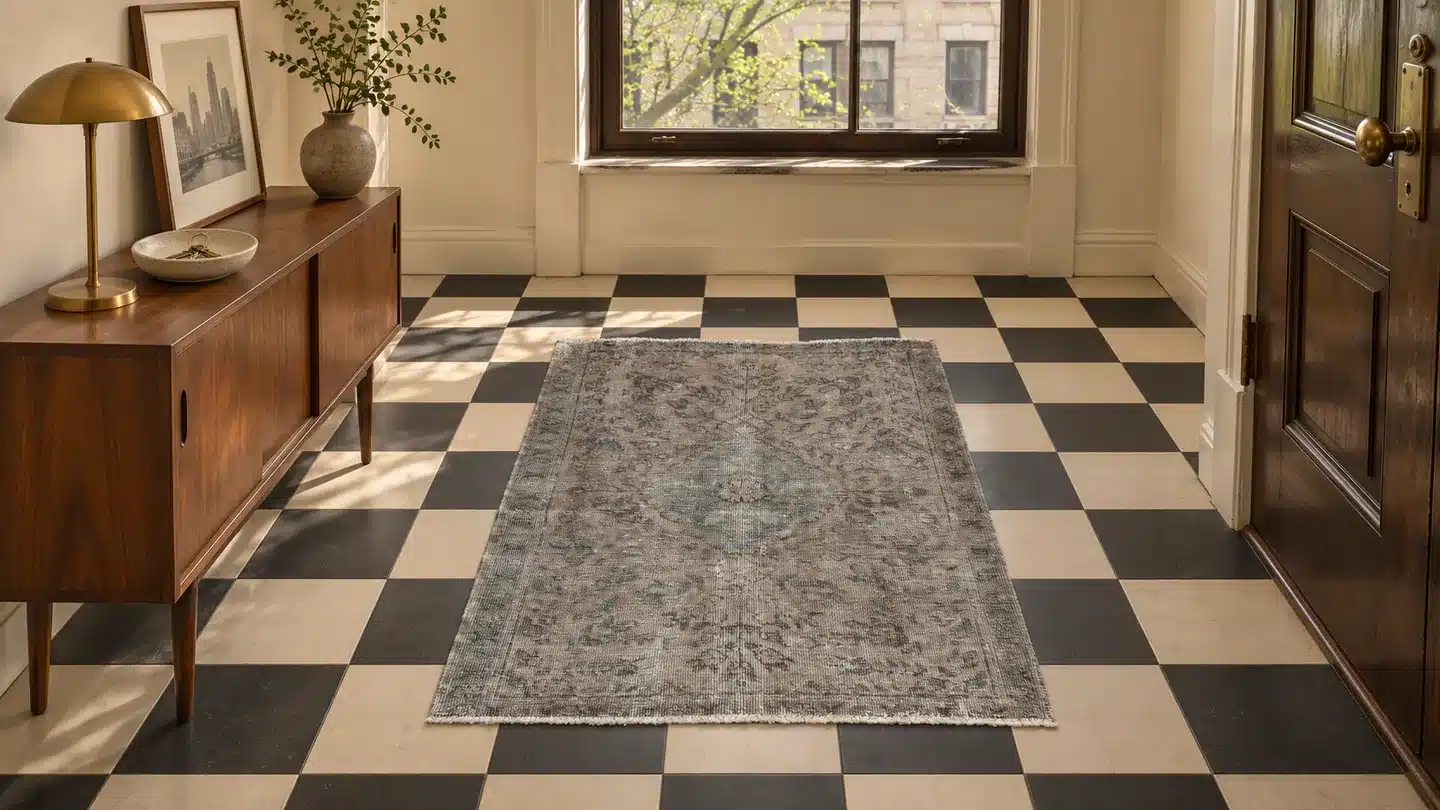
AI ROOM-STYLING CONCEPT · Inspired by this rug’s original catalog photograph; tile and room are illustrative. See the original below for the product’s actual design.
Pairing 01 / Let the checkerboard lead
Delightfully Distressed - Vintage Persian Malayer Rug - 3' x 4'2" ft.
CATALOG SKU 105731 · 36 × 50 inches
Why this works: At 3′ × 4′2″, the Malayer is an accent, not a floor covering. Its softened taupe and gray-blue field lets the black-and-cream grid take the lead. Fine floral details appear up close without competing with the checks from the doorway.
What to test: Leave both tile colors visible near the rug edges, then check whether its muted border separates clearly enough from the darker squares in your own light.
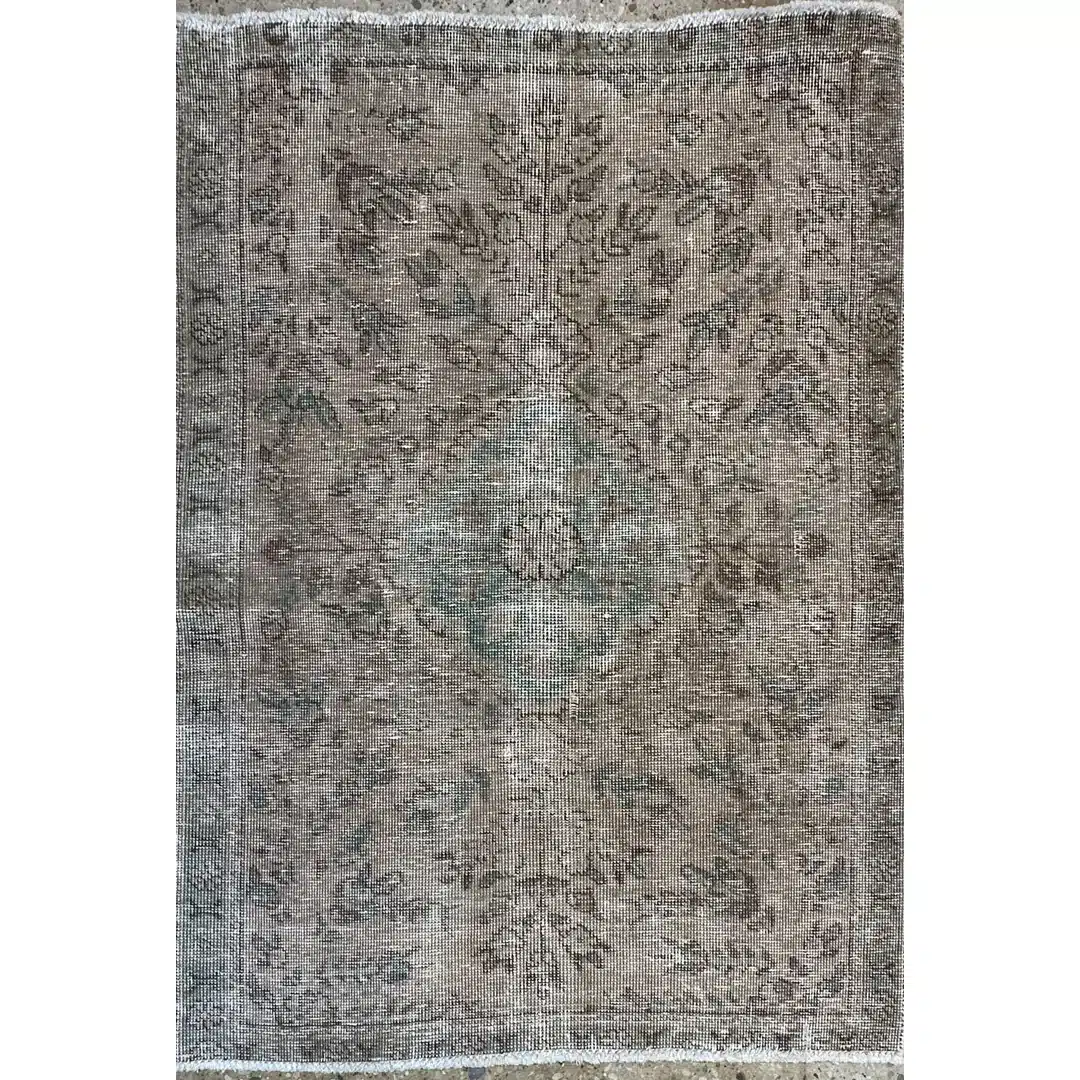
Original catalog photograph · Check color and details on the product listing.
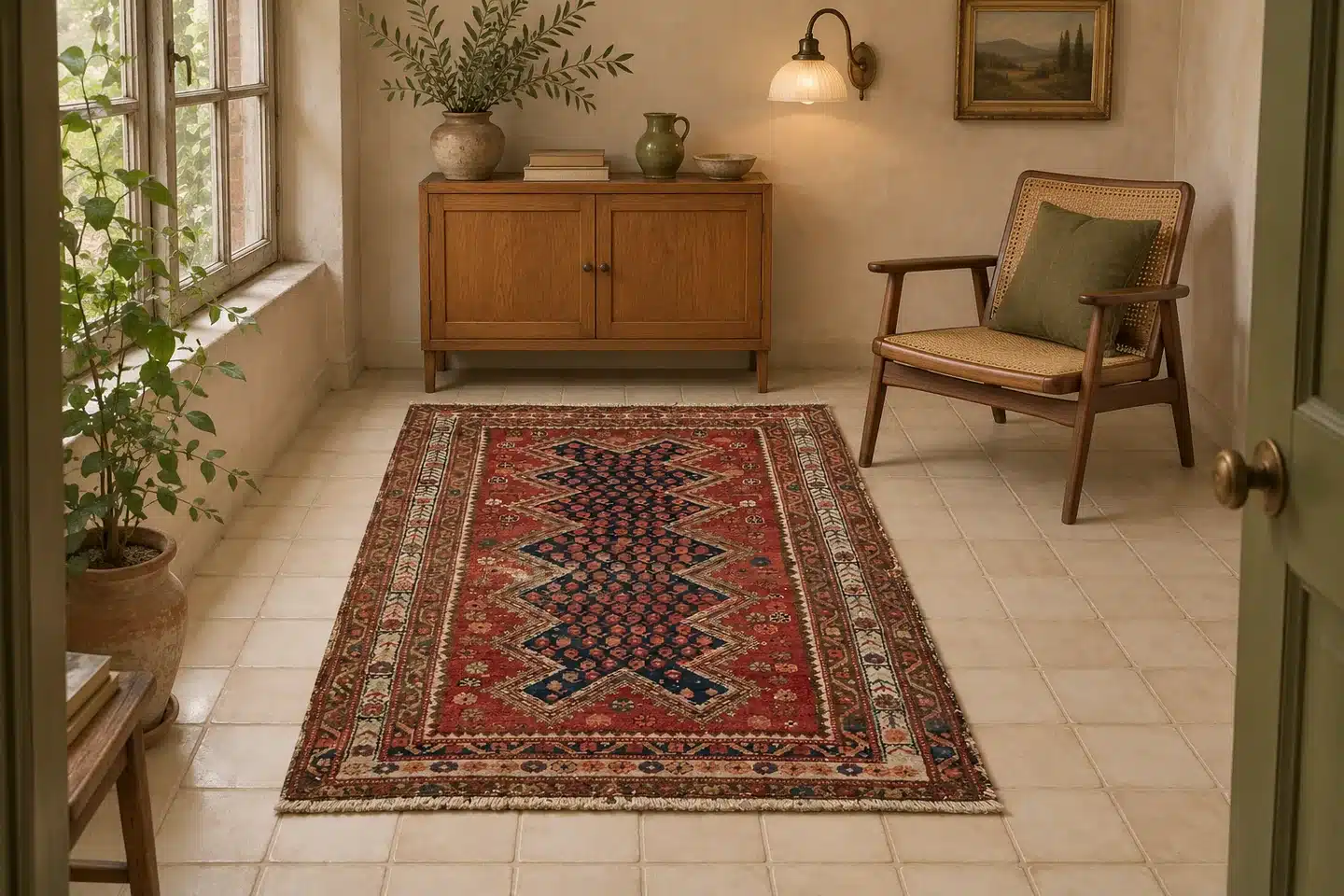
AI ROOM-STYLING CONCEPT · Inspired by this rug’s original catalog photograph; tile and room are illustrative. See the original below for the product’s actual design.
Pairing 02 / Let the geometry of the rug lead
High-Contrast Hamadan - Antique Persian Hamadan Area Rug – 4'1" x 6'0" ft.
CATALOG SKU 104566 · 49 × 72 inches
Why this works: This 4′1″ × 6′0″ Hamadan has a deep ink center with linked angular forms on a rust-red field. Quiet cream squares and subdued grout give the center spine and detailed edge space to read as one composition.
What to test: Borrow a small warm cream note from the rug border. Use the actual width of the floor panel and the door swing to decide whether the full border will stay visible.
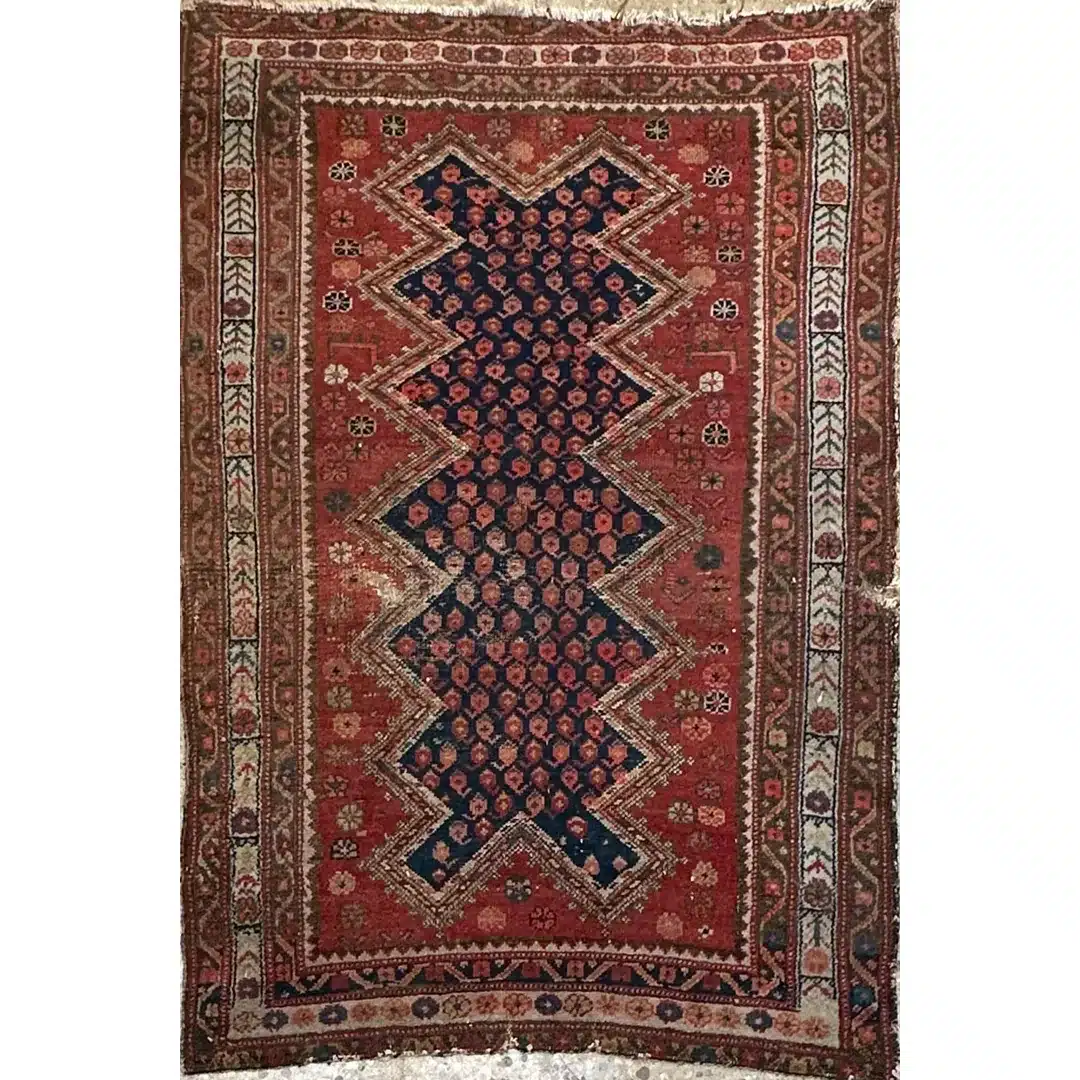
Original catalog photograph · Check color and details on the product listing.
The pairing matrix
Match the rug to what the floor does
| Retro tile | Rug direction to try | What to keep visible |
|---|---|---|
| Large, high-contrast checkerboard | A faded rust or olive field, or a single broad motif with soft outlines. | Enough of both tile colors to read the checks. A dark edge can disappear against the dark squares, so judge the seam from the doorway. |
| Small floral or star pattern | A broader medallion, an open field or a subdued border. Echo one secondary tile color. | An uninterrupted run of the grout grid or one complete tile repeat where the room allows it. |
| Small, nearly monochrome mosaic | A more defined border or stronger contrast in the rug if the mosaic reads as texture. | The mosaic texture at one or both sides and any intentional inlaid detail. |
| Floor with a contrasting decorative border | A compact rectangle or runner that sits inside the existing design when practical. | The border, especially where it turns a corner. If the rug overlaps it awkwardly, try a smaller footprint or shift to a separate spot. |
02 / SET THE PATTERN HIERARCHY
Change the scale or the contrast
When both surfaces have a tight, high-contrast repeat, the eye has little room to rest. Give one pattern a different job. Try a broad rug motif over small patterned tiles, or a softly colored rug over big graphic squares. A restrained tonal rug lets smaller details disappear at room distance, while a single larger medallion can separate itself from a compact tile repeat even when it contains decorative detail.
On black-and-cream checks: a rug with a softened rust, olive or terracotta field can bring warmth while the checks keep their structure. Pick up cream in the rug’s border or faded drawing. Turn the rug so its edges sit parallel to a clear architectural line, then look at the exposed checks: are they readable, or reduced to thin fragments?
On a star or floral floor: compare how much space falls between motifs. A broad center or an open field can contrast with a small repeat. When a medallion falls under the bench or chair you plan to use, judge the rug by the border and field that will remain visible.
03 / LINK ONE COLOR
Match the undertone in the room’s real light
Set a tile sample or a clear photo beside the rug’s overall and close-up pictures. Pull one supporting shade from the floor and find an echo in the textile. The colors do not need to be equal in strength. A small amount of warm ivory in a rug can tie it to a checkerboard without flattening the difference between tile and wool.
Try the comparison in daylight and after dark. Amber lighting can shift how a cream grout line reads; a rug’s pile may also make its colors look different from opposite sides of the room. If a pairing looks too strong from the doorway but works from the seating area, turn the rug 180 degrees and reassess before deciding. Our guide to how pile direction changes rug color explains what to look for.
Skip repeating every hue around the room. If the tiles are green and ivory and the rug answers with a faded ivory border, let that be enough; one wood tone or a plain bench can give the floor a quiet edge.
04 / TEST THE FIT
Measure the tile you want to leave in view
Map the rug’s job first. An accent rug beside a bench defines a stopping point; a runner frames a long route. Measure the clear space at its narrowest point, including doorways, baseboards, furniture legs, and changes in the floor. Compare that with the rug’s actual width and length, checking whether the listed dimensions include fringe. Our room-by-room rug shape guide is useful when deciding between an accent rectangle and a runner.
For example, a centered rug that is 34 inches wide on a 58-inch-wide section of tile leaves 12 inches on each side: (58 − 34) ÷ 2. That does not mean 12 inches is the right border for every room. If you want to show a complete tile repeat, compare those 12 inches with the repeat you measured. If the floor has a decorative frame, try aligning with that frame instead of the midpoint between the walls.
Lay out paper cut to size for a brief visual test, then remove it before walking through the area. Open the nearest doors, check the space under the lowest edge for the rug and pad together, and look at how the rug ends near any threshold. Do not force the rug to fit a tile line if doing so puts an edge in an awkward transition.
05 / KEEP THE ROUTE CLEAR
Check movement before you call the pairing finished
If the rug shifts, wrinkles, or has an edge that lifts, take it out of the walking route until the issue is resolved. Choose a pad whose maker confirms compatibility with both the rug and the specific tile or finish; do not assume that every rubber backing or adhesive is suitable for a historic, porous, sealed, or unusually delicate surface. With a sensitive floor or a valuable rug, ask a conservator or rug specialist before applying anything that sticks to either surface.
Use decorative rugs where the floor stays dry. A textile at a rain-prone entrance or right by a sink needs a different plan from an accent under a sheltered bench; if water regularly reaches the spot, move the Persian rug back to the dry side. CDC’s home fall-prevention guidance identifies loose throw rugs as a hazard. Where a rug would interfere with a mobility aid or there is a higher risk of falling, leave the route bare. If one corner lifts, see what to check when rug corners curl.
06 / SHOP WITH A SHORTLIST
Bring a floor photo, three measurements, and one color
Compare a full rug photograph with the view from your doorway. Write down three measurements before you browse: the available width, the available length, and the tile’s repeat. Add the shade you want to pick up. This keeps your attention on how the rug will work in the room, even when a striking product shot tempts you away from the plan.
Start with our persian rugs for sale and filter your choices by actual dimensions and the way the field reads from a few feet away. If you want to compare a different pattern rhythm, look through the turkish rugs for sale as a separate collection. To discuss sizes and see oriental rugs in Chicago, bring along the room photo and your dimensions. The right pairing is one where the floor still looks intentional from the doorway and the rug is useful where you put it.
Questions from the showroom floor
Small Persian rugs on retro tile: FAQ
Can a Persian rug go over a patterned tile floor?
Yes, if the two patterns play different roles. Look for a change in scale, fewer strong contrasts in one surface, or one shared color. Start by comparing the pairing from the doorway; close-ups can make both patterns look busier than they do in use.
How much tile should show around a small rug?
There is no universal margin. If showing the floor design matters to you, aim to leave a complete repeat or a visible strip of the original border where the layout allows. Door clearance and the walking route come before visual symmetry.
Do I need to match the rug precisely to the tile color?
No. One related tone is usually enough: a warm ivory can connect to a cream square, and soft rust in a border can answer a terracotta tile. Look at the pair in your own light before judging the undertone.
Can I use a vintage Persian rug in a tiled kitchen or entry?
A dry, stable area away from repeated spills may work. Measure door swing and the combined rug-and-pad thickness, use a pad approved for both surfaces, and remove the rug if it shifts or catches. Choose a sheltered spot if the entry regularly gets wet.
Should the rug be centered on the floor or on the furniture?
Start with the rug’s role. Align an accent rug with the bench or console it serves. If the tile has a framed field, check whether centering within that frame shows the pattern more clearly. Use the view from the doorway as the final test.
Before choosing, mark the outline on the floor
Compare the proposed footprint from the doorway and the main walking route. If the floor already frames itself, leave that frame visible. Choose a rug you like from both viewpoints and confirm the actual dimensions of the exact piece.