

THE RUG
COMPARISON
FILE / 06
ROUZATI JOURNAL
Oushak
or Heriz?
Comparing pattern scale, borders and room fit.
Two names can narrow a search. Two actual rugs can lead you to a decision. Start with the visible pattern and the space it will occupy.
THE SHORT ANSWER
Compare the rug, then the label.
For an Oushak vs Heriz rugs shortlist, compare the size of the main motifs, the visual weight of the border and the amount of field you can actually see. Neither name alone tells you which rug will fit your room, feel quieter or perform better. This comparison uses two specific Rouzati catalog photographs; it is not a rulebook for every rug carrying either name.
Separate design, origin and condition. A design name can describe inspiration. The seller’s origin statement, construction details and condition record are separate pieces of information.
EXHIBITS A + B / ORIGINAL CATALOG PHOTOGRAPHS
Look at the whole composition.
The photographs below are presented as individual catalog views, not to a shared physical scale. White margins, cropping and image dimensions can change apparent proportions. The listing measurements are seller statements, not measurements made for this article.
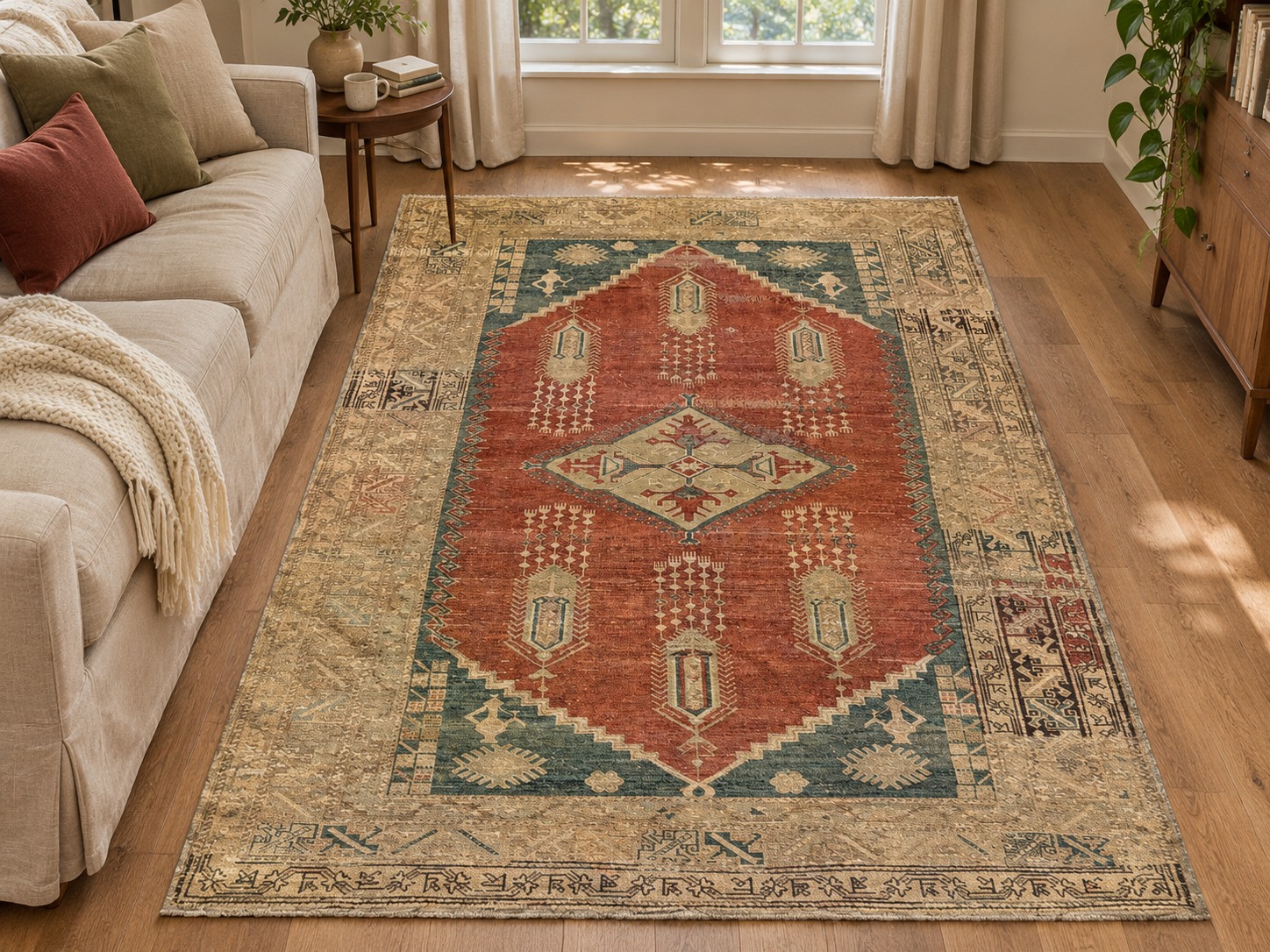
ROOM STYLING CONCEPT
AI-generated from this rug’s catalog reference. Not a real installation, exact reproduction or proof of scale, fit or condition.
ORIGINAL CATALOG REFERENCE · Click either view for this exact product.
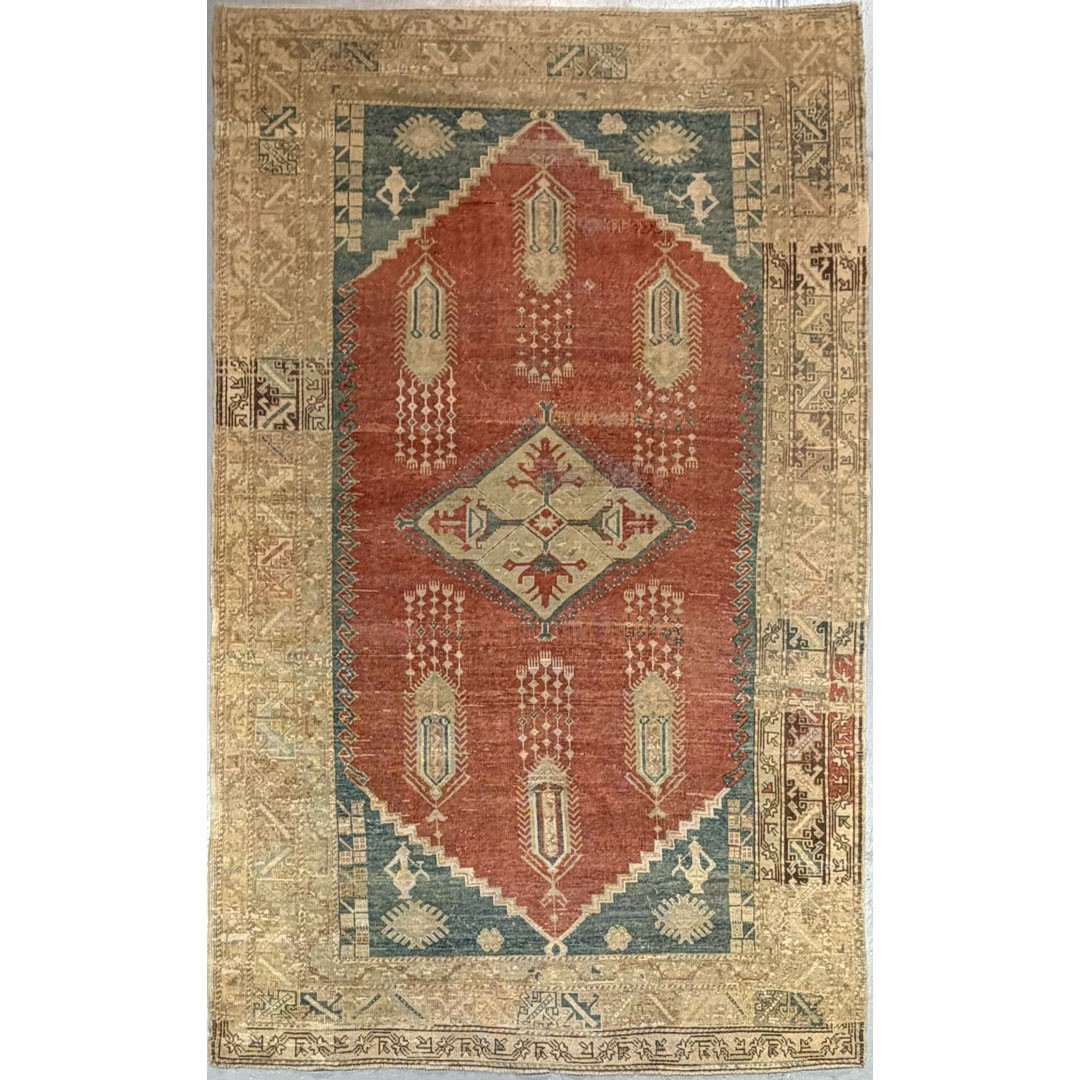
A / ANATOLIAN OUSHAK
Rustic Radiance
The catalog describes a vintage Anatolian Oushak area rug at 5′7″ × 9′0″. Treat that as the seller’s attribution and stated dimensions; the name does not independently authenticate the piece.
In the original catalog photograph, a small pale diamond sits within a much larger red, stepped outline. Widely separated hanging motifs leave comparatively open red intervals. A tan patterned border surrounds the darker corner areas. The central diamond is not the entire visual center: the larger red shape matters too.
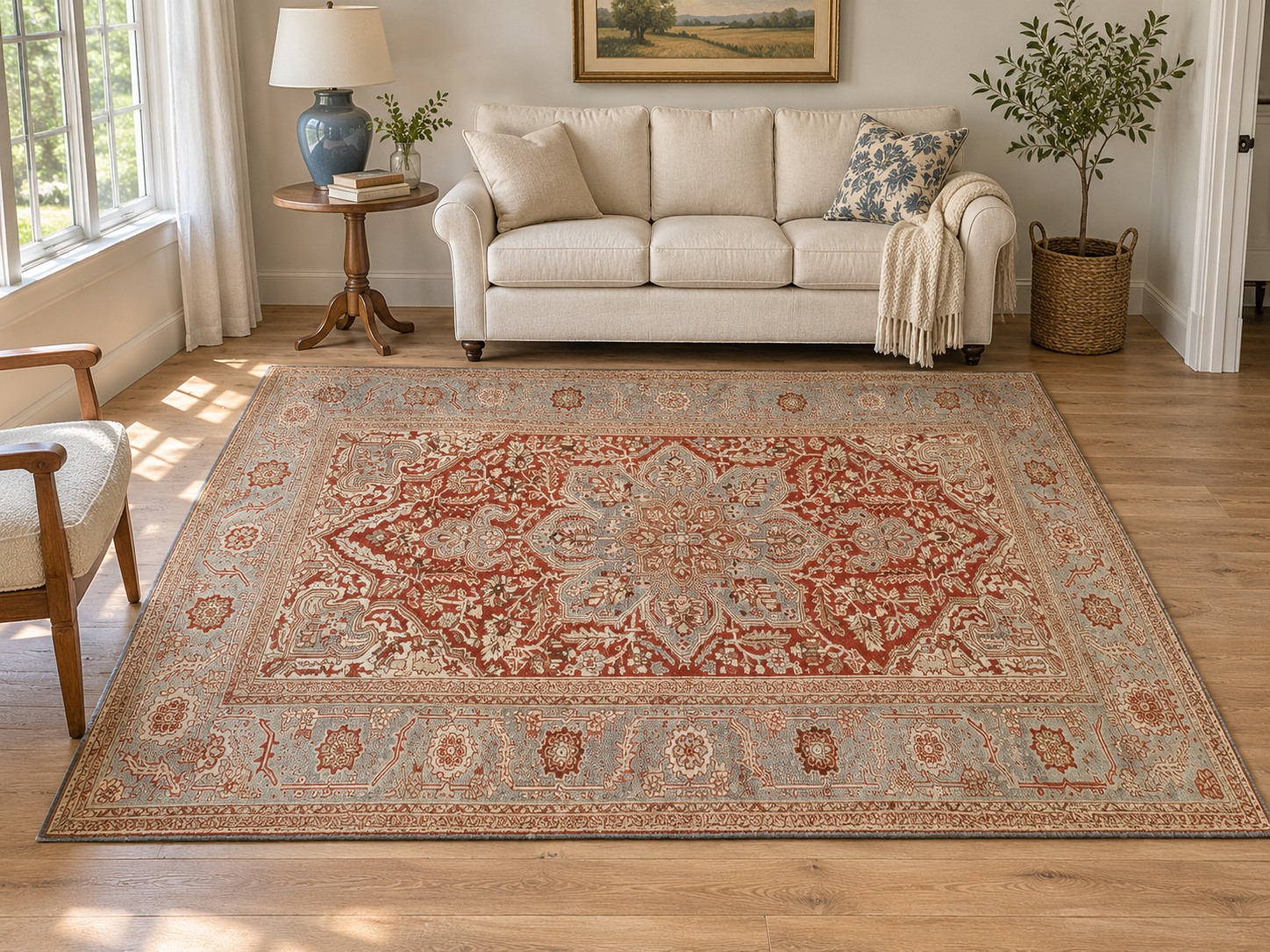
ROOM STYLING CONCEPT
AI-generated from this rug’s catalog reference. Not a real installation, exact reproduction or proof of scale, fit or condition.
ORIGINAL CATALOG REFERENCE · Click either view for this exact product.
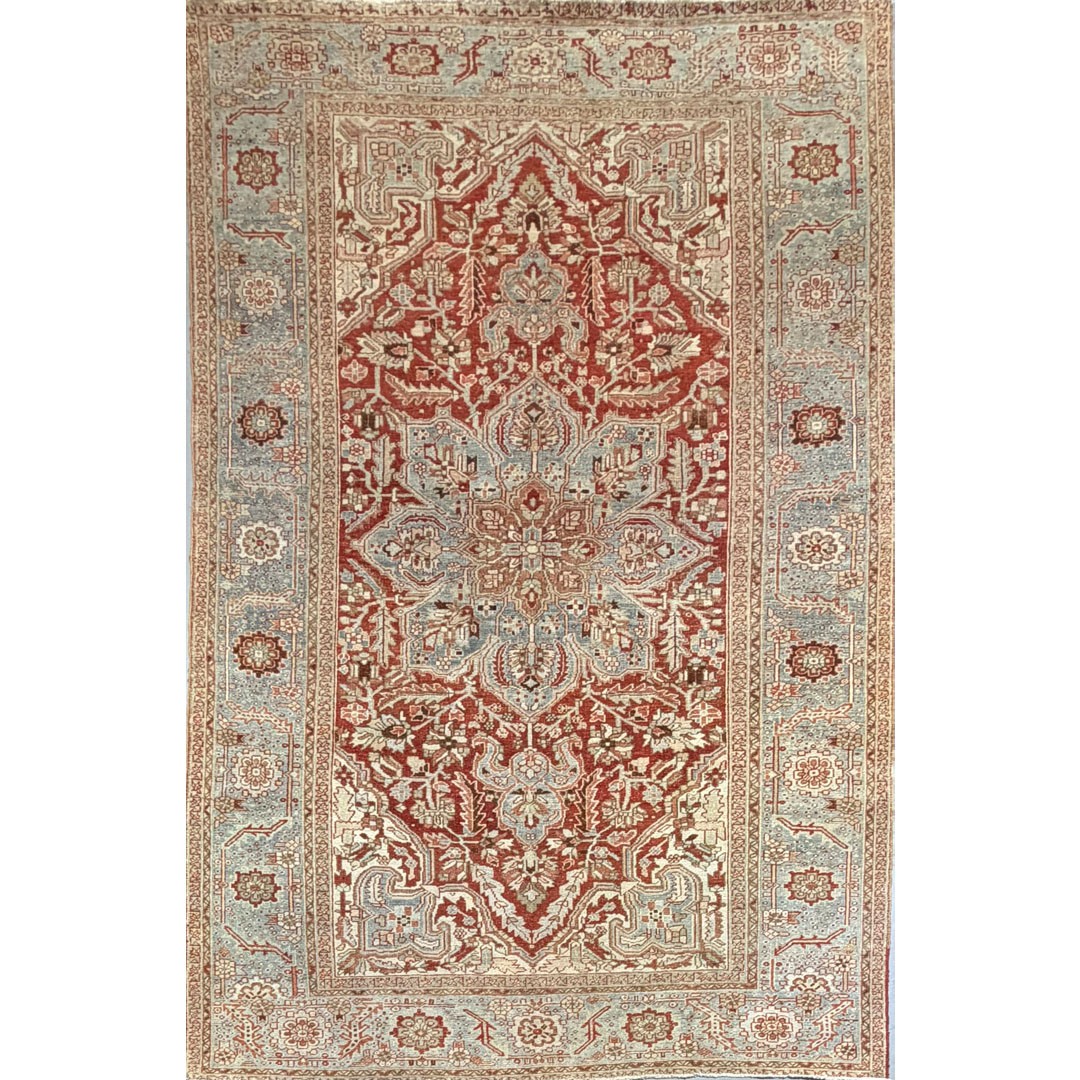
B / PERSIAN HERIZ
Heritage Heriz
The catalog describes an antique Persian wool rug at 8′1″ × 11′9″. The attribution, age description and dimensions are catalog statements; this article does not establish them independently.
In the original catalog photograph, the pale, lobed central medallion branches into angular floral forms across the red field. More small motifs occupy the spaces around it. The pale blue-gray border is a strong enclosing band with repeated red-and-cream ornament. Notice the relationship between that band and the central field rather than reducing the rug to its red color.
A side-by-side reading
| Decision point | Rustic Radiance / A | Heritage Heriz / B | What to check in your room |
|---|---|---|---|
| Dominant shape | A small diamond within a larger stepped red shape. | A larger pale medallion with branching angular forms. | Decide whether you want a single obvious center or a broader shape to organize the floor. |
| Pattern spacing | More visible red intervals between the hanging motifs. | More small motifs surrounding the central structure. | Look from the room entrance as well as from a nearby seat. |
| Border presence | Tan patterned framing with darker corner areas inside it. | A pale blue-gray enclosing band with repeated ornament. | Check how much of the border will remain exposed around furniture. |
| Catalog footprint | 5′7″ × 9′0″; seller-stated. | 8′1″ × 11′9″; seller-stated. | Compare confirmed body dimensions with your own plan, not the photo boxes. |
| Evidence still needed | Current dimensions, condition views, material and construction details. | Current dimensions, condition views, material and construction details. | Use the same questions for both; a regional label is not a condition report. |
Visual observations apply only to the two supplied photographs. No border widths, knot counts, pile thicknesses or durability ratings have been measured.
01
Read scale
in context.
Pattern scale is the size of a motif relative to the rug and the room. Pattern density is how much activity occupies an area. They are related but different. A rug can combine a large center with many small surrounding forms, as the Heritage Heriz photograph illustrates. Rustic Radiance combines an enclosing red shape with a smaller diamond and separated hanging motifs.
Keep two questions beside each candidate: “What is the largest shape I notice?” and “How much smaller detail competes with it?” Then compare a full-view photograph at a similar on-screen size. That comparison helps you read composition, but it still does not put the rugs at equal real-world scale.
For a room decision, first map the seller-confirmed footprint on your floor plan. Look at your existing upholstery, curtains and artwork from the usual viewing points. If those surfaces are busy, ask whether the rug adds a legible larger shape or another layer of small detail. This is a visual preference test, not a universal prohibition on mixing patterns.
02
Give the border
a job.
A border can frame a furniture group or read as an independent band. In these examples, both rugs have conspicuous framing; neither should be chosen on the assumption that an Oushak must have an inconspicuous edge or a Heriz must always have a wider one. Color contrast, ornament and physical width contribute differently to that effect.
Compare the outer edge, the main border and the field as three separate zones. A pale band may remain obvious even when its motifs blend at a distance. Conversely, a highly patterned border may merge visually with nearby flooring. Ask for an uncropped overall image so you can distinguish the woven edge from the photograph’s white margin.
Do not measure a border from the image margin. For an important physical-width question, request a measurement or a clear photograph with a scale reference from the seller.
03
Check the
visible field.
Room fit has both a dimensional and a visual side. A rug can meet your measured footprint yet place its most important shape where your furniture obscures it. Before deciding, mark the expected furniture positions on a separate floor plan and note which edges, corners and field areas remain visible. Do not stretch a catalog photograph until its outline happens to match the room.
If you want the center to act as a focal point, check that the actual central motif can be seen from your main seat and entrance. If you prefer the rug to frame the seating group, pay more attention to the border and the surrounding field. Neither priority selects Oushak or Heriz automatically; it tells you which part of each exact design must work.
The two catalog sizes here are different. A border that looks broad in the on-screen view is not a substitute for a floor measurement. Ask for body-only dimensions, any variation and the fringe-inclusive footprint where relevant. This article does not certify a furniture layout or promise that either example fits a particular room.
Why the names cannot make the decision
Historical museum examples also caution against a single modern stereotype. The Met’s Medallion Ushak record describes a repeating medallion system bounded by a border.1 Its Carpet with Quatrefoil Design has a dominant central motif and a prominent border; the museum discusses design connections separately from its proposed production place.2
These records support looking at composition and attribution separately. They do not authenticate the featured catalog rugs or establish that all Oushak designs are pale, open or floral. Similarly, this one Heriz photograph cannot define every Heriz-related design. Avoid turning either name into a promise about softness, cleaning behavior, strength or value.
BUILD A SHORTLIST, NOT A REGIONAL RANKING
Keep the evidence beside the picture.
- Save the exact product URL and stock number, not just a style name.
- Describe the largest shape, the detail density and the border in your own words.
- Record the seller-confirmed dimensions beside your room plan.
- Request current overall, edge, reverse and condition photographs for the exact piece.
- Ask the seller to state weaving origin separately from design inspiration and construction.
- Review any proposed rug-and-pad arrangement for your actual floor and furniture.
When browsing turkish rugs for sale, compare the individual compositions rather than assuming that every Turkish listing uses an Oushak design. When browsing persian rugs for sale, apply the same discipline: a national collection is broader than a single regional design label.
For the wider naming question, read our Persian and Turkish rug comparison. For the supporting photographs and seller questions, use the antique-rug online buying checklist. Those guides supply context; this shortlist focuses on the field-and-border decision between two actual designs.
Questions before you choose
Are Oushak rugs always less busy than Heriz rugs?
No. Look at the specific motifs, spacing and border. These two examples differ, but they do not establish a rule for either design family.
Which one has the wider border?
No physical border width was measured here. Compare its visual presence in the full photograph, then ask for measurements if actual width matters to your layout.
Does an Oushak design mean the rug was woven in Turkey?
A design label alone does not establish weaving origin. Ask the seller to identify origin and design separately, with the basis for the attribution.
Is either design more durable?
The design name does not establish durability. Request construction, materials and current condition information for the exact rug and discuss its intended use.
Can the photographs show which rug is the right size?
They show design, not a shared measurement scale. Use current seller-confirmed dimensions and your own room measurements.
What if both designs look good?
Choose the footprint and visible composition that work with your furniture, then resolve any condition or documentation questions before purchase. You do not have to rank an entire region to choose one rug.
Sources & scope
- The Metropolitan Museum of Art — Medallion Ushak Carpet, 08.173.13. Historical example of a repeating medallion composition contained by a border; not evidence about the featured rugs.
- The Metropolitan Museum of Art — Carpet with Quatrefoil Design, 22.100.115. Describes a dominant central pattern, border and separate reasoning about production attribution.
Prepared 8 November 2026. Product names, dates, origins and dimensions are catalog/seller statements. Pattern readings are visual observations of the original photographs. No physical inspection, product authentication, border measurement or performance test was performed. No price, availability or fit guarantee is offered.