

ROUZATI JOURNAL / THE LAYOUT ISSUE
Medallion
or allover?
Choose the pattern you will actually see.
A rug looks complete in a catalog photograph. In your room, a sofa and coffee table may hide its most noticeable feature. The useful comparison starts with the exposed field and border, rather than the unobstructed center.
The short answer
In a medallion vs allover rug decision, choose a central medallion if the visible surrounding design still appeals to you when the center is covered. Choose an allover field if you prefer the pattern to continue through several exposed areas. Neither layout automatically solves furniture placement: test the exact rug photograph against the footprint of your furniture.
Cover the center before you fall in love with the center. A beautiful medallion can still work under a table, but the remaining pattern has to carry the room.
THE OCCLUSION TEST
Same question. Two different fields.
The two original Rouzati catalog photographs below have simple furniture masks over them. The cream rectangles are labelled schematic sofa and coffee-table footprints, not photographed furniture. They show where pattern is hidden, not a measured room proposal. Click either image to inspect the original product listing.
SCHEMATIC OVERLAYS · NOT TO SCALE · DIFFERENT RUG SIZES · NOT A FIT COMPARISON
A / CENTRAL EMPHASIS
Terrific Turkish - Vintage Anatolian Oushak Rug - 5'1" x 9'7" ft.
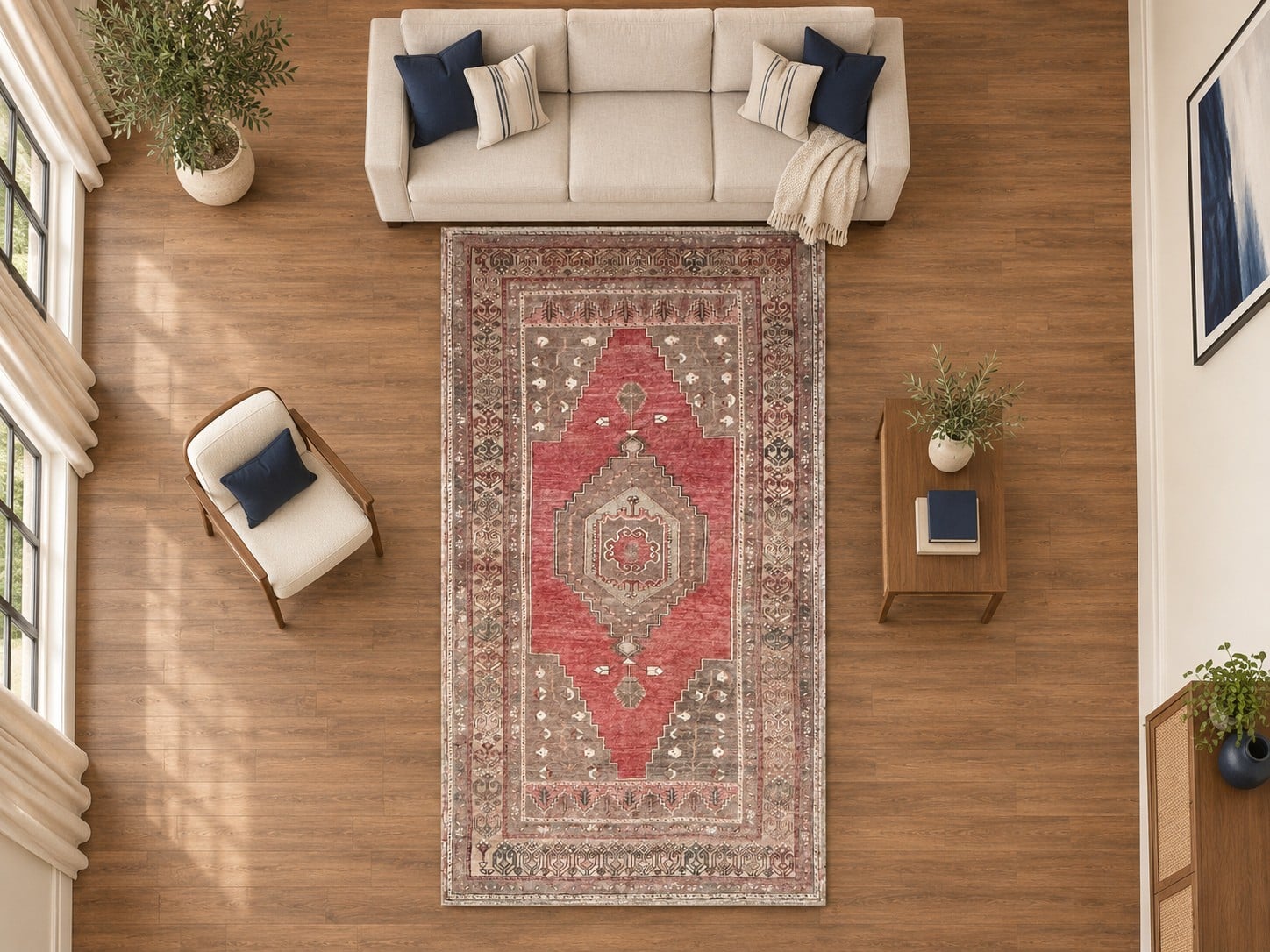
AI ROOM-STYLING CONCEPT · Based on the original catalog reference and title-stated proportions. Approximate visualization, not a real installation, exact reproduction, inscription evidence or measured fit. The schematic gives the stated proportions separately.

The seller calls this a vintage Anatolian Oushak rug. The photograph shows a stepped central motif, quieter surrounding areas and a patterned border. With the middle hidden, the medallion’s outline and the exposed end sections become the main surviving cues.
Ask yourself: Do I like those surviving shapes, or am I choosing it mainly for the center I will cover?
B / DISTRIBUTED EMPHASIS
Stately Sarouk – Antique Persian Wool Carpet – 10’ x 15’2″ ft.
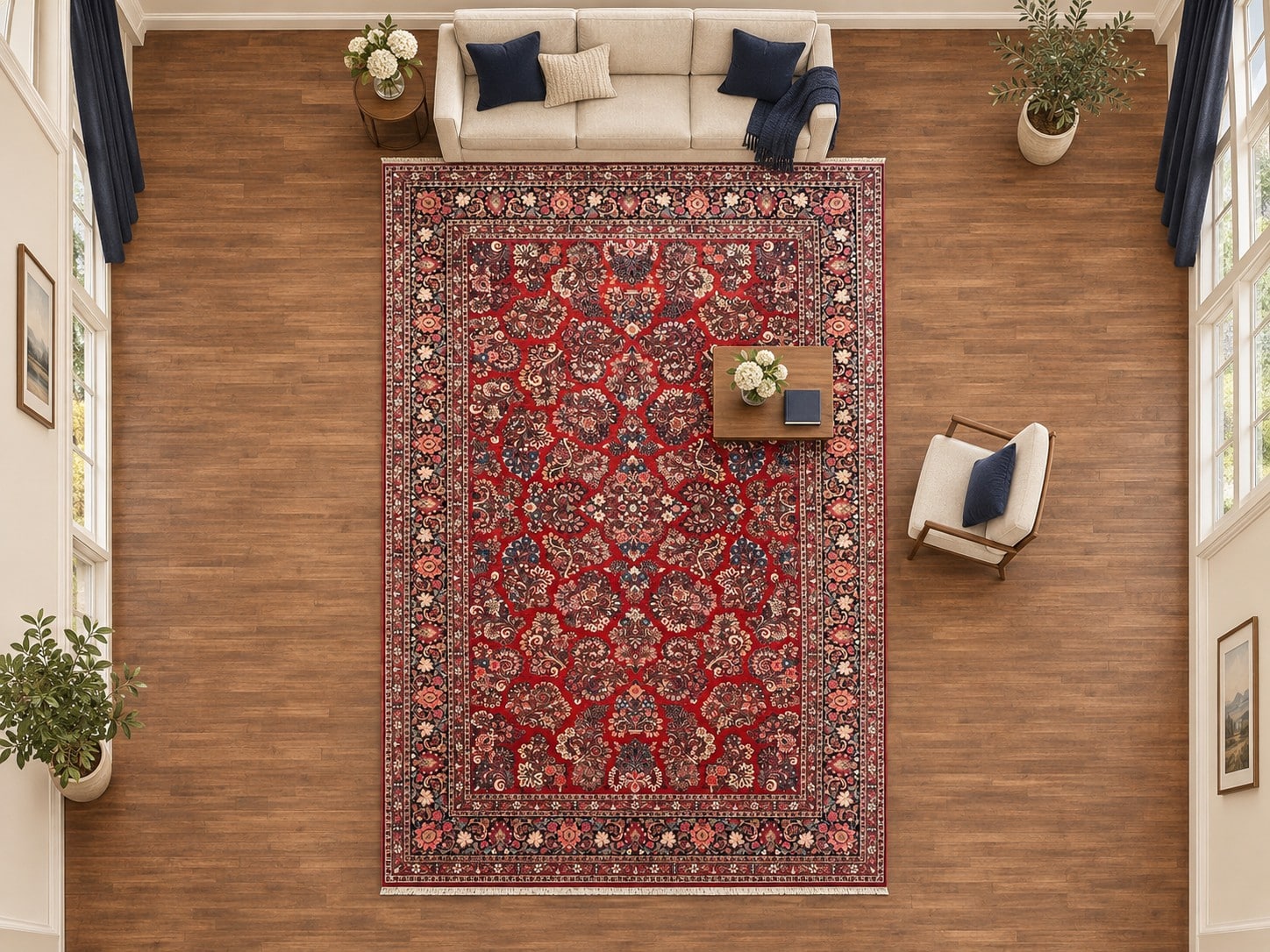
AI ROOM-STYLING CONCEPT · Based on the original catalog reference and title-stated proportions. Approximate visualization, not a real installation, exact reproduction, inscription evidence or measured fit. The schematic gives the stated proportions separately.
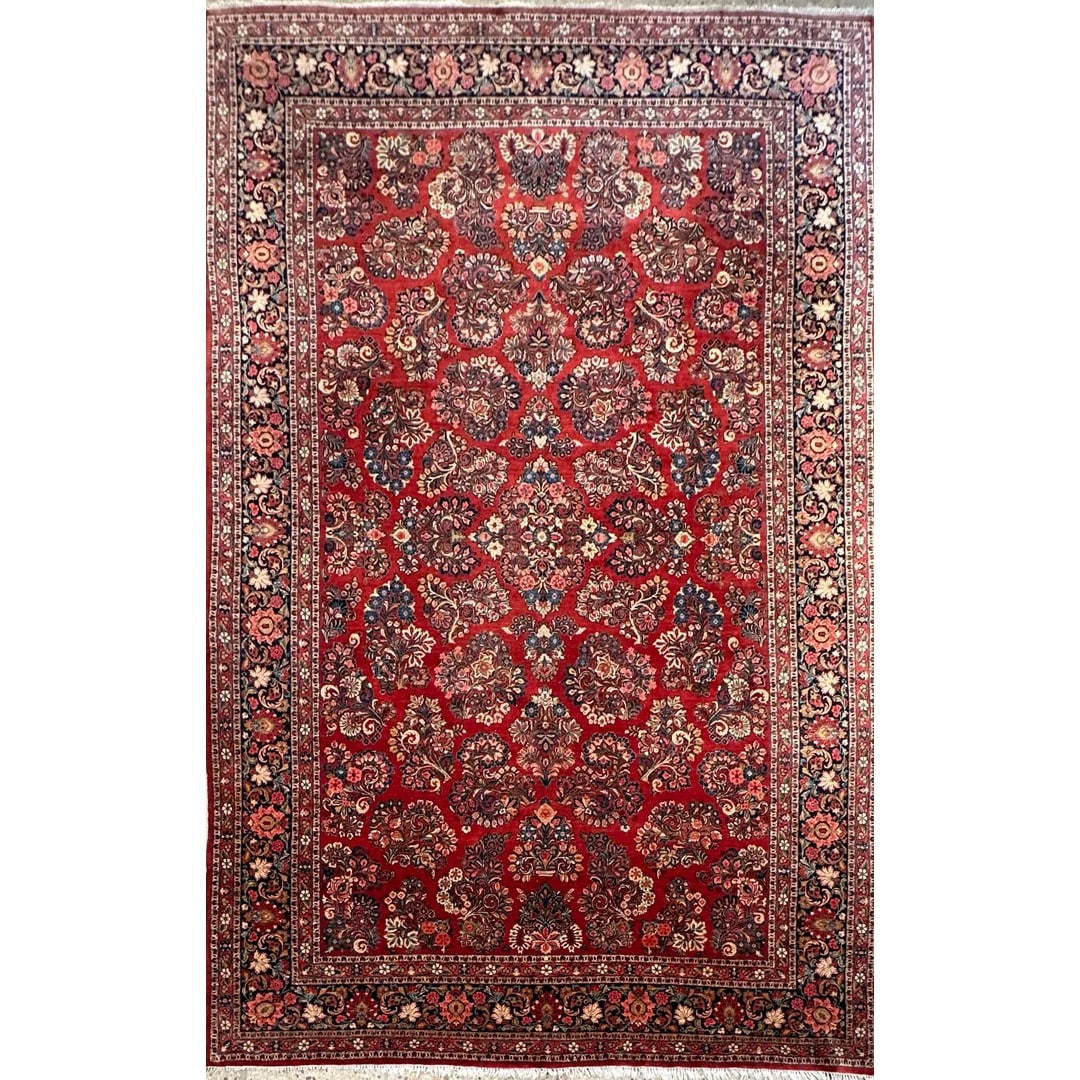
The seller identifies this as an antique Persian Sarouk. Detached floral forms spread across its red field, enclosed by a dark border. Covering a central patch leaves other floral groups visible around it. That is the allover effect being compared here, rather than a claim that the layout is perfectly uniform.
Ask yourself: Does the remaining floral rhythm feel balanced beside my upholstery and other patterns?
Product names and regional/age descriptions are seller attributions. These rugs are not dimension-matched alternatives. The Turkish listing’s title and size attribute differ at the time checked; request current measured dimensions before planning a fit. No size, condition or suitability is inferred from these masks.
First, separate layout from origin.
For this decorating comparison, a medallion means a visually dominant central motif. An allover field distributes motifs across the interior instead of making one large center the main event. These are useful visual descriptions, not quality grades or reliable country-of-origin tests.
Historical terminology is less binary than a shopping filter. The Walters Art Museum describes a familiar central-medallion arrangement; the Met’s “Medallion Ushak” example has a repeating design extending conceptually beyond its border. A rug can therefore contain repeated medallions and still read as an overall pattern. Look at the actual composition.
The room-placement suggestions below are practical visual judgments. The museum sources explain pattern vocabulary; they do not certify these products or prescribe furniture arrangements.
01
Map the hidden area.
Measure the solid footprint of your sofa and table, then mark the proposed rug boundary on the floor with a removable method suitable for that surface. Include furniture legs, the table top’s outline as seen from above, and the positions you can realistically use. A compact rug in an oversized imaginary room is not a meaningful test.
For an online shortlist, place a simple rectangle over a copy of each full-view photo. Scale that rectangle to the furniture-to-rug proportions using confirmed rug-body dimensions. Keep the unmarked original. A decorative mockup cannot replace measurement, and a catalog photo with white margins needs those margins excluded from the rug boundary.
02
Inspect three windows.
- The strip in front of the sofa: Is it mostly border, plain field, or small motifs? This is often a large uninterrupted part of the pattern you will see.
- The sides of the coffee table: Are recognizable parts of a central motif visible, or only fragments that you personally find awkward?
- The exposed far end: Does the design still look intentional from the entrance and the seats you actually use?
A medallion partly covered by an opaque table may still read clearly from its outer shape and pendants. An allover design can retain continuity while looking visually busy beside patterned seating. Pattern scale and contrast matter alongside the layout name.
03
Change one thing.
Compare the current table with a smaller footprint, if that is a realistic option. A glass top may reveal more pattern, but its frame, reflections and objects on top still interrupt the view. Do not count it as invisible. Next, try rotating the rug in the mockup only if the actual room dimensions allow it.
With an off-center seating group, compare the visible composition from the doorway rather than forcing the medallion to align with every object. If centering on the table produces an awkward rug edge or seating arrangement, decide whether seeing the center is worth that compromise. The best outcome is the one you prefer in the real layout.
Compare what remains visible.
| Room situation | Medallion layout | Allover layout | Check before choosing |
|---|---|---|---|
| Opaque coffee table over the middle | The main motif may be partly concealed; its outer shape can still contribute. | Other motifs remain visible around the covered patch. | Mask the real table footprint on each rug photo. |
| Sofa covers one long edge | The border and adjacent field may disappear into the seating footprint. | Repeated motifs may help connect the exposed strips. | Inspect the strip in front of the sofa, not only the far end. |
| Asymmetric seating | A strong center can emphasize or complicate the asymmetry. | Distributed motifs may put less emphasis on one central point. | Compare from the entrance and from your usual seat. |
| Patterned upholstery | Large open areas may provide a pause, depending on the rug. | A dense field may create more visual activity. | Compare motif scale and contrast with a fabric sample. |
| Furniture may change later | Future table placement could reveal or conceal the main motif. | Several distributed focal details may offer placement options. | Choose a pattern you also like without the current furniture. |
These are visual checks, not universal decorating rules or performance ratings.
Build a shortlist around the exposed pattern.
When browsing turkish rugs for sale, compare the exact photographed field and border rather than assuming every Oushak-style rug has the same large central motif. Confirm where the specific rug was woven separately from its design name.
Likewise, use persian rugs for sale to compare both central and distributed compositions. Persian is not a synonym for medallion, and Turkish is not a synonym for allover. The two rugs above illustrate individual layouts, not a national design rule.
For the origin distinction, read our Persian and Turkish rug comparison. Before buying an older rug, use the antique-rug photo request checklist to ask for unmasked full views, current measurements and a condition description. Layout preference does not establish construction, age or condition.
Questions to settle before checkout
Is a medallion rug wasted beneath a coffee table?
Not necessarily. The border, surrounding field and visible parts of the medallion may still be what you enjoy. Test the covered view before deciding.
Does an allover pattern always work better in a small room?
No. Motif size, color contrast, visible floor and furniture coverage can change the result. Compare the exposed sections at realistic proportions rather than relying on a room-size rule.
Does the medallion have to sit exactly under the table?
There is no universal requirement. Check the alignment from the doorway and seated positions, while keeping a practical rug and furniture arrangement.
Can I compare these two product images for size?
No. Their display sizes and masks are illustrative, not dimension-matched. Confirm the measured rug-body dimensions and build a separate scaled plan for each candidate.
Should I choose a glass table to reveal the pattern?
Only if that table also suits your room. A transparent top can expose more design, but the frame, reflections and objects on it still affect the view.
What if I love the center but dislike the border?
A covered center may leave the border doing most of the visual work. Inspect that version carefully; loving the unobstructed catalog image may not mean you will like the furnished view.